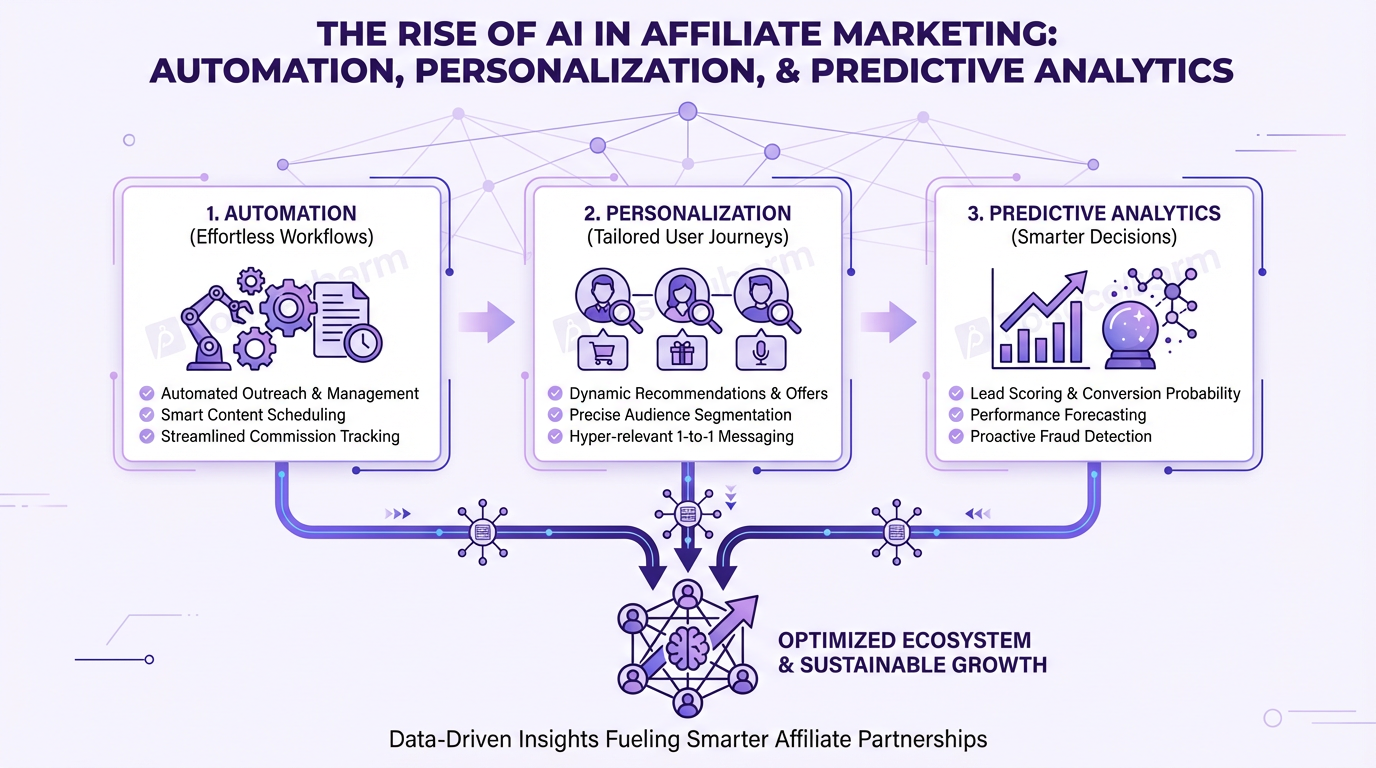
The Rise of AI in Affiliate Marketing: Automation, Personalization, and Predictive Analytics
The Rise of AI in Affiliate Marketing: Automation, Personalization, and Predictive Analytics
Artificial Intelligence (AI) is no longer a futuristic concept but a present-day reality rapidly reshaping industries, and affiliate marketing is no exception. The integration of AI in affiliate marketing is fundamentally transforming how affiliates operate, offering unprecedented opportunities for automation, hyper-personalization, and data-driven decision-making. From optimizing campaign performance to identifying high-value audiences, AI tools are becoming indispensable for affiliates looking to stay competitive and maximize their return on investment. Understanding these shifts is crucial for anyone navigating the evolving landscape of Affiliate Marketing Trends.This article delves into the core applications of AI in affiliate marketing, exploring how it empowers affiliates to work smarter, not just harder. We'll examine the practical ways AI enhances various aspects of the affiliate journey, from content creation to fraud detection, and provide actionable insights for leveraging these powerful technologies.
Key AI in Affiliate Marketing Statistics • A recent study by Statista projects the global AI market to grow to over $1.5 trillion by 2030, indicating widespread adoption across sectors, including marketing. • Marketers using AI for personalization have seen an average uplift of 10-15% in conversion rates. • 75% of companies that adopted AI in their marketing efforts reported an increase in customer engagement. • AI-powered fraud detection systems can reduce fraudulent transactions by up to 60% for e-commerce businesses.
AI-Powered Automation: Streamlining Affiliate Operations
One of the most immediate and impactful benefits of AI in affiliate marketing is its ability to automate repetitive and time-consuming tasks. This frees up affiliates to focus on strategic initiatives, creative development, and relationship building. Automation extends across various operational facets, from ad bidding and campaign management to reporting and customer service.Automated Campaign Optimization and Bidding
AI algorithms can analyze vast datasets in real-time, identifying optimal bidding strategies for pay-per-click (PPC) campaigns and adjusting bids dynamically to achieve the best possible ROI. This eliminates the guesswork and manual adjustments traditionally required, leading to more efficient ad spend and improved campaign performance. Furthermore, AI can predict which ad placements are most likely to convert, ensuring that affiliate offers are seen by the most receptive audiences.| Automation Task | Best For | Difficulty | ROI Potential |
|---|---|---|---|
| Ad Bidding & Optimization | Large-scale PPC campaigns, maximizing ad spend efficiency | Medium | Very High |
| Content Curation & Scheduling | Maintaining consistent content flow, audience engagement | Easy | Medium |
| Lead Scoring & Nurturing | Identifying high-potential leads, improving conversion funnels | Medium | High |
| Performance Reporting | Real-time insights, quick decision-making | Easy | High |
Hyper-Personalization: Delivering Tailored Affiliate Experiences
In an increasingly crowded digital landscape, generic marketing messages fall flat. AI enables affiliates to deliver highly personalized content and offers, significantly enhancing user engagement and conversion rates. By analyzing user behavior, preferences, and demographics, AI can tailor every interaction to the individual.Dynamic Content Generation and Recommendation Engines
AI-powered tools can generate variations of ad copy, landing page content, and email sequences, testing them in real-time to determine which performs best for specific audience segments. Recommendation engines, similar to those used by major e-commerce platforms, can suggest relevant products or services to users based on their browsing history, purchase patterns, and even sentiment analysis of their online activity. This level of personalization makes affiliate offers feel less like advertisements and more like helpful suggestions.Expert Insight: "The true power of AI in personalization isn't just about showing the right product; it's about understanding the user's intent and context. An AI system that can predict a user's next likely purchase or information need before they even articulate it offers an unparalleled advantage in affiliate conversions. It moves beyond simple segmentation to true individual-level marketing."
Predictive Analytics: Forecasting Trends and Mitigating Risks
One of AI's most powerful capabilities is its ability to analyze historical data and predict future outcomes. For affiliate marketers, this translates into a significant competitive edge, allowing them to anticipate market shifts, identify emerging niches, and proactively address potential issues like fraud.Identifying Emerging Niches and Product Opportunities
AI algorithms can scour vast amounts of online data, including social media trends, search queries, and competitor activity, to identify nascent niches and product categories with high growth potential. This allows affiliates to be early adopters, positioning themselves to capture significant market share before the competition catches up. This proactive approach is a key component of staying ahead in the dynamic world of Affiliate Marketing Trends.5-Step AI-Driven Campaign Optimization Framework
AI in Fraud Detection and Compliance
Affiliate marketing is susceptible to various forms of fraud, from click fraud to lead generation scams. AI plays a critical role in identifying and mitigating these risks, protecting both affiliates and advertisers from financial losses and reputational damage. This is particularly important as the industry navigates complex Affiliate Marketing Regulations.Anomaly Detection and Pattern Recognition
AI systems can analyze traffic patterns, user behavior, and conversion data to detect anomalies that indicate fraudulent activity. For instance, an unusual spike in clicks from a single IP address, or a sudden drop-off in conversion quality from a specific traffic source, can be flagged by AI for further investigation. This proactive detection helps maintain the integrity of affiliate programs.Diagram: AI-Powered Affiliate Fraud Detection Flow [Traffic Source Data] → [AI Anomaly Detection Engine] → [Flag Suspicious Activity] → [Human Review & Verification] → [Fraudulent Activity Blocked/Mitigated] → [Feedback Loop to AI Engine for Learning]
The Future Landscape: AI as a Collaborative Partner
As AI technology continues to advance, its role in affiliate marketing will evolve from a tool to a collaborative partner. Future AI systems will not only automate tasks but also provide strategic recommendations, identify untapped opportunities, and even assist in complex decision-making processes. This symbiotic relationship will empower affiliates to achieve unprecedented levels of efficiency and profitability.Ethical Considerations and Transparency
While the benefits of AI are clear, it's crucial to address ethical considerations, particularly regarding data privacy and algorithmic bias. Affiliates must ensure transparency in their use of AI, adhering to data protection regulations and maintaining consumer trust. Responsible AI implementation will be key to sustainable growth in the affiliate sector.Frequently Asked Questions
How does AI improve affiliate marketing ROI?
AI improves ROI by optimizing ad spend through automated bidding, enhancing conversion rates via hyper-personalization, and identifying high-potential niches and audiences, leading to more efficient campaigns and higher profits.Can small affiliates leverage AI tools?
Yes, many AI tools are now accessible and scalable, with freemium models or affordable subscriptions. Even small affiliates can use AI for tasks like content optimization, basic analytics, and ad targeting to gain a competitive edge.What are the main challenges of implementing AI in affiliate marketing?
The main challenges include data integration and quality, the need for specialized skills to interpret AI insights, initial setup costs, and ensuring ethical data usage and transparency to maintain consumer trust.How does AI help with content creation for affiliates?
AI assists with content creation by generating topic ideas, optimizing headlines and ad copy, suggesting keywords, and even drafting initial content outlines, significantly speeding up the content production process and improving its relevance.Is AI replacing human affiliate managers?
No, AI is not replacing human affiliate managers but rather augmenting their capabilities. AI handles repetitive tasks and data analysis, allowing human managers to focus on strategic thinking, creative development, relationship building, and complex problem-solving that require human intuition.Key Takeaways
- AI is revolutionizing affiliate marketing through automation, personalization, and predictive analytics, leading to increased efficiency and profitability.
- Automated campaign optimization and bidding free up affiliates to focus on strategic initiatives, while AI-driven content curation maintains consistent audience engagement.
- Hyper-personalization, powered by AI, delivers tailored content and offers, significantly boosting user engagement and conversion rates.
- Predictive analytics enables affiliates to identify emerging niches, forecast trends, and proactively mitigate risks like fraud, offering a significant competitive advantage.
- AI also plays a crucial role in fraud detection and ensuring compliance, protecting both affiliates and advertisers from financial and reputational damage.
- The future of AI in affiliate marketing involves a collaborative partnership, where AI augments human capabilities, making ethical considerations and transparency paramount for sustainable growth.