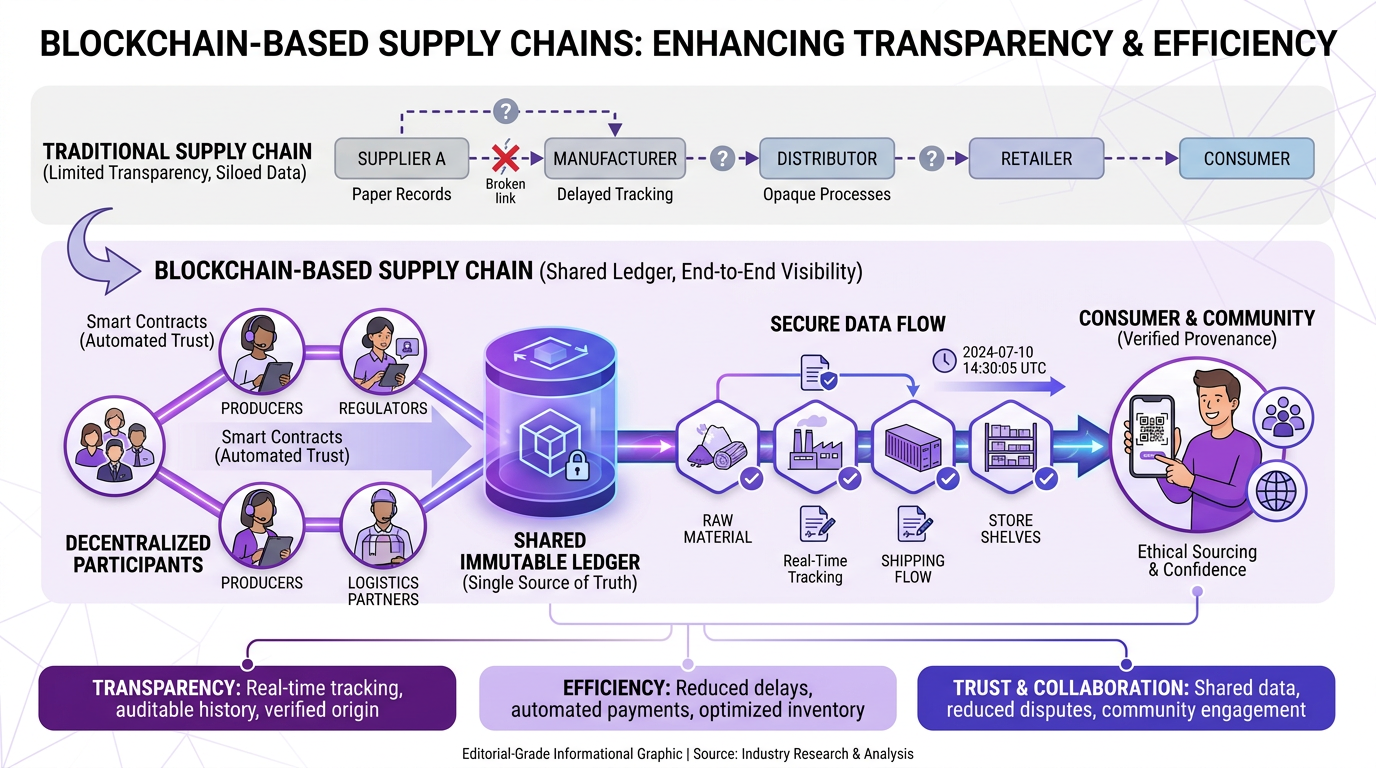
Blockchain-Based Supply Chains: Enhancing Transparency and Efficiency in Decentralized Commerce
Blockchain-Based Supply Chains: Enhancing Transparency and Efficiency in Decentralized Commerce
The advent of blockchain technology has ushered in a new era for supply chain management, promising unprecedented levels of transparency, efficiency, and security. In the context of Decentralized Commerce, blockchain-based supply chains are not merely an enhancement but a foundational element, enabling trustless transactions and verifiable product provenance from source to consumer. This shift moves away from opaque, centralized systems to a distributed ledger where every participant can verify the authenticity and journey of goods, fundamentally reshaping how businesses and consumers interact.Traditional supply chains are often plagued by inefficiencies, fraud, and a lack of visibility, leading to significant financial losses and erosion of consumer trust. Blockchain's immutable and transparent nature directly addresses these challenges, offering a robust framework for tracking goods, managing payments, and ensuring compliance across complex global networks. This integration is critical for the growth and adoption of decentralized marketplaces, where the integrity of the product and the transaction is paramount.
Key Blockchain Supply Chain Statistics • The global blockchain in supply chain market is projected to grow from USD 253 million in 2020 to USD 3,272 million by 2026, at a Compound Annual Growth Rate (CAGR) of 52.8%. • 90% of supply chain executives believe blockchain will be critical for their operations within the next five years. • Companies using blockchain for supply chain management have reported a 15-20% reduction in administrative costs. • Over 70% of consumers are willing to pay more for products from brands that offer full transparency regarding their supply chain.
The Core Principles of Blockchain in Supply Chain Management
At its heart, a blockchain-based supply chain leverages a distributed ledger to record every transaction and movement of a product. Each 'block' contains a timestamped record of data, which, once added to the chain, cannot be altered. This immutability ensures data integrity and provides an undeniable audit trail. Key principles include decentralization, transparency, and immutability, all of which contribute to a more resilient and trustworthy supply network.Decentralization and Data Integrity
Unlike traditional systems where a central authority controls all data, blockchain distributes data across a network of nodes. This decentralization eliminates single points of failure and reduces the risk of data manipulation. For supply chains, this means that information about a product's origin, manufacturing process, and transportation history is accessible and verifiable by all authorized participants, fostering a new level of trust among stakeholders. This enhanced data integrity is crucial for building robust decentralized marketplaces.| Feature | Traditional Supply Chain | Blockchain Supply Chain |
|---|---|---|
| Data Storage | Centralized databases | Distributed Ledger Technology (DLT) |
| Transparency | Limited, often siloed | High, immutable records |
| Trust Mechanism | Intermediaries, contracts | Cryptographic proof, consensus |
| Fraud Risk | High | Low |
| Efficiency | Manual processes, delays | Automated, real-time tracking |
Enhancing Traceability and Provenance
One of the most significant benefits of integrating blockchain into supply chains is the enhanced ability to trace products from their origin to the end consumer. This is particularly vital for industries where authenticity and ethical sourcing are paramount, such as luxury goods, pharmaceuticals, and food. Consumers can scan a QR code on a product and instantly access its entire history, including where it was grown, manufactured, and transported.Real-time Tracking and Verification
Blockchain enables real-time tracking of goods, providing up-to-the-minute information on their location and status. Smart contracts, self-executing agreements stored on the blockchain, can automate verification processes, triggering payments or alerts when certain conditions are met. For instance, a smart contract could automatically release payment to a supplier once a shipment is confirmed to have arrived at its destination, as verified by IoT sensors integrated into the blockchain network. This automation significantly reduces delays and human error, contributing to the overall efficiency of decentralized autonomous organizations operating in commerce.5-Step Blockchain Supply Chain Implementation Framework
Overcoming Challenges and Future Outlook
While the benefits are clear, implementing blockchain-based supply chains is not without its challenges. Interoperability between different blockchain networks, regulatory uncertainties, and the initial cost of implementation are significant hurdles. However, ongoing advancements in technology and increasing industry collaboration are steadily addressing these issues.Expert Insight: "The real power of blockchain in supply chains isn't just about tracking a product; it's about building a digital twin of the physical world that's verifiable and trustworthy. This allows for entirely new business models and a level of consumer confidence that was previously impossible. The challenge isn't the technology itself, but the organizational change required to embrace true transparency."The future of supply chains is undoubtedly decentralized. As more companies recognize the competitive advantage offered by enhanced transparency and efficiency, the adoption of blockchain technology will accelerate. This will not only streamline operations but also empower consumers with more information, fostering a more ethical and sustainable global commerce ecosystem. The integration of decentralized identity solutions will further enhance security and privacy within these systems.
Diagram: Blockchain Supply Chain Flow [Raw Material Supplier] → [Manufacturer] → [Distributor] → [Retailer] → [Consumer] (Each arrow represents a transaction recorded on the blockchain, with smart contracts automating verification and payment.)
Frequently Asked Questions
What is the primary benefit of using blockchain in supply chains?
The primary benefit is enhanced transparency and traceability. Blockchain creates an immutable, shared record of every step a product takes, from raw material to consumer, significantly reducing fraud, improving accountability, and enabling real-time tracking.How do smart contracts contribute to blockchain supply chains?
Smart contracts automate agreements and processes within the supply chain. They automatically execute predefined actions, such as releasing payments or updating inventory, when specific conditions (e.g., product arrival, quality verification) are met, reducing manual intervention and increasing efficiency.Is blockchain suitable for all types of supply chains?
While highly beneficial for many, blockchain implementation is most impactful for complex supply chains with multiple intermediaries, high-value goods, or those requiring stringent regulatory compliance and authenticity verification. Its benefits might be less pronounced for very simple, localized supply chains.Key Takeaways
- Blockchain technology fundamentally transforms supply chains by introducing unprecedented transparency, immutability, and efficiency.
- It enables real-time product traceability and verifiable provenance, crucial for consumer trust and combating counterfeiting.
- Decentralization and smart contracts automate processes, reduce fraud, and eliminate single points of failure in the supply network.
- While challenges like interoperability and initial costs exist, the long-term benefits of blockchain in supply chains are driving widespread adoption.
- The integration of blockchain is a cornerstone for the evolution of truly Decentralized Commerce, fostering a more trustworthy and efficient global economy.