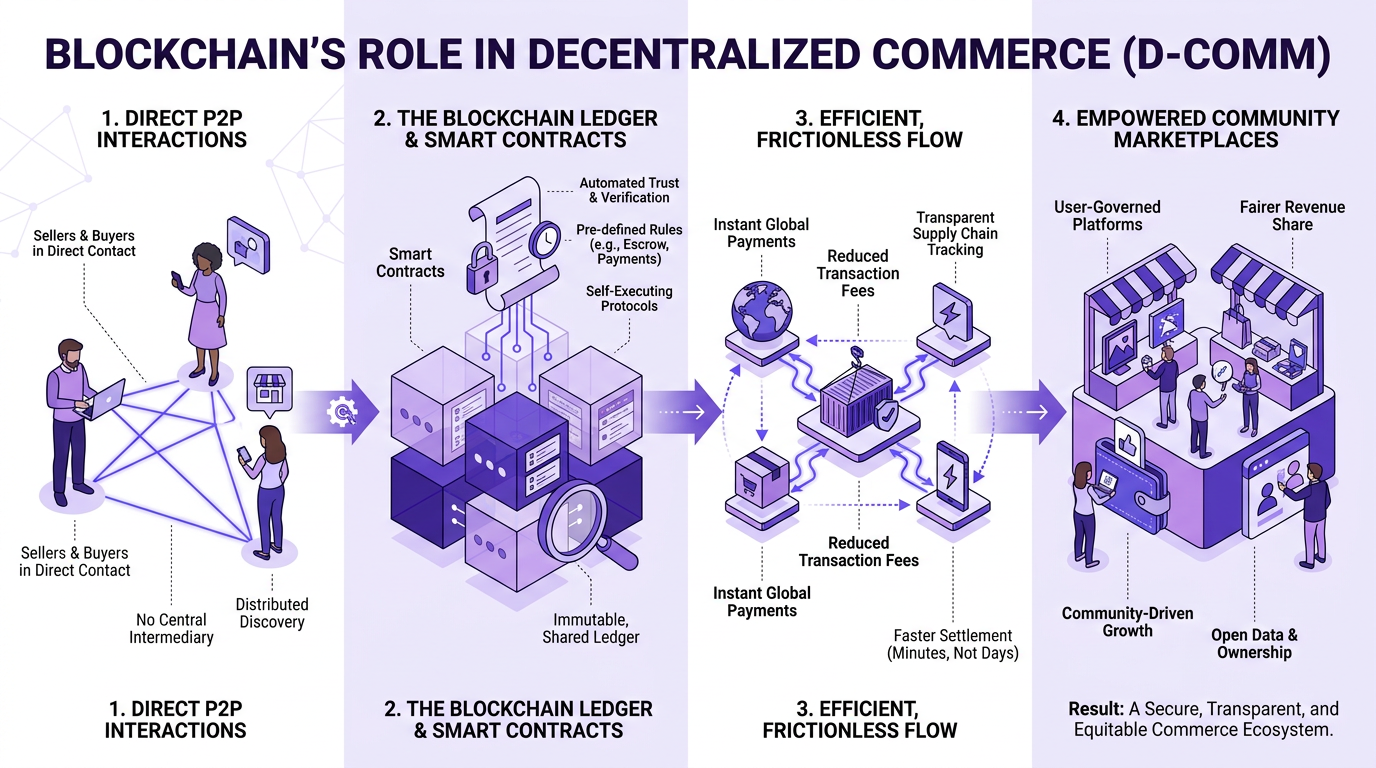
Understanding Blockchain's Role in Decentralized Commerce
Blockchain technology is the foundational layer enabling the paradigm shift towards
Decentralized Commerce. By providing a secure, transparent, and immutable ledger, blockchain eliminates the need for central intermediaries in transactions, fundamentally reshaping how businesses and consumers interact. This distributed ledger technology underpins the trustless environments essential for true peer-to-peer economic activity, moving beyond traditional e-commerce models that rely heavily on centralized platforms and their associated fees and vulnerabilities. As we delve deeper, it becomes clear that blockchain isn't just a component; it's the very architecture upon which the future of commerce is being built, promising greater efficiency, reduced costs, and enhanced user control.
Key Blockchain Adoption Statistics
• The global blockchain market size is projected to grow from USD 11.1 billion in 2022 to USD 469.4 billion by 2030, at a CAGR of 57.4%.
• Over 70% of businesses surveyed believe blockchain will be critical for their operations within the next five years.
• Enterprise blockchain spending is expected to reach nearly $19 billion by 2024.
• Approximately 30% of global supply chain transactions are expected to be on blockchain platforms by 2025.
The Immutable Ledger: Core of Trustless Transactions
At its heart, blockchain offers an immutable and transparent record of all transactions. Each 'block' contains a timestamped batch of transactions, and once validated, it's added to the chain, creating a permanent and unalterable history. This inherent characteristic is crucial for
decentralized marketplaces, where trust is established not through a central authority, but through cryptographic proof and network consensus. This eliminates the risk of fraud, double-spending, and data manipulation, which are persistent challenges in traditional commerce.
How Immutability Powers Decentralized Trust
Unlike traditional databases where a central administrator can modify records, blockchain's distributed nature means that every participant holds a copy of the ledger. Any attempt to alter a past transaction would require changing every subsequent block on every copy of the ledger simultaneously, an almost impossible feat. This cryptographic security ensures that once a transaction, such as a payment or a record of ownership, is confirmed, it cannot be reversed or tampered with. This foundational trust mechanism is vital for fostering confidence in a system without central oversight.
| Blockchain Type | Best For | Difficulty | ROI Potential |
|---|
| Public (e.g., Ethereum) | Open participation, high transparency, broad adoption | Medium | High |
| Private (e.g., Hyperledger Fabric) | Enterprise use, permissioned access, high transaction speed | Hard | Very High |
| Consortium (e.g., R3 Corda) | Industry-specific collaborations, shared governance | Medium | High |
Smart Contracts: Automating Agreements Without Intermediaries
Smart contracts are self-executing contracts with the terms of the agreement directly written into lines of code. They run on the blockchain, automatically executing when predefined conditions are met, without the need for lawyers, banks, or other third parties. In
decentralized payment systems, smart contracts can automate escrow services, release funds upon delivery confirmation, or manage complex supply chain logistics. This automation significantly reduces operational costs and speeds up transaction times, making commerce more efficient.
The Lifecycle of a Smart Contract in Commerce
Smart contracts streamline various aspects of commerce. For instance, in a purchase agreement, a smart contract could hold payment in escrow until a shipping tracking number is verified and the item is marked as delivered by the buyer. If conditions are met, the payment is automatically released to the seller. If not, the funds are returned to the buyer, all without human intervention or the need for a trusted third party. This capability is a cornerstone of building robust and reliable
decentralized applications (dApps) for commerce.
5-Step Smart Contract Implementation Framework
Define Agreement Terms — Clearly outline all conditions, obligations, and outcomes of the commercial agreement. This includes payment terms, delivery conditions, and dispute resolution mechanisms.
Code the Contract — Translate the defined terms into a smart contract language (e.g., Solidity for Ethereum). Ensure all conditions are precisely coded to avoid ambiguities.
Audit and Test — Thoroughly test the smart contract in a simulated environment to identify and fix any bugs or vulnerabilities. Security audits by third-party experts are highly recommended.
Deploy to Blockchain — Once validated, deploy the smart contract onto the chosen blockchain network. This makes it immutable and ready for execution.
Monitor and Interact — Monitor the contract's execution and interact with it as needed (e.g., initiating a transaction that triggers a condition). Ensure all parties understand how to interact with the deployed contract.
Tokenization: Representing Value on the Blockchain
Tokenization involves representing real-world assets or utilities as digital tokens on a blockchain. These tokens can represent anything from fractional ownership of real estate to loyalty points, digital art, or even a share in a company. In decentralized commerce, tokenization enables new forms of ownership, investment, and exchange. For example, a product's authenticity can be verified via a unique token, or a customer can earn and spend loyalty tokens across different
decentralized autonomous organizations (DAOs) within an ecosystem. This opens up novel business models and enhances liquidity for various assets.
The Power of Fractional Ownership and Liquidity
Expert Insight: "Tokenization isn't just about digital assets; it's about democratizing access to value. By breaking down large, illiquid assets into smaller, tradable units, blockchain allows a broader range of participants to engage in commerce and investment, fundamentally altering traditional market structures and creating unprecedented liquidity for previously inaccessible assets."
Tokenization allows for fractional ownership, meaning multiple individuals can own a small part of a high-value asset. This significantly lowers the barrier to entry for investors and consumers, fostering a more inclusive economic environment. Furthermore, tokens are easily transferable and tradable on global decentralized exchanges, providing instant liquidity that traditional assets often lack. This capability is a game-changer for
decentralized finance (DeFi) and its integration with commerce.
Diagram: Tokenized Asset Lifecycle
[Real-World Asset] → [Asset Digitization/Token Creation] → [Token Issuance on Blockchain] → [Trading/Transfer on Decentralized Exchanges] → [Redemption/Utility Use] → [Feedback Loop to Asset Digitization]
Decentralized Identity: Enhancing Privacy and Security
Traditional e-commerce often requires users to create multiple accounts, each storing personal data on centralized servers, making them vulnerable to breaches. Decentralized Identity (DID) solutions, built on blockchain, give individuals control over their digital identities. Users can selectively share verifiable credentials without revealing unnecessary personal information, enhancing privacy and security in online transactions. This shift from centralized identity providers to self-sovereign identity is critical for building a truly secure and user-centric
Decentralized Commerce ecosystem.
Self-Sovereign Identity in Practice
With DID, a user might prove they are over 18 without revealing their birth date, or confirm they have sufficient funds for a purchase without disclosing their bank balance. This 'zero-knowledge proof' capability is revolutionary for privacy-preserving commerce. It reduces the risk of identity theft and data exploitation, fostering greater trust between buyers and sellers in a decentralized environment. This is a crucial element for the future of
web3 commerce, where user control is paramount.
Frequently Asked Questions
What is the primary advantage of using blockchain in decentralized commerce?
The primary advantage is the creation of a trustless environment through immutable records and cryptographic security. This eliminates the need for central intermediaries, reducing costs, increasing transparency, and enhancing security for all participants in a
Decentralized Commerce transaction.
How do smart contracts contribute to decentralized commerce?
Smart contracts automate the execution of agreements based on predefined conditions, removing the need for third-party intermediaries like lawyers or banks. This streamlines processes such as payments, escrow, and logistics, making transactions faster, cheaper, and more reliable in a decentralized setting.
Can blockchain truly eliminate fraud in online transactions?
While blockchain significantly reduces the potential for fraud by making transactions immutable and transparent, it cannot eliminate all forms of fraud, particularly those involving off-chain activities or human error. However, it provides a robust framework for verifying authenticity and preventing manipulation of transaction records.
What are the challenges of integrating blockchain into existing commerce systems?
Challenges include scalability limitations of some blockchain networks, regulatory uncertainties, the complexity of integrating blockchain with legacy systems, and the need for user education. Overcoming these requires significant investment in infrastructure, development, and standardization efforts.
Key Takeaways
- Blockchain provides the foundational immutable ledger for trustless transactions in decentralized commerce.
- Smart contracts automate commercial agreements, reducing reliance on intermediaries and increasing efficiency.
- Tokenization enables new forms of asset ownership and liquidity, democratizing access to value.
- Decentralized Identity solutions enhance user privacy and security by giving individuals control over their data.
- The integration of blockchain is essential for building a secure, transparent, and efficient Decentralized Commerce ecosystem.