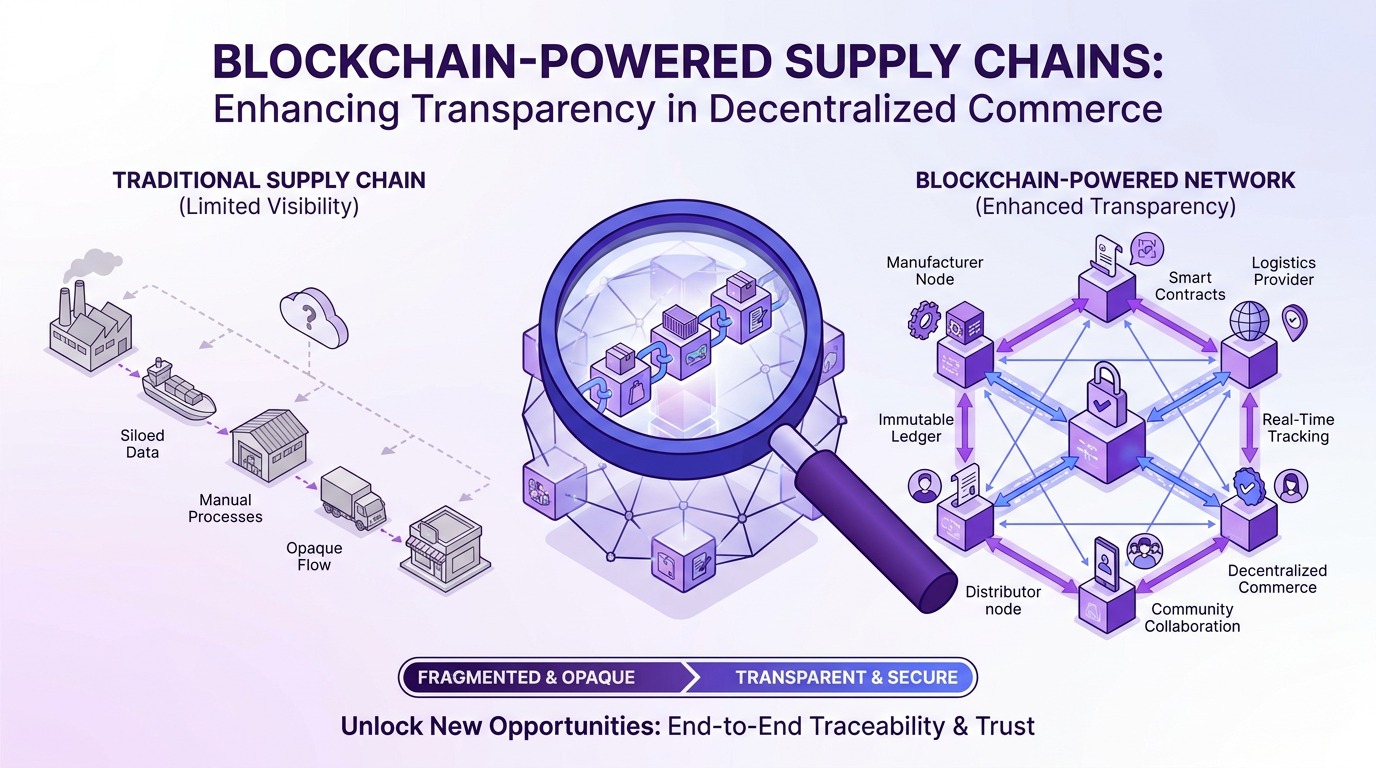
Blockchain-Powered Supply Chains: Enhancing Transparency in Decentralized Commerce
Blockchain-Powered Supply Chains: Enhancing Transparency in Decentralized Commerce
The advent of blockchain technology has ushered in a new era of transparency and efficiency, particularly within the complex landscape of supply chains. For businesses operating in a world increasingly demanding accountability, integrating blockchain offers a robust solution to traditional opaque systems. This innovation is a cornerstone of the broader movement towards Decentralized Commerce, where trust is distributed rather than centralized, and every transaction and movement of goods can be immutably recorded and verified. By leveraging the distributed ledger capabilities of blockchain, companies can create an unalterable record of a product's journey from raw material to consumer, fundamentally reshaping how we perceive and manage supply chain integrity.This shift is not merely about tracking; it's about building inherent trust into the system itself. In a decentralized model, all participants in the supply chain – from producers and manufacturers to logistics providers and retailers – can access a shared, tamper-proof ledger. This eliminates information silos, reduces fraud, and provides consumers with unprecedented visibility into the provenance and authenticity of their purchases, a critical factor for the success of any decentralized marketplace.
Key Supply Chain Transparency Statistics • 71% of consumers believe it's important for brands to be transparent about their supply chain practices. • Companies with highly transparent supply chains experience 1.8x faster revenue growth than those with less transparency. • Blockchain technology could reduce supply chain costs by 15-20% by improving efficiency and reducing fraud. • Over 90% of global companies are exploring or implementing blockchain for supply chain management.
The Imperative for Transparency in Modern Supply Chains
Traditional supply chains are often characterized by a lack of visibility, making them susceptible to inefficiencies, fraud, and ethical concerns. From counterfeit goods to unsustainable sourcing practices, the opaque nature of conventional systems poses significant risks to both businesses and consumers. The demand for ethical sourcing, sustainability, and product authenticity has never been higher, pushing companies to seek innovative solutions.Blockchain technology directly addresses these challenges by creating a single, shared source of truth. Each step in the supply chain, from the origin of raw materials to manufacturing, shipping, and retail, can be recorded as a block on the chain. These blocks are cryptographically linked, forming an immutable ledger that is accessible to authorized participants. This inherent transparency fosters greater accountability and reduces the potential for disputes, making it a vital component for any decentralized autonomous organization (DAO) involved in commerce.
How Blockchain Enhances Traceability and Authenticity
Blockchain's core strength lies in its ability to provide end-to-end traceability. Imagine a consumer scanning a QR code on a product and instantly accessing its entire history: where the raw materials were sourced, who manufactured it, when it was shipped, and even its environmental impact. This level of detail is transformative for industries battling counterfeiting, such as luxury goods and pharmaceuticals, and for those committed to ethical practices, like food and apparel.| Feature | Traditional Supply Chain | Blockchain-Powered Supply Chain |
|---|---|---|
| Traceability | Limited, often manual, prone to errors | End-to-end, automated, immutable record |
| Transparency | Opaque, information silos | Shared, verifiable ledger for all participants |
| Security | Centralized, vulnerable to single points of failure | Decentralized, cryptographically secured, tamper-proof |
| Efficiency | Manual reconciliation, delays | Automated processes, real-time updates |
| Trust | Relies on intermediaries | Cryptographic proof, distributed trust |
Implementing Blockchain for Supply Chain Optimization
Integrating blockchain into existing supply chain operations requires careful planning and execution. It's not merely a technological upgrade but a strategic shift towards a more collaborative and transparent ecosystem. The process often begins with identifying critical pain points that blockchain can effectively address, such as reducing lead times, preventing fraud, or ensuring regulatory compliance. For businesses exploring the broader landscape of Decentralized Commerce, understanding these implementation steps is crucial.5-Step Blockchain Supply Chain Integration Framework
The Impact on Consumer Trust and Brand Reputation
In an age where consumers are increasingly conscious of the origins and ethical implications of their purchases, blockchain-powered supply chains offer a powerful tool for building and maintaining trust. Brands that can demonstrate verifiable transparency gain a significant competitive advantage. This transparency extends beyond just product origin; it encompasses fair labor practices, environmental sustainability, and responsible sourcing.Expert Insight: "True supply chain transparency isn't just about showing where a product came from; it's about demonstrating ethical integrity at every single node. Blockchain provides the cryptographic backbone for this, allowing brands to move beyond mere claims to verifiable proof, fundamentally altering consumer-brand relationships in the decentralized future."This enhanced trust translates directly into stronger brand loyalty and a positive public image. Companies that proactively adopt these technologies are seen as innovators and leaders, attracting a growing segment of ethically-minded consumers. The ability to provide irrefutable proof of claims, rather than just marketing assertions, is a game-changer for brand reputation in the evolving landscape of Decentralized Commerce.
Diagram: Blockchain-Powered Supply Chain Flow [Raw Material Sourcing] → [Manufacturer Production] → [Quality Assurance & Packaging] → [Logistics & Distribution] → [Retailer Sales] → [Consumer Verification (via QR/NFC)] → [Immutable Blockchain Record]
Challenges and Future Outlook
While the benefits of blockchain in supply chains are clear, implementation is not without its challenges. Interoperability between different blockchain networks, the significant initial investment in technology and training, and the need for industry-wide collaboration are major hurdles. Data privacy concerns, especially when dealing with sensitive business information, also need careful consideration. However, as the technology matures and standards emerge, these challenges are becoming more manageable.The future of blockchain-powered supply chains is bright. We can expect to see greater adoption across diverse industries, from agriculture to aerospace. The integration of artificial intelligence (AI) and the Internet of Things (IoT) with blockchain will create even more intelligent and autonomous supply chain networks. This synergy will further automate processes, predict disruptions, and optimize logistics, making the vision of truly transparent and efficient Decentralized Commerce a reality. The evolution of decentralized identity will also play a crucial role in verifying participants within these complex networks.
Frequently Asked Questions
What is a blockchain-powered supply chain?
A blockchain-powered supply chain leverages distributed ledger technology to create an immutable, transparent, and verifiable record of a product's journey from its origin to the consumer. Each transaction and movement is recorded as a block, enhancing traceability, authenticity, and trust among all participants.How does blockchain improve supply chain transparency?
Blockchain improves transparency by providing a shared, tamper-proof ledger accessible to authorized parties, eliminating information silos and enabling real-time tracking of goods. This allows for easy verification of product origin, ethical sourcing, and authenticity, reducing fraud and increasing accountability.What are the main benefits of using blockchain in supply chains?
The main benefits include enhanced traceability and authenticity, reduced fraud and counterfeiting, improved operational efficiency through automation, increased consumer trust and brand reputation, and better compliance with regulatory and ethical standards.Is blockchain suitable for all types of supply chains?
While highly beneficial for many, blockchain implementation is most impactful for complex supply chains with multiple intermediaries, high-value goods, or those requiring stringent regulatory compliance and ethical sourcing. Industries like pharmaceuticals, luxury goods, food, and electronics are prime candidates.What are the primary challenges in adopting blockchain for supply chains?
Key challenges include achieving interoperability between different blockchain platforms, managing the initial investment costs, ensuring data privacy for sensitive information, and fostering collaboration among diverse supply chain partners to adopt a unified system.Key Takeaways
- Blockchain technology is revolutionizing supply chains by providing unprecedented transparency and traceability.
- It creates an immutable, shared record of a product's journey, combating fraud and enhancing authenticity.
- Implementing blockchain involves defining scope, selecting platforms, onboarding participants, developing smart contracts, and iterative scaling.
- Enhanced transparency builds significant consumer trust and strengthens brand reputation in a competitive market.
- Despite challenges like interoperability and cost, the future of blockchain in supply chains points towards greater integration with AI and IoT for optimized, decentralized commerce.