Blockchain-Powered Supply Chains: Enhancing Transparency and Trust in Decentralized Commerce
Blockchain-Powered Supply Chains: Enhancing Transparency and Trust in Decentralized Commerce
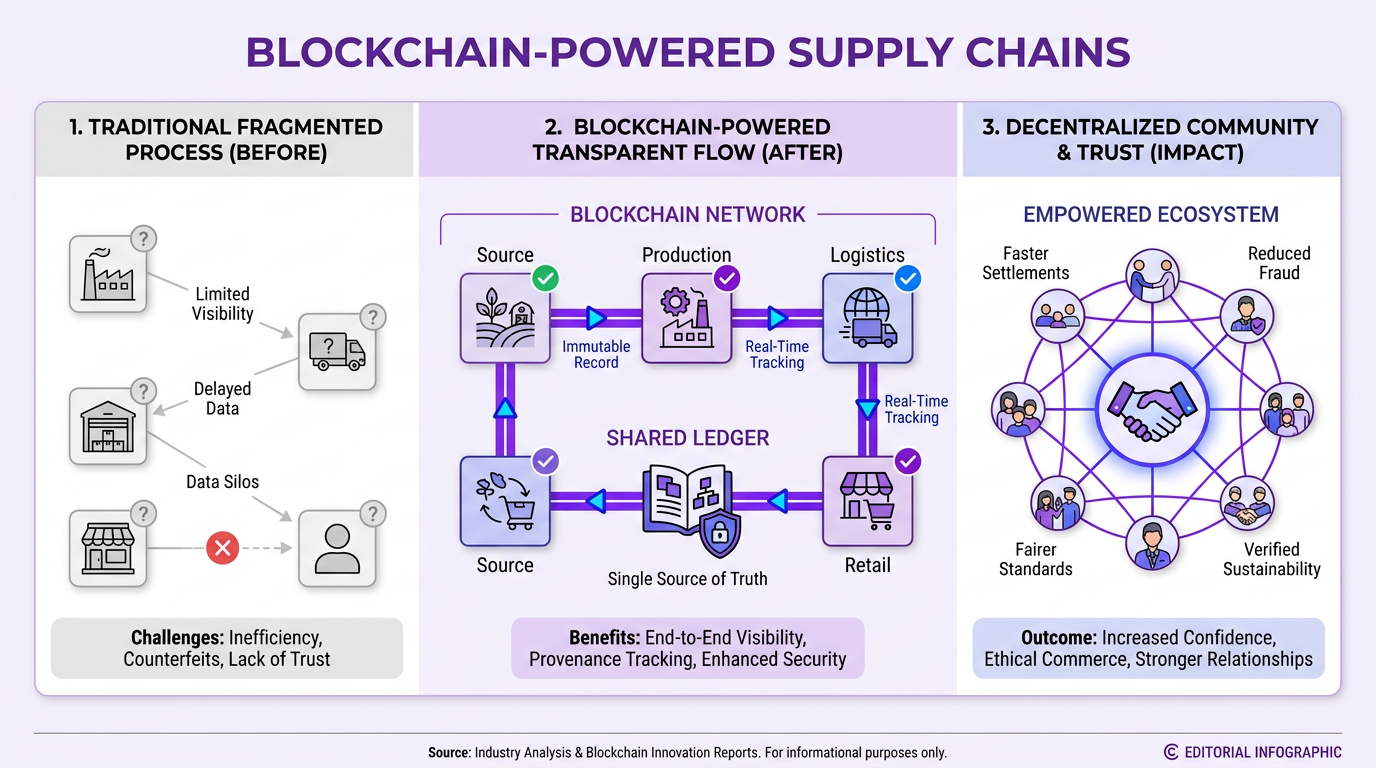
The advent of blockchain technology has ushered in a new era for supply chain management, promising unprecedented levels of transparency, traceability, and trust. In the context of Decentralized Commerce, blockchain-powered supply chains are not merely an enhancement but a foundational element, enabling direct, peer-to-peer transactions and verifiable product journeys without reliance on central authorities. This shift moves beyond traditional, opaque supply networks, offering consumers and businesses alike a clear, immutable record of every product's origin, movement, and authenticity. The implications for ethical sourcing, fraud prevention, and operational efficiency are profound, reshaping how goods are produced, distributed, and consumed in a decentralized ecosystem.Traditional supply chains are often fragmented, with numerous intermediaries and disparate data systems, leading to inefficiencies, lack of visibility, and vulnerability to fraud. Blockchain, with its distributed ledger technology, provides a shared, tamper-proof record that all participants can access and verify. This inherent transparency fosters trust among stakeholders, from raw material suppliers to end consumers, aligning perfectly with the core tenets of decentralized commerce.
Key Supply Chain Transparency Statistics • 71% of consumers believe it's important for brands to be transparent about their supply chain practices (IBM Institute for Business Value). • Supply chain attacks increased by 42% in the last year, impacting 71% of organizations (ENISA Threat Landscape Report). • Companies using blockchain for supply chain management report an average 15% reduction in operational costs (Deloitte). • 90% of consumers are more likely to trust brands that are transparent about their sourcing (Label Insight).
The Core Mechanics of Blockchain in Supply Chains
At its heart, a blockchain-powered supply chain leverages the distributed ledger to record every transaction and event in a product's lifecycle. Each step, from sourcing raw materials to manufacturing, shipping, and delivery, is logged as an immutable block of data. This creates an unbroken chain of custody, verifiable by all authorized participants. Smart contracts, self-executing agreements coded onto the blockchain, automate processes like payments upon delivery or quality checks, further reducing manual intervention and potential for disputes.Immutability and Traceability
The immutability of blockchain records means that once data is entered, it cannot be altered or deleted. This provides an unparalleled level of data integrity, crucial for verifying product authenticity and preventing counterfeiting. For instance, a consumer can scan a QR code on a product and instantly access its entire history, including origin, manufacturing date, and even environmental certifications. This level of traceability empowers consumers to make informed purchasing decisions, aligning with the principles of decentralized marketplaces.| Feature | Traditional Supply Chain | Blockchain-Powered Supply Chain |
|---|---|---|
| Data Integrity | Prone to manipulation, siloed | Immutable, transparent, verifiable |
| Traceability | Limited, manual, fragmented | End-to-end, real-time, automated |
| Trust | Relies on intermediaries | Cryptographically secured, peer-to-peer |
| Efficiency | Manual processes, delays | Automated, streamlined via smart contracts |
| Fraud Prevention | Reactive, difficult to prove | Proactive, inherent authenticity |
Enhancing Trust and Authenticity
One of the most significant contributions of blockchain to supply chains is the establishment of trust without relying on a central authority. In a decentralized commerce environment, where buyers and sellers might be geographically dispersed and unknown to each other, verifiable product information is paramount. Blockchain provides this verification, ensuring that products are genuine, ethically sourced, and meet stated quality standards. This is particularly vital for high-value goods, pharmaceuticals, and food products where authenticity and safety are critical.Combating Counterfeiting and Fraud
Counterfeiting is a multi-billion dollar problem globally, eroding consumer trust and brand value. Blockchain offers a robust solution by creating a digital fingerprint for each product. From the moment a product is manufactured, its unique identifier is recorded on the blockchain. Any attempt to introduce a counterfeit item into the supply chain would be immediately detectable, as its identifier would not match the blockchain record. This proactive approach to fraud prevention is a game-changer for businesses operating within a decentralized autonomous organization framework.5-Step Blockchain Supply Chain Integration Framework
The Impact on Decentralized Commerce
For Decentralized Commerce to truly flourish, consumers need assurance that the goods they purchase are legitimate and that their transactions are secure. Blockchain-powered supply chains provide this assurance by embedding trust directly into the product's journey. This fosters a more resilient and transparent ecosystem where intermediaries are minimized, and value flows directly between producers and consumers. The ability to verify ethical sourcing, environmental impact, and product quality directly from the blockchain empowers consumers and drives demand for responsible commerce.Expert Insight: "The real power of blockchain in supply chains isn't just about tracking; it's about shifting the burden of trust from centralized entities to cryptographic proof. This fundamentally changes the relationship between brands and consumers, building loyalty through verifiable transparency rather than marketing claims. It's the bedrock for truly decentralized and ethical commerce."Furthermore, the integration of blockchain with IoT devices can provide real-time data on environmental conditions during transit, ensuring product integrity for temperature-sensitive goods. This level of granular detail, accessible on an immutable ledger, significantly enhances consumer confidence in the quality and safety of their purchases.
Diagram: Blockchain-Powered Product Journey [Raw Material Sourcing (Supplier)] → [Manufacturing (Factory)] → [Quality Assurance (Smart Contract)] → [Logistics & Shipping (IoT Tracking)] → [Retailer/Marketplace (Immutable Record)] → [Consumer Verification (QR Scan)]
Challenges and Future Outlook
While the benefits are clear, implementing blockchain in supply chains presents challenges. These include the need for industry-wide standardization, interoperability between different blockchain networks, and the significant upfront investment in technology and training. Data privacy concerns, especially for sensitive commercial information, also need careful consideration, often addressed through permissioned blockchains or zero-knowledge proofs.Despite these hurdles, the trajectory for blockchain-powered supply chains is upward. As the technology matures and adoption grows, we will see more seamless integration, leading to even greater efficiencies and transparency. This evolution is critical for the widespread acceptance and success of decentralized commerce, creating a global marketplace built on verifiable trust and direct connections.
Frequently Asked Questions
What is the primary benefit of blockchain in supply chains?
The primary benefit is enhanced transparency and traceability, providing an immutable record of a product's journey from origin to consumer. This fosters trust, reduces fraud, and improves operational efficiency by eliminating reliance on intermediaries.How does blockchain prevent counterfeiting in supply chains?
Blockchain prevents counterfeiting by assigning a unique, verifiable digital identity to each product recorded on the distributed ledger. Any attempt to introduce a fake product with an unrecorded or duplicated identifier would be immediately detectable, ensuring authenticity.Can small businesses utilize blockchain for their supply chains?
Yes, while initial setup can be complex, many blockchain-as-a-service (BaaS) platforms are emerging, making the technology more accessible and affordable for small and medium-sized enterprises (SMEs) to integrate into their supply chain operations.What role do smart contracts play in blockchain supply chains?
Smart contracts automate and enforce agreements between parties without intermediaries. In supply chains, they can automatically trigger payments upon delivery, verify quality control steps, or release goods once compliance checks are completed, streamlining processes and reducing disputes.Key Takeaways
- Blockchain fundamentally transforms supply chains by providing immutable transparency and end-to-end traceability.
- It is a critical enabler for Decentralized Commerce, building trust through verifiable product authenticity and ethical sourcing.
- Smart contracts automate processes, enhancing efficiency and reducing the potential for fraud and disputes.
- While challenges exist in adoption and standardization, the long-term benefits of increased trust and operational efficiency are substantial.
- Blockchain-powered supply chains empower consumers with unprecedented access to product information, driving informed purchasing decisions.