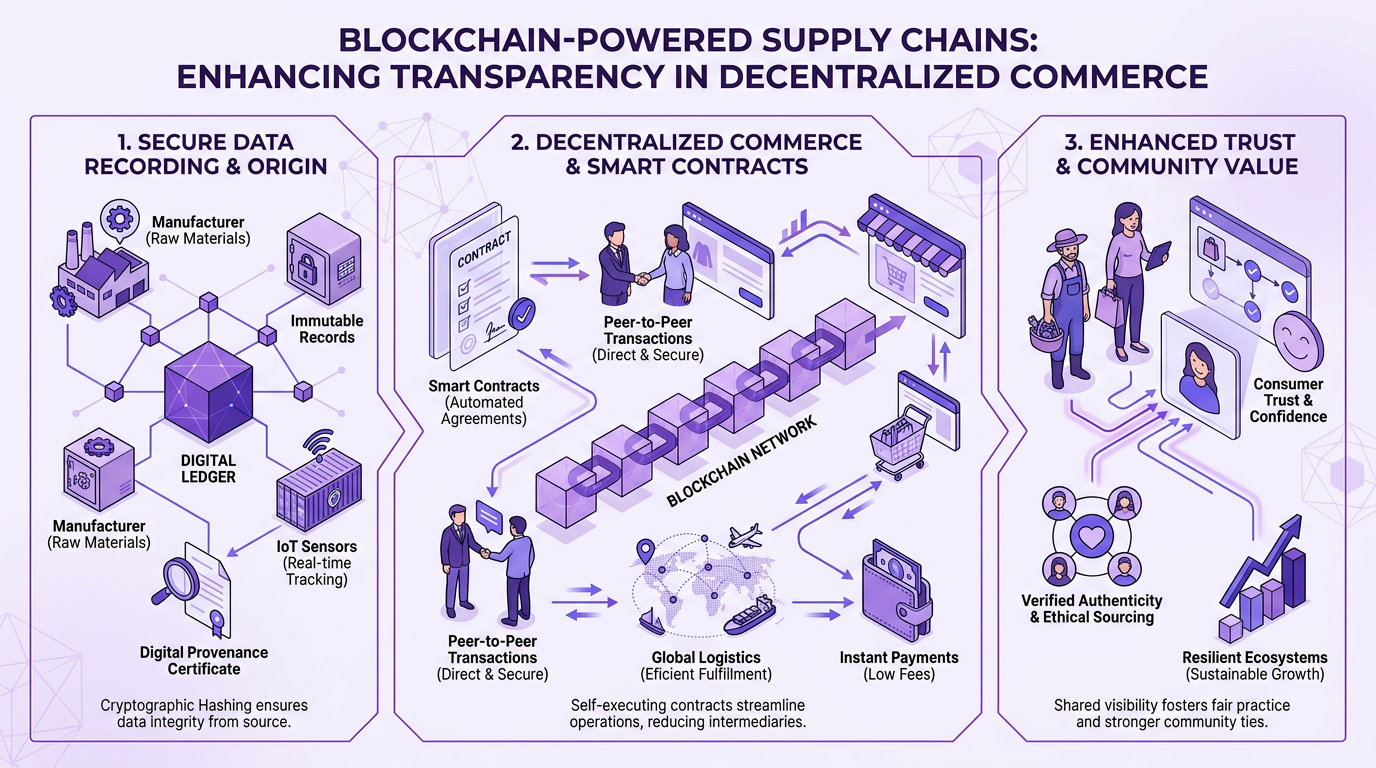
Blockchain-Powered Supply Chains: Enhancing Transparency in Decentralized Commerce
Blockchain-Powered Supply Chains: Enhancing Transparency in Decentralized Commerce
The advent of blockchain technology has ushered in a new era for supply chain management, promising unprecedented levels of transparency, efficiency, and security. In the context of Decentralized Commerce, blockchain-powered supply chains are not just an improvement; they are a fundamental shift, enabling a peer-to-peer economic model where trust is inherent in the system rather than relying on intermediaries. This technology allows for an immutable, distributed ledger that records every transaction and movement of goods, from raw material sourcing to final delivery, making it nearly impossible to tamper with data or hide inefficiencies. For businesses and consumers alike, this translates into greater confidence and accountability across the entire value chain.Traditional supply chains are often opaque, fragmented, and prone to fraud, leading to significant losses and a lack of consumer trust. Blockchain addresses these challenges by creating a single source of truth accessible to all authorized participants. This shared ledger eliminates information silos, reduces disputes, and provides real-time visibility into product origins, quality, and ethical sourcing. As decentralized commerce continues to evolve, the integration of blockchain into supply chain operations will be a critical differentiator, fostering a more resilient and trustworthy global trading environment.
Key Supply Chain Transparency Statistics • 85% of consumers are more likely to purchase from companies that provide transparent product information. • Supply chain disruptions cost companies an average of 45% of their annual profits. • Blockchain technology could reduce supply chain costs by up to 15-20% by 2030. • 71% of organizations believe blockchain will be critical for supply chain visibility within the next five years.
The Core Mechanics of Blockchain in Supply Chains
At its heart, a blockchain-powered supply chain leverages the distributed ledger technology (DLT) to create an unchangeable record of all transactions and events. Each 'block' contains a timestamped batch of transactions, and once validated, it's added to the chain, creating an immutable history. This cryptographic security ensures that data cannot be altered retroactively, providing a high degree of data integrity. Smart contracts, self-executing agreements coded directly onto the blockchain, automate many of the manual processes involved in supply chain management, from payment releases upon delivery to quality assurance checks.This architecture fundamentally changes how participants interact. Instead of relying on a central authority to verify transactions, every participant on the network can verify the authenticity of data. This distributed verification process enhances security and reduces the risk of single points of failure. For instance, tracking the provenance of goods, a crucial aspect of ethical sourcing and combating counterfeiting, becomes significantly more robust. Consumers can scan a QR code on a product and instantly access its entire journey, from farm to factory to store shelf, complete with certifications and quality checks.
Immutable Ledger and Smart Contracts
The immutable ledger is the backbone of transparency. Every step, from the origin of raw materials to manufacturing, shipping, and retail, is recorded. This includes details like batch numbers, dates, locations, and responsible parties. This granular data is invaluable for auditing, compliance, and dispute resolution. Smart contracts further automate and enforce these processes. For example, a smart contract can automatically release payment to a supplier once a shipment is confirmed as received and inspected, eliminating delays and manual paperwork. This automation reduces operational costs and minimizes human error, making the entire process more efficient and reliable.| Feature | Benefit in Supply Chain | Impact on Transparency | Implementation Difficulty |
|---|---|---|---|
| Immutable Ledger | Permanent record of all transactions | High: Full traceability, fraud prevention | Medium |
| Smart Contracts | Automated agreements & payments | High: Enforced compliance, reduced disputes | Medium |
| Decentralized Network | No single point of control | High: Enhanced security, censorship resistance | Medium |
| Tokenization | Digital representation of assets | Medium: Improved asset tracking & ownership | Medium |
Enhancing Traceability and Authenticity
One of the most compelling applications of blockchain in supply chains is its ability to provide end-to-end traceability. This is particularly vital in industries where product authenticity, ethical sourcing, or safety are paramount, such as food, pharmaceuticals, and luxury goods. By tracking each item's journey, businesses can quickly identify the source of contamination in a food recall or verify the authenticity of a high-value product, combating the multi-billion dollar counterfeit market.This enhanced traceability also empowers consumers. With a simple scan, they can access detailed information about a product's origin, ingredients, manufacturing process, and even environmental impact. This level of transparency builds trust and allows consumers to make more informed purchasing decisions, aligning with the core principles of Decentralized Finance (DeFi) and consumer empowerment. It shifts power from centralized entities to individual participants, a hallmark of the broader decentralized movement.
5-Step Blockchain Supply Chain Implementation Framework
Overcoming Challenges and Future Outlook
While the benefits of blockchain-powered supply chains are clear, their implementation is not without challenges. Interoperability between different blockchain networks, regulatory uncertainty, and the initial cost of infrastructure development are significant hurdles. Furthermore, ensuring data privacy while maintaining transparency requires careful architectural design, often involving zero-knowledge proofs or private data layers. The successful adoption of these systems will depend on industry-wide collaboration and the development of standardized protocols.Expert Insight: "The real game-changer for blockchain in supply chains isn't just tracking widgets; it's about creating a verifiable, shared narrative for every product. This narrative builds trust not just between businesses, but directly with the end consumer, fundamentally altering brand loyalty and market dynamics in a decentralized world."Despite these challenges, the trajectory for blockchain in supply chains is overwhelmingly positive. As the technology matures and becomes more accessible, we can expect to see widespread adoption across various sectors. The future of Decentralized Commerce is intrinsically linked to transparent and efficient supply chains, and blockchain is the technology poised to deliver this vision. It promises a future where consumers have unprecedented insight into the products they buy, and businesses operate with greater integrity and efficiency, fostering a truly global and equitable marketplace. This evolution is also closely tied to the development of Web3 Commerce, where decentralized technologies underpin the entire digital economy.
Diagram: Blockchain-Powered Supply Chain Flow Raw Material Sourcing (Supplier) → Manufacturing (Factory) → Quality Assurance (Auditor) → Logistics (Shipper) → Retail (Store) → Consumer Verification (QR Scan) → Immutable Record on Blockchain
Impact on Global Trade and Sustainability
The implications of blockchain-powered supply chains extend beyond mere efficiency; they have the potential to revolutionize global trade and significantly advance sustainability efforts. By providing verifiable data on product origins and manufacturing processes, blockchain can help combat unethical labor practices, deforestation, and other environmental harms. Consumers and regulators can demand higher standards, backed by irrefutable evidence on the blockchain. This level of accountability can drive a more sustainable and ethical global economy, aligning with the broader goals of Decentralized Autonomous Organizations (DAOs) that prioritize collective governance and transparency.Furthermore, for small and medium-sized enterprises (SMEs) in developing countries, blockchain can level the playing field. It provides a trusted, transparent platform to connect with global markets, bypassing traditional intermediaries that often impose high fees and complex requirements. This democratization of trade is a core tenet of decentralized commerce, fostering economic inclusion and empowering producers worldwide. The ability to prove authenticity and ethical sourcing can open up new markets and command premium prices for responsibly produced goods, creating a virtuous cycle of sustainable development.
Frequently Asked Questions
What is the primary benefit of blockchain in supply chains?
The primary benefit is enhanced transparency and traceability. Blockchain creates an immutable, shared record of every transaction and movement of goods, allowing all authorized participants to verify product origins, quality, and ethical sourcing, significantly reducing fraud and increasing trust.How do smart contracts improve supply chain efficiency?
Smart contracts automate key processes and agreements within the supply chain. They self-execute when predefined conditions are met, such as payment release upon delivery or quality inspection, eliminating manual paperwork, reducing delays, and minimizing human error.Is blockchain suitable for all types of supply chains?
While highly beneficial for many, blockchain is particularly impactful for supply chains dealing with high-value goods, perishable items, ethical sourcing requirements, or complex multi-party networks. Its suitability depends on the specific needs for transparency, security, and automation within a given industry.What are the main challenges in adopting blockchain for supply chains?
Key challenges include interoperability between different blockchain platforms, regulatory uncertainty, the initial cost of infrastructure development, and ensuring data privacy while maintaining transparency. Overcoming these requires industry collaboration and standardized protocols.How does blockchain help combat counterfeiting?
Blockchain combats counterfeiting by providing an immutable record of a product's entire journey from origin to consumer. Consumers can verify the authenticity of a product by scanning a unique identifier, instantly accessing its verified history and ensuring it hasn't been tampered with or replaced by a fake.Key Takeaways
- Blockchain technology provides unparalleled transparency and traceability in supply chains, creating an immutable record of all transactions.
- Smart contracts automate processes, reduce human error, and enforce agreements, significantly boosting efficiency and trust.
- Enhanced traceability combats counterfeiting and supports ethical sourcing, empowering both businesses and consumers.
- While challenges like interoperability and cost exist, the long-term benefits for global trade, sustainability, and consumer trust are substantial.
- Blockchain-powered supply chains are a foundational element for the future of Decentralized Commerce, fostering a more equitable and resilient global marketplace.