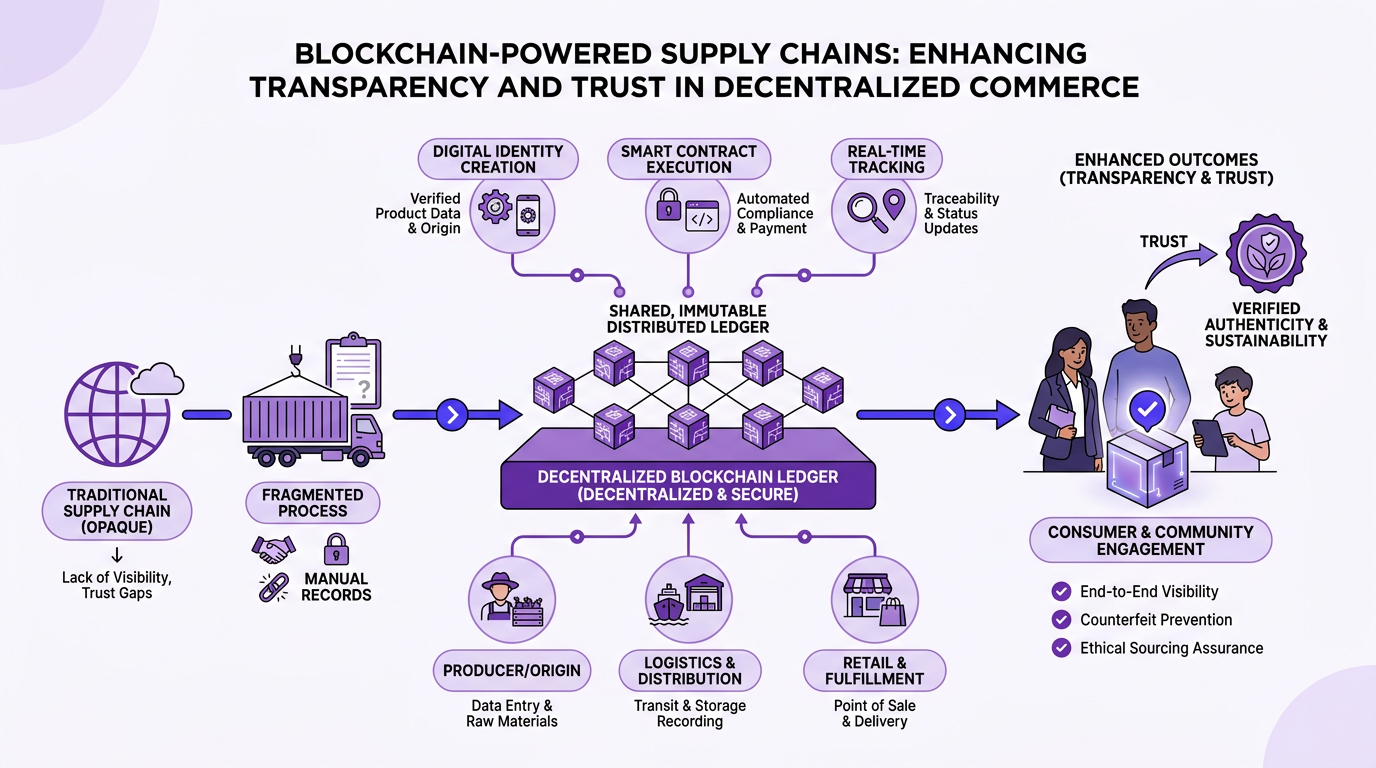
Blockchain-Powered Supply Chains: Enhancing Transparency and Trust in Decentralized Commerce
Blockchain-Powered Supply Chains: Enhancing Transparency and Trust in Decentralized Commerce
The advent of blockchain technology has ushered in a new era of possibilities for various industries, and none stands to benefit more profoundly than supply chain management, especially within the context of decentralized commerce. Traditional supply chains are often opaque, fragmented, and prone to inefficiencies, making it difficult to trace products, verify authenticity, and ensure ethical sourcing. Blockchain-powered supply chains offer a revolutionary solution by providing an immutable, transparent, and distributed ledger for every transaction and movement of goods. This fundamental shift from centralized control to a network of verifiable records is critical for building trust and efficiency in a truly Decentralized Commerce ecosystem.By leveraging blockchain, businesses can create a single source of truth for all participants, from raw material suppliers to end consumers. This not only reduces fraud and counterfeiting but also streamlines operations, enhances accountability, and fosters greater collaboration among stakeholders. The implications for global trade and consumer confidence are immense, paving the way for a more resilient and trustworthy commercial landscape.
Key Supply Chain Transparency Statistics • 71% of consumers believe it's important for brands to be transparent about their supply chains, according to a 2023 IBM study. • Supply chain disruptions cost companies an average of 184 million USD annually, highlighting the need for more resilient systems. • Blockchain technology can reduce supply chain administrative costs by up to 30% by eliminating intermediaries and manual processes. • Over 60% of consumers are willing to pay more for products from brands that demonstrate full transparency in their sourcing and production.
The Core Principles of Blockchain in Supply Chain Management
Blockchain's application in supply chains is rooted in its inherent characteristics: decentralization, immutability, and transparency. Each block in the chain contains a timestamped record of transactions, and once added, it cannot be altered. This creates an unchangeable audit trail that can be accessed by all authorized participants, eliminating the need for intermediaries to verify information.This distributed ledger technology (DLT) ensures that every step of a product's journey – from its origin to its final destination – is recorded and verifiable. This includes details like manufacturing dates, quality control checks, shipping information, and even environmental impact data. For businesses operating in a decentralized marketplace, this level of verifiable data is invaluable for building consumer trust and complying with increasingly stringent regulatory requirements.
Enhancing Traceability and Authenticity
One of the most significant benefits of blockchain in supply chains is enhanced traceability. Consumers are increasingly demanding to know the origin and journey of their products, especially for high-value goods, food, and pharmaceuticals. Blockchain provides this granular visibility, allowing consumers to scan a QR code on a product and instantly access its entire history.This capability is a powerful deterrent against counterfeiting, a multi-billion dollar problem globally. By recording unique product identifiers on the blockchain, manufacturers can prove authenticity, and consumers can verify it, protecting both brand reputation and consumer safety. This is particularly crucial for digital asset ownership where the provenance of virtual goods can be just as important as physical ones.
| Feature | Traditional Supply Chain | Blockchain-Powered Supply Chain |
|---|---|---|
| Data Storage | Centralized databases, siloed | Distributed ledger, shared across network |
| Transparency | Limited, often opaque | High, all authorized participants see data |
| Trust Mechanism | Intermediaries, contracts | Cryptographic proof, immutability |
| Traceability | Manual, prone to errors | Automated, real-time, verifiable |
| Fraud Prevention | Reactive, difficult to prove | Proactive, inherent immutability |
| Efficiency | Manual processes, delays | Automated, streamlined, faster |
Implementing Blockchain for Supply Chain Optimization
Adopting blockchain technology in supply chains requires careful planning and strategic implementation. It's not merely about integrating a new piece of software but rethinking existing processes and fostering collaboration across the entire ecosystem. The goal is to create a more efficient, transparent, and trustworthy network that benefits all participants.5-Step Blockchain Supply Chain Integration Framework
The Impact on Trust and Consumer Confidence
In an increasingly skeptical marketplace, trust is the ultimate currency. Blockchain-powered supply chains directly address this by providing irrefutable proof of a product's journey and ethical credentials. This transparency builds significant consumer confidence, which translates into brand loyalty and potentially higher sales.Expert Insight: "True supply chain decentralization isn't just about technology; it's about a paradigm shift in how businesses collaborate. It forces companies to move beyond siloed operations and embrace a shared, verifiable truth. Those who master this collaborative transparency will dominate the future of commerce, especially as consumers demand more accountability from brands."For industries like food and pharmaceuticals, where product safety and authenticity are paramount, blockchain offers a life-saving advantage. The ability to quickly trace contaminated products back to their source can prevent widespread outbreaks and minimize recalls, protecting both public health and corporate reputation. This level of verifiable trust is a cornerstone of effective decentralized identity management.
Diagram: Blockchain Supply Chain Flow [Raw Material Supplier] → [Manufacturer (Smart Contract for QC)] → [Logistics Provider (GPS & Temp Data)] → [Retailer (Inventory & Sale)] → [Consumer (Verify Product History via QR)]
Challenges and Future Outlook
Despite the immense potential, implementing blockchain in supply chains is not without its challenges. Interoperability between different blockchain networks, the cost of initial setup, and the need for industry-wide standardization are significant hurdles. Furthermore, convincing all participants in a complex supply chain to adopt a new system requires strong leadership and a clear demonstration of value.However, the trajectory is clear. As blockchain technology matures and becomes more accessible, its integration into supply chains will become increasingly commonplace. We will see more sophisticated smart contracts automating complex agreements, advanced analytics providing deeper insights into supply chain performance, and greater collaboration across global networks. The future of Decentralized Commerce hinges on these transparent and trustworthy supply chains, fostering an environment where consumers can buy with confidence and businesses can operate with unprecedented efficiency and integrity.
Frequently Asked Questions
What is the primary benefit of using blockchain in supply chains?
The primary benefit is enhanced transparency and traceability. Blockchain creates an immutable, shared record of a product's journey, allowing all authorized participants to verify its origin, authenticity, and handling, significantly reducing fraud and increasing trust.How does blockchain prevent counterfeiting in supply chains?
Blockchain prevents counterfeiting by assigning unique digital identities to products, often linked to physical identifiers like QR codes or NFC tags. This allows consumers and businesses to verify the product's authenticity against the immutable record on the blockchain, making it extremely difficult for counterfeit goods to pass as genuine.Is blockchain suitable for all types of supply chains?
While blockchain offers benefits to many supply chains, its suitability depends on factors like the complexity of the chain, the value of the goods, and the need for transparency. It is particularly impactful for high-value goods, pharmaceuticals, food, and luxury items where authenticity and traceability are critical concerns.What are smart contracts in the context of blockchain supply chains?
Smart contracts are self-executing contracts with the terms of the agreement directly written into code on the blockchain. In supply chains, they can automate processes like payments upon delivery verification, trigger quality control checks, or release goods from customs once conditions are met, reducing manual intervention and delays.What are the main challenges to adopting blockchain in supply chains?
Key challenges include achieving interoperability between different blockchain platforms, the initial cost and complexity of implementation, the need for industry-wide standardization, and the significant effort required to onboard and gain consensus from all stakeholders across the supply chain.Key Takeaways
- Blockchain fundamentally transforms supply chains by providing unparalleled transparency, immutability, and traceability.
- It significantly enhances consumer trust by allowing verification of product authenticity and ethical sourcing.
- Implementation requires a strategic approach, including defining scope, platform selection, stakeholder engagement, and smart contract development.
- Despite challenges like interoperability and adoption costs, blockchain is poised to become a cornerstone of efficient and trustworthy global commerce.
- The technology is crucial for building a resilient and accountable ecosystem for the future of decentralized commerce.