Blockchain-Powered Supply Chains: Enhancing Transparency and Efficiency in Decentralized Commerce
The advent of blockchain technology has ushered in a new era for supply chain management, promising unprecedented levels of transparency, efficiency, and security. In the context of
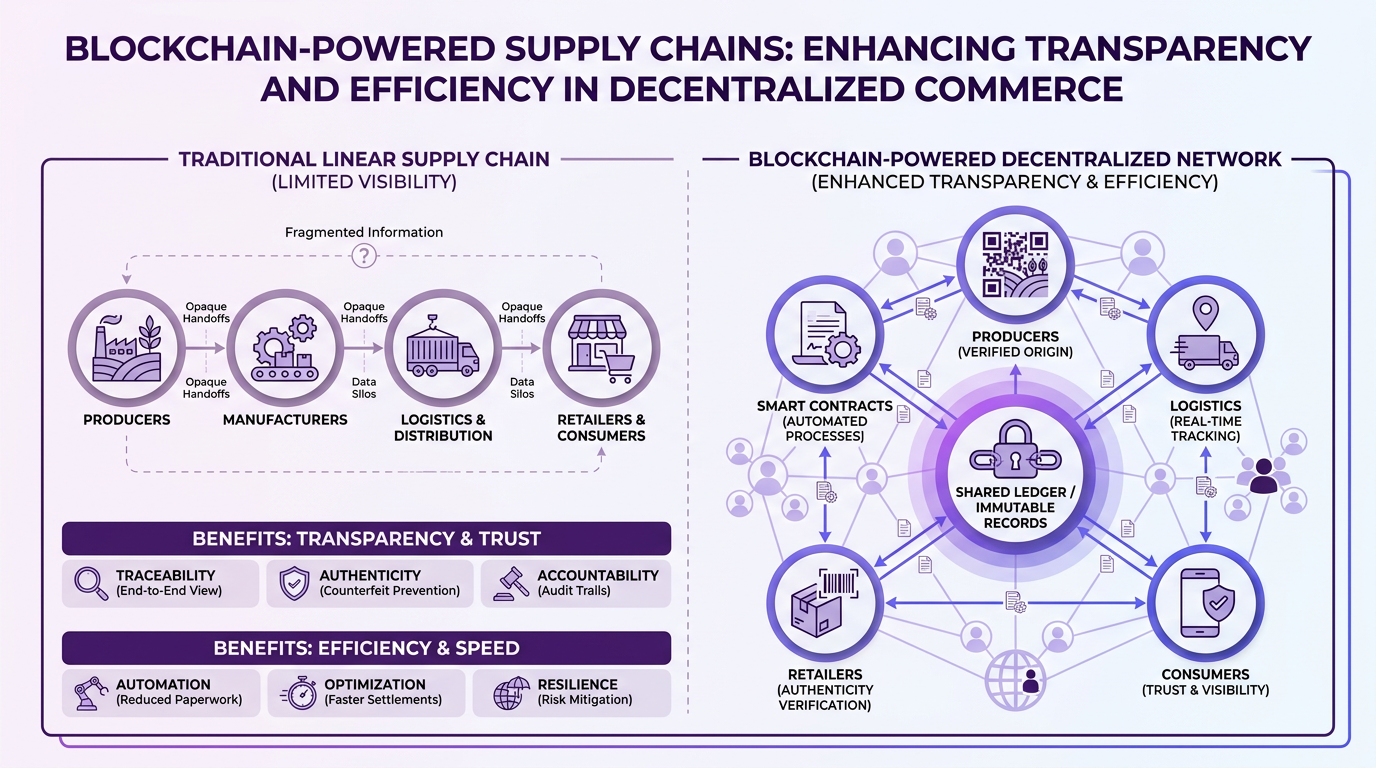
Decentralized Commerce, blockchain-powered supply chains are not merely an enhancement but a foundational element, enabling trustless transactions and verifiable product provenance from source to consumer. This shift moves away from opaque, centralized systems to a distributed ledger where every transaction and movement of goods is immutably recorded and accessible to authorized participants. The implications for reducing fraud, improving accountability, and streamlining logistics are profound, fundamentally reshaping how goods are tracked and traded globally.
Key Supply Chain Transparency Statistics
• 85% of consumers want more transparency from brands regarding their supply chains.
• Companies using blockchain for supply chain management have reported up to a 30% reduction in administrative costs.
• The global blockchain in supply chain market is projected to reach over $10 billion by 2025.
The Core Mechanics of Blockchain in Supply Chains
At its heart, a blockchain-powered supply chain leverages a distributed ledger to create a shared, immutable record of all activities. Each step in the product's journey—from raw material sourcing, manufacturing, shipping, to final delivery—is recorded as a block on the chain. This cryptographic linking of blocks ensures that once data is entered, it cannot be altered or deleted, providing an unalterable audit trail. This inherent immutability is crucial for building trust among disparate parties who may not otherwise trust each other directly.
Smart Contracts: Automating Supply Chain Processes
Smart contracts are self-executing contracts with the terms of the agreement directly written into code. In a supply chain context, they automate various processes, such as payments upon delivery, quality checks, or regulatory compliance. For instance, a smart contract can automatically release payment to a supplier once a shipment is confirmed to have arrived at its destination and passed a predefined quality inspection. This eliminates the need for intermediaries, reduces delays, and minimizes human error, significantly boosting the efficiency of
Decentralized Commerce operations.
| Smart Contract Application | Best For | Difficulty | ROI Potential |
|---|
| Automated Payments | Supplier relations, timely settlement | Medium | High |
| Quality Assurance Triggers | Product integrity, compliance | Hard | Very High |
| Inventory Management | Real-time stock tracking, demand forecasting | Medium | High |
| Regulatory Compliance | Adherence to international standards | Hard | High |
Enhancing Traceability and Authenticity
One of the most compelling benefits of blockchain in supply chains is its ability to provide end-to-end traceability. Consumers can scan a QR code on a product and instantly access its entire history, including origin, manufacturing details, and transportation routes. This level of transparency is invaluable for industries where authenticity and ethical sourcing are paramount, such as luxury goods, pharmaceuticals, and organic food. It empowers consumers to make informed decisions and holds brands accountable for their claims.
Combating Counterfeiting and Fraud
Counterfeiting is a multi-billion dollar problem globally, eroding consumer trust and brand value. Blockchain technology offers a robust solution by creating a verifiable digital identity for each product. By registering products on a blockchain at the point of manufacture, and tracking their movement through the supply chain, it becomes significantly harder for counterfeit goods to infiltrate the legitimate market. Any attempt to introduce a fake product would break the chain of custody, making it easily detectable. This enhanced security is a cornerstone of a truly
secure decentralized marketplace.
The 5-Step Blockchain Supply Chain Integration Framework
Integrating blockchain into existing supply chain infrastructure requires a strategic approach. Here’s a framework to guide the process:
Define Scope and Objectives — Clearly identify which parts of the supply chain will benefit most from blockchain integration (e.g., raw material sourcing, logistics, consumer-facing transparency). Set measurable goals like reducing fraud by X% or improving delivery times by Y%.
Select Blockchain Platform — Choose a suitable blockchain platform (e.g., Ethereum, Hyperledger Fabric, VeChain) based on scalability, privacy requirements, smart contract capabilities, and ecosystem support. Consider whether a public, private, or consortium blockchain best fits your needs.
Pilot Project Implementation — Start with a small, manageable pilot project involving a limited number of partners and products. This allows for testing the technology, identifying bottlenecks, and gathering feedback without disrupting the entire operation.
Integrate with Existing Systems — Develop APIs and connectors to integrate the blockchain solution with existing ERP, CRM, and IoT systems. Data flow between legacy systems and the blockchain must be seamless for effective operation.
Scale and Expand — Based on the success and lessons learned from the pilot, gradually expand the blockchain solution to cover more products, partners, and geographical regions. Continuously monitor performance and iterate on the implementation.
Addressing Challenges and Future Outlook
While the benefits are clear, implementing blockchain in supply chains is not without its challenges. Interoperability between different blockchain networks, the initial cost of implementation, and the need for industry-wide collaboration are significant hurdles. Data privacy concerns, especially in public blockchains, also need careful consideration, often leading to the adoption of permissioned or hybrid blockchain models.
Expert Insight: "The real power of blockchain in supply chains isn't just about tracking; it's about shifting from a reactive, audit-based model to a proactive, trust-by-design system. Companies that embrace this early will gain a significant competitive edge, not just in efficiency but in building unparalleled consumer trust and brand loyalty. The challenge isn't the technology; it's the organizational and inter-organizational change management required."
Despite these challenges, the trajectory for blockchain-powered supply chains is overwhelmingly positive. As the technology matures and standards emerge, we can expect broader adoption across various industries. The integration of IoT devices with blockchain will further enhance real-time data capture and verification, creating truly autonomous and intelligent supply networks. This evolution is critical for the future of
Decentralized Commerce, enabling a more resilient, transparent, and equitable global trading system.
Diagram: Blockchain-Powered Supply Chain Flow
Raw Material Sourcing (Supplier) → Manufacturing (Producer) → Quality Control (Inspector) → Logistics (Shipper) → Retailer/Distributor → Consumer (Verification) → Feedback Loop to Supplier/Producer
The Role of Decentralized Autonomous Organizations (DAOs)
Decentralized Autonomous Organizations (DAOs) can play a pivotal role in governing blockchain-powered supply chains. By enabling stakeholders to collectively manage and make decisions about the network, DAOs can ensure fairness, transparency, and responsiveness. For instance, a DAO could vote on new suppliers, approve changes to smart contract terms, or resolve disputes, further decentralizing control and fostering a more equitable ecosystem. This aligns perfectly with the ethos of
decentralized governance models that are emerging in the broader decentralized commerce landscape.
Frequently Asked Questions
What is the primary benefit of using blockchain in supply chains?
The primary benefit is enhanced transparency and traceability, providing an immutable record of a product's journey from origin to consumer. This helps combat counterfeiting, ensures ethical sourcing, and builds greater consumer trust.
How do smart contracts improve supply chain efficiency?
Smart contracts automate various processes, such as payments, quality checks, and compliance, based on predefined conditions. This reduces manual intervention, minimizes errors, speeds up transactions, and eliminates the need for intermediaries.
Is blockchain suitable for all types of supply chains?
While highly beneficial for many, blockchain implementation is most impactful for complex supply chains with multiple intermediaries, high-value goods, or those requiring stringent regulatory compliance and authenticity verification. The initial investment and complexity might not be justified for very simple, localized supply chains.
Key Takeaways
- Blockchain technology provides an immutable and transparent ledger for supply chain activities, crucial for Decentralized Commerce.
- Smart contracts automate processes, reducing manual effort and increasing efficiency in logistics and payments.
- Enhanced traceability combats counterfeiting and fraud, building consumer trust and ensuring product authenticity.
- Successful integration requires careful planning, pilot projects, and seamless integration with existing enterprise systems.
- DAOs can provide decentralized governance, further strengthening trust and collective decision-making within supply chain networks.