Blockchain-Powered Supply Chains: Enhancing Transparency and Efficiency in Decentralized Commerce
The advent of blockchain technology has ushered in a new era for supply chain management, promising unprecedented levels of transparency, efficiency, and security. In the context of
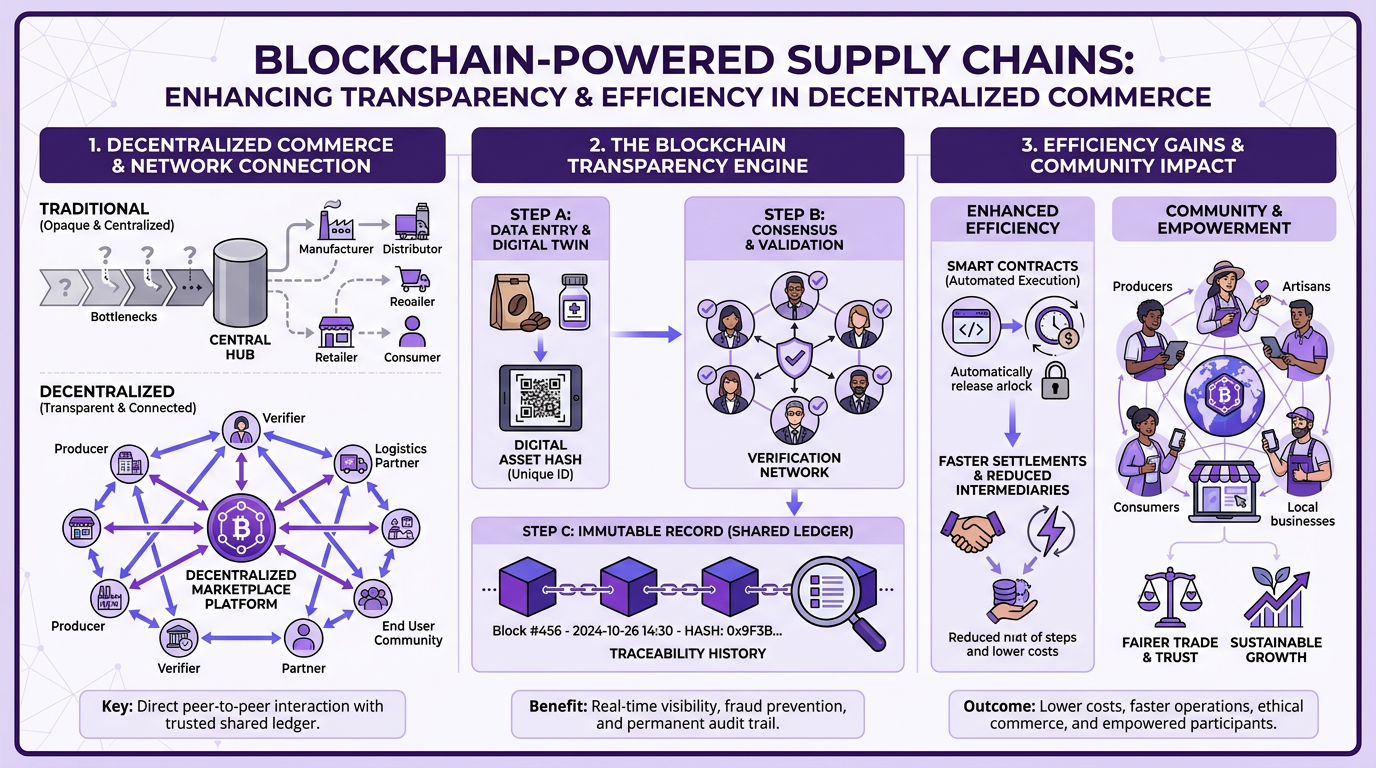
Decentralized Commerce, blockchain-powered supply chains are not merely an enhancement but a foundational element, enabling trustless interactions and verifiable transactions across complex global networks. By leveraging the immutable and distributed ledger capabilities of blockchain, businesses can track products from origin to consumer with granular detail, mitigating fraud, reducing delays, and fostering greater accountability among all participants. This shift from opaque, centralized systems to transparent, decentralized ones is revolutionizing how goods and services move through the global economy, directly impacting the viability and growth of decentralized marketplaces.
Key Supply Chain Transparency Statistics
• 71% of consumers believe it's important for brands to be transparent about their supply chain practices.
• Companies with highly transparent supply chains experience 1.8x higher revenue growth than those with opaque ones.
• Supply chain disruptions cost companies an average of $184 million annually, with lack of visibility being a major contributing factor.
• Blockchain technology could reduce supply chain costs by 15-20% for many industries.
The Imperative for Transparency in Modern Supply Chains
Traditional supply chains are often characterized by a lack of visibility, fragmented data, and numerous intermediaries, each adding layers of complexity and potential points of failure. This opacity makes it challenging to verify the authenticity of products, trace their origins, or ensure ethical sourcing practices. For consumers and businesses alike, this creates a trust deficit, particularly in an age where ethical consumption and product integrity are paramount. Blockchain addresses these challenges by creating a shared, immutable record of every transaction and movement within the supply chain.
How Blockchain Enhances Traceability
At its core, blockchain provides an unalterable digital ledger where every step of a product's journey can be recorded. From the sourcing of raw materials to manufacturing, shipping, and final delivery, each event is timestamped and cryptographically linked to the previous one, forming a chain of verifiable data. This comprehensive record allows for instant traceability, enabling stakeholders to pinpoint the exact origin of a product, verify its components, and track its environmental footprint. This level of detail is crucial for industries dealing with high-value goods, pharmaceuticals, or perishable items, where authenticity and provenance are critical.
| Feature | Traditional Supply Chain | Blockchain-Powered Supply Chain |
|---|
| Data Storage | Centralized, siloed databases | Distributed, immutable ledger |
| Transparency | Limited, often opaque | High, verifiable by all participants |
| Trust Mechanism | Intermediaries, contracts | Cryptographic proof, consensus mechanisms |
| Fraud Prevention | Manual checks, audits | Automated verification, tamper-proof records |
| Efficiency | Prone to delays, manual processes | Streamlined, automated, real-time data |
Smart Contracts: Automating Supply Chain Operations
Beyond mere record-keeping, blockchain's true power in supply chains is unlocked through smart contracts. These self-executing agreements, with the terms directly written into code, automatically trigger actions when predefined conditions are met. This automation eliminates the need for intermediaries, reduces administrative overhead, and accelerates transaction settlements, all vital components of efficient
Decentralized Commerce operations. For instance, a smart contract can automatically release payment to a supplier once goods are verified as received and inspected, or trigger a new order when inventory levels drop below a certain threshold.
5-Step Smart Contract Implementation Framework for Supply Chains
Identify Key Processes for Automation — Pinpoint specific, repetitive supply chain tasks that involve multiple parties and clear conditions, such as payment releases, quality checks, or inventory reordering. Focus on areas where manual intervention causes delays or disputes.
Define Contract Parameters and Conditions — Clearly outline the 'if-then' logic for each smart contract. What triggers an action? What are the verifiable conditions? For example, 'IF goods are delivered AND quality check passes, THEN release payment.'
Select a Suitable Blockchain Platform — Choose a blockchain that supports smart contracts and aligns with your scalability, privacy, and cost requirements. Options include Ethereum, Hyperledger Fabric, or Solana, depending on the specific use case and industry needs.
Develop and Audit Smart Contracts — Write the smart contract code, ensuring it accurately reflects the agreed-upon terms. Crucially, conduct thorough security audits and testing to identify and rectify any vulnerabilities before deployment, as smart contracts are immutable once live.
Integrate with Existing Systems and Onboard Participants — Connect the blockchain solution with your enterprise resource planning (ERP) systems, IoT devices, and other relevant technologies. Crucially, educate and onboard all supply chain partners, ensuring they understand the benefits and how to interact with the new system.
Addressing Challenges and Ensuring Adoption
While the benefits of blockchain in supply chains are clear, widespread adoption faces several hurdles. Interoperability between different blockchain networks, regulatory uncertainties, and the significant upfront investment in technology and training are common concerns. Furthermore, convincing all participants in a complex supply chain, from small farmers to multinational corporations, to adopt a new system requires strong incentives and a clear demonstration of value. However, the long-term gains in efficiency, trust, and resilience often outweigh these initial challenges.
Expert Insight: "The real game-changer for blockchain in supply chains isn't just tracking, it's the shift from reactive problem-solving to proactive prevention. When every participant has a shared, real-time view of the entire chain, anomalies are detected instantly, and disputes are minimized. This moves us from a 'fix-it-after-it-breaks' mentality to a 'prevent-it-from-breaking' paradigm, which is invaluable for Decentralized Commerce platforms aiming for true autonomy and efficiency."
The Role of IoT and AI in Blockchain Supply Chains
Integrating Internet of Things (IoT) devices with blockchain further enhances data accuracy and automation. IoT sensors can automatically record data such as temperature, humidity, and location, feeding this information directly into the blockchain. This eliminates manual data entry errors and provides real-time, verifiable conditions for smart contracts. Artificial intelligence (AI) can then analyze this vast dataset to predict potential disruptions, optimize routes, and improve demand forecasting, creating a truly intelligent and self-optimizing supply chain. This synergy between blockchain, IoT, and AI is critical for building robust
decentralized marketplaces and fostering a more resilient global trade ecosystem.
Diagram: Blockchain-IoT Integrated Supply Chain
[Raw Material Sourcing (IoT Sensors)] → [Manufacturing (IoT & Blockchain Record)] → [Logistics & Shipping (GPS/RFID & Smart Contract)] → [Distribution & Retail (Inventory Mgmt & Payment)] → [Consumer (Product Authenticity Verification)] → [Feedback Loop to Sourcing/Manufacturing]
Future Outlook: Towards Fully Autonomous Supply Networks
The trajectory for blockchain-powered supply chains points towards increasingly autonomous and self-governing networks. As more industries embrace these technologies, we can expect to see greater standardization, improved interoperability, and the emergence of specialized blockchain solutions tailored to specific supply chain needs. The ultimate vision is a global network of interconnected, transparent, and efficient supply chains that operate with minimal human intervention, driven by smart contracts and secured by cryptographic principles. This evolution is not just about technology; it's about fundamentally redefining trust and collaboration in global trade, paving the way for a truly global and efficient
Decentralized Commerce ecosystem.
Frequently Asked Questions
What is the primary benefit of blockchain in supply chains?
The primary benefit is enhanced transparency and traceability. Blockchain creates an immutable, shared record of all transactions and movements, allowing all participants to verify product origins, authenticity, and journey in real-time, significantly reducing fraud and increasing trust.
How do smart contracts improve supply chain efficiency?
Smart contracts automate key processes by executing predefined actions when specific conditions are met, without the need for intermediaries. This reduces manual errors, accelerates payment settlements, streamlines logistics, and lowers administrative costs, leading to significant efficiency gains.
Is blockchain suitable for all types of supply chains?
While highly beneficial for many, blockchain's suitability depends on the complexity and specific needs of the supply chain. It offers the most value in industries requiring high transparency, authenticity verification (e.g., pharmaceuticals, luxury goods), or those with many intermediaries and potential for disputes. Initial implementation costs and the need for ecosystem-wide adoption can be barriers for simpler chains.
What role does IoT play with blockchain in supply chains?
IoT devices provide real-time, verifiable data (e.g., temperature, location) directly to the blockchain, eliminating manual data entry and enhancing accuracy. This data can then trigger smart contracts, automating processes based on actual physical conditions, creating a more robust and intelligent supply chain.
Key Takeaways
- Blockchain technology is transforming supply chains by providing unparalleled transparency and traceability, crucial for building trust in global trade.
- Smart contracts automate complex supply chain processes, from payments to inventory management, significantly boosting efficiency and reducing reliance on intermediaries.
- The integration of IoT and AI with blockchain creates intelligent, self-optimizing supply networks capable of real-time monitoring and predictive analytics.
- While challenges like interoperability and adoption exist, the long-term benefits of reduced fraud, increased efficiency, and enhanced consumer trust make blockchain a vital component for the future of Decentralized Commerce.
- The move towards blockchain-powered supply chains represents a fundamental shift towards more resilient, ethical, and autonomous global trade ecosystems, directly supporting the growth of decentralized marketplaces and decentralized autonomous organizations (DAOs).