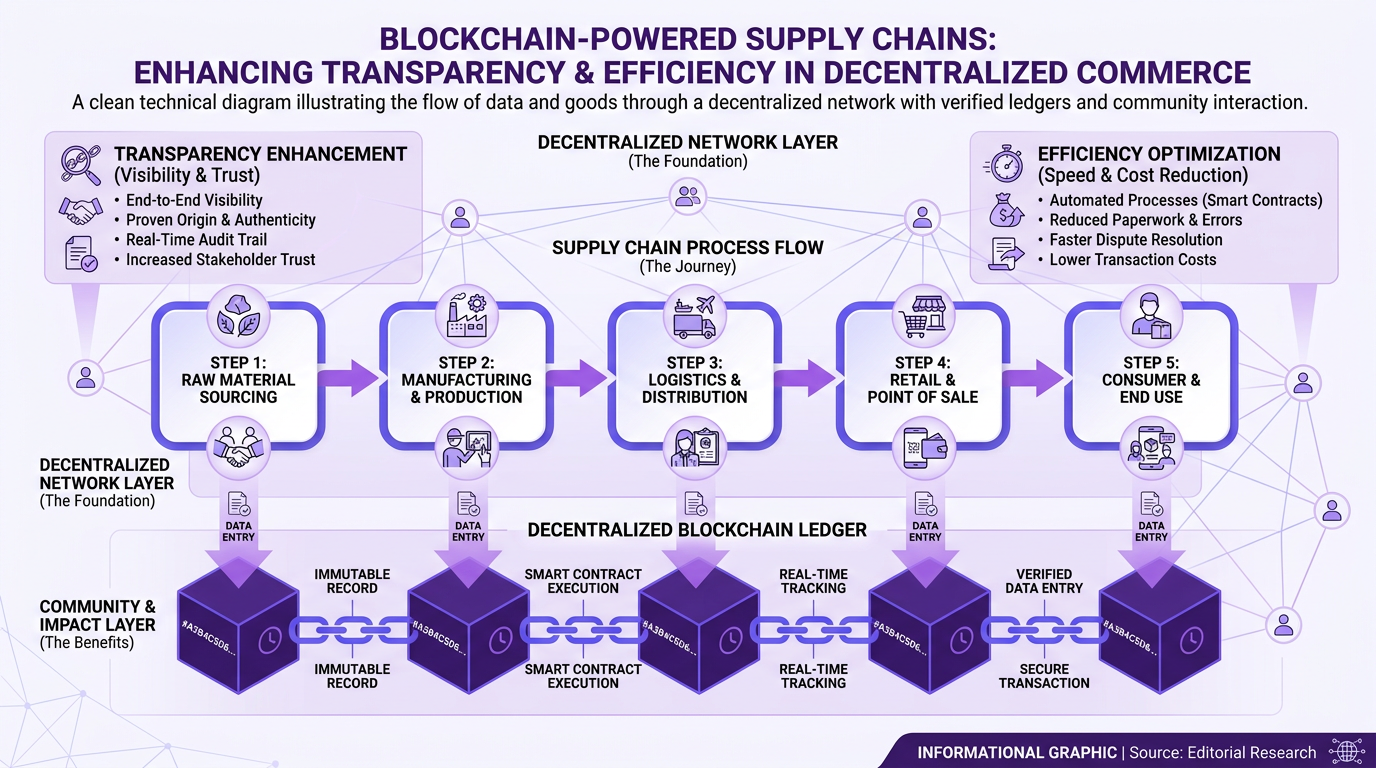
Blockchain-Powered Supply Chains: Enhancing Transparency and Efficiency in Decentralized Commerce
The advent of blockchain technology has ushered in a new era for supply chain management, promising unprecedented levels of transparency, efficiency, and security. In the context of
Decentralized Commerce, blockchain-powered supply chains are not merely an enhancement but a foundational component, enabling trustless transactions and verifiable product provenance from source to consumer. This shift moves away from opaque, centralized systems to a distributed ledger where every transaction and movement of goods is immutably recorded, accessible to all authorized participants. The implications for reducing fraud, improving accountability, and streamlining logistics are profound, fundamentally reshaping how goods are tracked and traded globally.
Key Blockchain in Supply Chain Statistics
• The global blockchain in supply chain market size is projected to reach over $10 billion by 2027, growing at a CAGR of 87.5% from 2022.
• 90% of supply chain executives believe blockchain will be critical for future supply chain resilience.
• Companies utilizing blockchain in their supply chains report an average 15% reduction in operational costs.
• Traceability solutions powered by blockchain can reduce food waste by up to 20% by improving inventory management and recall efficiency.
The Core Mechanics of Blockchain in Supply Chain Management
At its heart, a blockchain-powered supply chain leverages a distributed ledger to create a shared, unchangeable record of all transactions and events. Each 'block' contains a timestamped batch of transactions, and once recorded, it cannot be altered. This inherent immutability and transparency are critical for building trust among disparate parties in a supply network. From raw material sourcing to manufacturing, shipping, and final delivery, every step can be logged on the blockchain, creating an end-to-end audit trail. This eliminates the need for intermediaries to verify information, significantly reducing delays and potential for disputes.
Smart Contracts: Automating Supply Chain Processes
Smart contracts are self-executing contracts with the terms of the agreement directly written into code. In a blockchain supply chain, these contracts can automate various processes, such as payments upon delivery verification, triggering new orders when inventory levels drop, or releasing funds once quality checks are confirmed. This automation not only speeds up operations but also minimizes human error and the potential for fraud. For instance, a smart contract could automatically release payment to a supplier once a shipment's GPS data confirms its arrival at the destination port and IoT sensors verify the goods' condition.
| Smart Contract Application | Best For | Difficulty | ROI Potential |
|---|
| Automated Payments | Reducing payment delays, ensuring compliance | Medium | High |
| Inventory Management | Real-time stock tracking, reorder automation | Medium | Medium |
| Quality Assurance | Verifying product conditions, triggering alerts | Hard | Very High |
| Dispute Resolution | Providing undeniable evidence for claims | Medium | High |
Enhancing Transparency and Traceability
One of the most compelling benefits of blockchain in supply chains is its ability to provide unparalleled transparency and traceability. Consumers are increasingly demanding to know the origin and journey of their products, especially in sectors like food, pharmaceuticals, and luxury goods. Blockchain provides a verifiable narrative for each product, detailing its journey through the supply chain. This level of detail helps combat counterfeiting, ensures ethical sourcing, and allows for rapid identification and recall of faulty products.
The Role of IoT and Data Oracles
For blockchain to accurately reflect the physical world, it needs reliable data inputs. This is where Internet of Things (IoT) devices and data oracles come into play. IoT sensors can monitor conditions like temperature, humidity, and location, automatically feeding this data onto the blockchain. Data oracles act as bridges, connecting real-world data to smart contracts. For example, an oracle could provide weather data to a smart contract that adjusts shipping routes based on adverse conditions, or verify customs clearance information before releasing a payment. This integration ensures that the digital record on the blockchain is a true reflection of the physical state of goods.
5-Step Blockchain Supply Chain Implementation Framework
Define Scope & Objectives — Clearly identify which parts of your supply chain will benefit most from blockchain, e.g., traceability for high-value goods, payment automation, or compliance. Set measurable goals.
Select Blockchain Platform — Choose a suitable blockchain (e.g., Hyperledger Fabric, Ethereum, VeChain) based on scalability, privacy requirements, and smart contract capabilities. Consider whether a public, private, or consortium chain is best.
Integrate Data Sources — Connect existing ERP, CRM, and IoT systems to the blockchain. This involves developing APIs and data connectors to ensure seamless data flow and accurate record-keeping.
Develop Smart Contracts — Design and deploy smart contracts for key processes like order placement, payment release, quality checks, and dispute resolution. Thorough testing is crucial to prevent vulnerabilities.
Pilot & Scale — Start with a small-scale pilot project involving key partners. Gather feedback, refine the system, and gradually expand its application across the entire supply chain, ensuring all stakeholders are onboarded and trained.
Addressing Challenges and Future Outlook
While the potential of blockchain-powered supply chains is immense, several challenges remain. Interoperability between different blockchain networks, regulatory uncertainty, and the significant upfront investment in technology and training are key hurdles. However, ongoing developments in Decentralized Autonomous Organizations (DAOs) and the increasing maturity of blockchain platforms are paving the way for broader adoption. The future will likely see more consortium blockchains, where industry players collaborate to build shared, trusted networks.
Expert Insight: "The real game-changer for blockchain in supply chains isn't just about tracking; it's about creating a shared, immutable source of truth that fundamentally alters how trust is established and maintained between independent entities. This shifts the focus from auditing individual transactions to verifying the integrity of the entire network, leading to unprecedented efficiencies and resilience. The biggest mistake companies make is trying to replicate existing processes on blockchain instead of reimagining them for a truly decentralized paradigm."
Impact on Global Trade and Logistics
Blockchain's impact extends beyond individual supply chains to transform global trade and logistics. By digitizing trade finance, customs procedures, and shipping documentation, it can significantly reduce administrative burdens and transit times. The ability to verify the authenticity of goods and documents instantly will streamline cross-border transactions, making international trade more accessible and secure. This contributes directly to the broader vision of a more efficient and equitable
Decentralized Commerce ecosystem.
Diagram: Blockchain-Powered Supply Chain Flow
Raw Material Supplier (Data Input) → Manufacturer (Production & Quality Log) → Distributor (Logistics & Inventory) → Retailer (Sales & Provenance) → Consumer (Verification & Feedback) → Smart Contract (Automated Payments & Reorders)
Security and Data Integrity in Decentralized Supply Chains
Security is paramount in any supply chain, and blockchain offers robust solutions. The cryptographic nature of blockchain ensures that data, once recorded, cannot be tampered with. This immutability protects against fraud and unauthorized alterations, providing a high degree of data integrity. Furthermore, the distributed nature of the ledger means there's no single point of failure, making the system highly resilient to cyberattacks. While the blockchain itself is secure, the integration points with off-chain systems (like IoT devices) require careful attention to prevent vulnerabilities. Implementing strong access controls and encryption for data before it enters the blockchain is crucial.
Addressing Privacy Concerns with Zero-Knowledge Proofs
While transparency is a core benefit, businesses often have concerns about sharing sensitive commercial data with competitors on a public ledger. Technologies like zero-knowledge proofs (ZKPs) offer a solution. ZKPs allow one party to prove that they possess certain information (e.g., a product meets specific quality standards) without revealing the actual information itself. This enables verification and compliance without compromising proprietary data, striking a balance between transparency and privacy in a decentralized environment. This nuanced approach is vital for the widespread adoption of blockchain in competitive industries, aligning with the principles of
decentralized marketplaces where data sovereignty is key.
Frequently Asked Questions
What is the primary benefit of using blockchain in supply chains?
The primary benefit is enhanced transparency and traceability, providing an immutable, verifiable record of a product's journey from origin to consumer. This reduces fraud, improves accountability, and builds trust among all participants without relying on a central authority.
How do smart contracts improve supply chain efficiency?
Smart contracts automate various processes, such as payments, inventory management, and quality assurance, based on predefined conditions. This automation reduces manual effort, minimizes errors, speeds up transactions, and ensures compliance, leading to significant operational efficiencies.
Can blockchain solve all supply chain problems?
While blockchain offers powerful solutions for transparency, traceability, and automation, it is not a panacea. It requires reliable data input from IoT devices and other systems, and its effectiveness depends on the willingness of all supply chain partners to adopt and integrate the technology. Challenges like interoperability and regulatory clarity still need to be addressed.
Key Takeaways
- Blockchain fundamentally transforms supply chains by providing an immutable, transparent, and distributed ledger for all transactions and product movements.
- Smart contracts automate critical processes, reducing manual intervention, errors, and delays, thereby boosting efficiency and compliance.
- Enhanced transparency and traceability combat counterfeiting, ensure ethical sourcing, and enable rapid product recalls, meeting growing consumer demands.
- Integration with IoT devices and data oracles ensures that real-world data is accurately reflected on the blockchain, bridging the physical and digital realms.
- While challenges like interoperability and privacy exist, solutions like zero-knowledge proofs are emerging, making blockchain a cornerstone for the future of Decentralized Commerce and global trade.