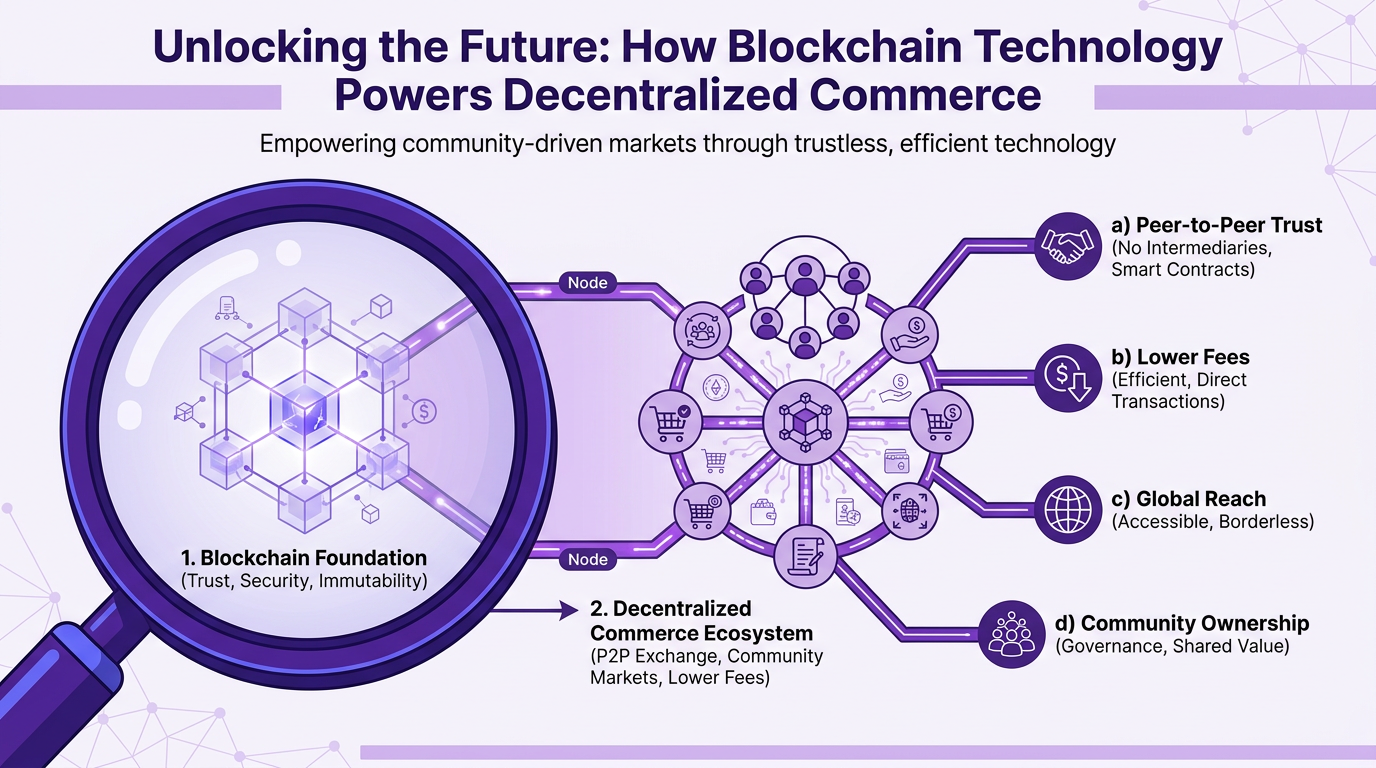
Unlocking the Future: How Blockchain Technology Powers Decentralized Commerce
Unlocking the Future: How Blockchain Technology Powers Decentralized Commerce
Decentralized Commerce, a revolutionary approach to online transactions, is fundamentally reshaped by the underlying power of blockchain technology. This innovative paradigm shifts control from centralized intermediaries to a distributed network, fostering greater transparency, security, and efficiency. At its core, blockchain provides the immutable ledger and cryptographic security necessary to build trustless environments, which are essential for true Decentralized Commerce to flourish. Without the robust and verifiable nature of blockchain, the promises of peer-to-peer transactions, reduced fees, and enhanced privacy would remain largely theoretical.Blockchain technology isn't just a component of Decentralized Commerce; it's the very infrastructure upon which it's built. From managing digital identities to facilitating secure payments and smart contract execution, blockchain underpins every critical function. Understanding this symbiotic relationship is crucial for anyone looking to navigate or contribute to the evolving landscape of decentralized marketplaces and services, as explored in depth on our main page about Decentralized Commerce.
Key Blockchain in Commerce Statistics • The global blockchain market size is projected to reach over $163 billion by 2029, growing at a CAGR of 56.3% from 2022 to 2029. • Over 70% of businesses are exploring or implementing blockchain technology for various applications, including supply chain and payments. • Blockchain-based payment systems can reduce transaction costs by up to 80% compared to traditional banking methods. • Smart contracts, a core blockchain feature, are estimated to save businesses billions annually by automating agreements and reducing legal overhead.
The Immutable Ledger: Foundation of Trust
The most fundamental contribution of blockchain technology to Decentralized Commerce is its immutable, distributed ledger. Unlike traditional databases controlled by a single entity, a blockchain is a chain of blocks, each containing a list of transactions, cryptographically linked together. Once a transaction is recorded on the blockchain, it cannot be altered or deleted, creating an unchangeable record of all activities.This immutability is paramount for building trust in a decentralized environment where participants may not know or trust each other directly. For buyers, it means verifiable proof of purchase and ownership. For sellers, it ensures transparent transaction histories and reduces the risk of fraud. This foundational trust mechanism eliminates the need for central authorities to validate transactions, directly addressing one of the core challenges that Decentralized Commerce aims to solve.
How Immutability Enhances Transaction Security
When a transaction occurs on a blockchain, it's broadcast to the network, verified by multiple nodes, and then added to a block. This block is then cryptographically linked to the previous block, forming a chain. Any attempt to tamper with a past transaction would require altering all subsequent blocks, a computationally infeasible task. This inherent security makes blockchain an ideal backbone for secure and verifiable commerce.| Feature | Traditional Commerce | Blockchain-Powered Commerce |
|---|---|---|
| Record Keeping | Centralized databases, prone to single points of failure | Distributed, immutable ledger, highly resistant to tampering |
| Trust Mechanism | Relies on intermediaries (banks, payment processors) | Cryptographic proof and network consensus |
| Transparency | Limited visibility, often opaque | Full transaction history visible to all participants (pseudonymously) |
| Fraud Prevention | Reactive measures, chargebacks | Proactive through cryptographic security and immutability |
Smart Contracts: Automating Agreements in a Trustless World
Beyond simple transaction recording, blockchain technology introduces smart contracts – self-executing contracts with the terms of the agreement directly written into code. These contracts automatically execute when predefined conditions are met, without the need for intermediaries. In Decentralized Commerce, smart contracts are game-changers, automating everything from payment releases upon delivery confirmation to escrow services and dispute resolution.For instance, a smart contract can hold funds in escrow until both buyer and seller confirm the successful delivery and receipt of goods or services. If a dispute arises, the contract can be programmed to trigger an arbitration process, potentially involving decentralized autonomous organizations (DAOs) or pre-selected arbiters. This automation significantly reduces operational costs, speeds up transactions, and minimizes the potential for human error or bias.
5-Step Smart Contract Implementation Framework for Decentralized Marketplaces
Decentralized Identity and Reputation Systems
Traditional e-commerce relies heavily on centralized identity providers and reputation systems, often controlled by platforms like Amazon or eBay. Blockchain technology enables the creation of decentralized identity (DID) solutions, giving users sovereign control over their personal data. Instead of storing sensitive information on a central server, users can store verifiable credentials on the blockchain, selectively sharing them as needed.This shift is crucial for privacy-centric Decentralized Commerce. Coupled with decentralized reputation systems, where feedback and ratings are immutably recorded on the blockchain, users can build a trustworthy profile without revealing excessive personal information. This fosters a more equitable and secure environment, reducing the risk of data breaches and censorship. The concept of decentralized identity is a cornerstone of this new paradigm, offering users unprecedented control.
Expert Insight: "The real revolution of blockchain in commerce isn't just about payments; it's about re-architecting trust. By moving from 'trusting intermediaries' to 'trusting cryptography,' we unlock entirely new models of interaction that are more resilient, fair, and efficient. The challenge now is to make these complex systems user-friendly enough for mass adoption, bridging the gap between cryptographic elegance and everyday usability."
Tokenization and Digital Assets
Blockchain technology facilitates the tokenization of assets, both tangible and intangible. This means representing real-world assets (like real estate, art, or commodities) or digital assets (like intellectual property or in-game items) as digital tokens on a blockchain. These tokens can then be easily traded, fractionalized, and managed within decentralized marketplaces.Tokenization opens up new avenues for commerce, enabling fractional ownership, increased liquidity for illiquid assets, and transparent ownership transfers. For instance, a piece of art could be tokenized into hundreds of smaller units, allowing more people to invest. This concept is closely related to how NFTs in e-commerce are transforming digital ownership and creative economies.
Diagram: Blockchain's Role in Decentralized Commerce Flow [User Initiates Transaction] → [Smart Contract Deploys/Activates] → [Payment via Cryptocurrency/Token] → [Transaction Recorded on Immutable Ledger] → [Decentralized Identity Verified] → [Goods/Services Delivered] → [Reputation Updated] → [Funds Released by Smart Contract]
Overcoming Challenges: Scalability and Interoperability
While blockchain offers immense potential for Decentralized Commerce, challenges remain. Scalability, the ability of a blockchain network to handle a high volume of transactions, is a significant hurdle. Early blockchains like Ethereum faced limitations in transaction speed and cost, impacting their suitability for high-frequency commercial applications. However, ongoing developments in layer-2 solutions, sharding, and alternative consensus mechanisms are actively addressing these issues.Interoperability, the ability of different blockchain networks to communicate and exchange data, is another critical area of focus. For a truly global Decentralized Commerce ecosystem, seamless interaction between various blockchains is essential. Projects focusing on cross-chain bridges and standardized protocols are paving the way for a more connected and efficient decentralized future. These advancements are vital for the continued growth and mainstream adoption of Decentralized Commerce.
Frequently Asked Questions
How does blockchain ensure security in decentralized commerce?
Blockchain ensures security through cryptographic hashing, immutability, and decentralization. Every transaction is cryptographically linked to the previous one, making it virtually impossible to alter past records. The distributed nature of the network means there's no single point of failure, enhancing resistance to attacks.What are smart contracts and how do they benefit decentralized commerce?
Smart contracts are self-executing agreements with the terms directly coded into the blockchain. They benefit decentralized commerce by automating transactions, escrow services, and dispute resolution without intermediaries, reducing costs, increasing speed, and minimizing human error.Can blockchain solve all the problems of traditional e-commerce?
While blockchain addresses many issues like trust, transparency, and intermediary costs, it faces its own challenges, including scalability, regulatory uncertainty, and user experience complexities. It's a powerful tool, but not a universal panacea, and its full potential is still being realized.Key Takeaways
- Blockchain technology is the foundational infrastructure enabling the core principles of Decentralized Commerce, providing trust, transparency, and security.
- The immutable ledger ensures verifiable and tamper-proof transaction records, eliminating the need for central authorities.
- Smart contracts automate agreements, streamlining processes like payments, escrow, and dispute resolution, significantly reducing operational overhead.
- Decentralized identity and reputation systems empower users with data sovereignty and foster trust without relying on centralized platforms.
- Tokenization of assets opens new commercial opportunities for fractional ownership and increased liquidity.
- Ongoing advancements in scalability and interoperability are crucial for the widespread adoption and future success of blockchain-powered Decentralized Commerce.