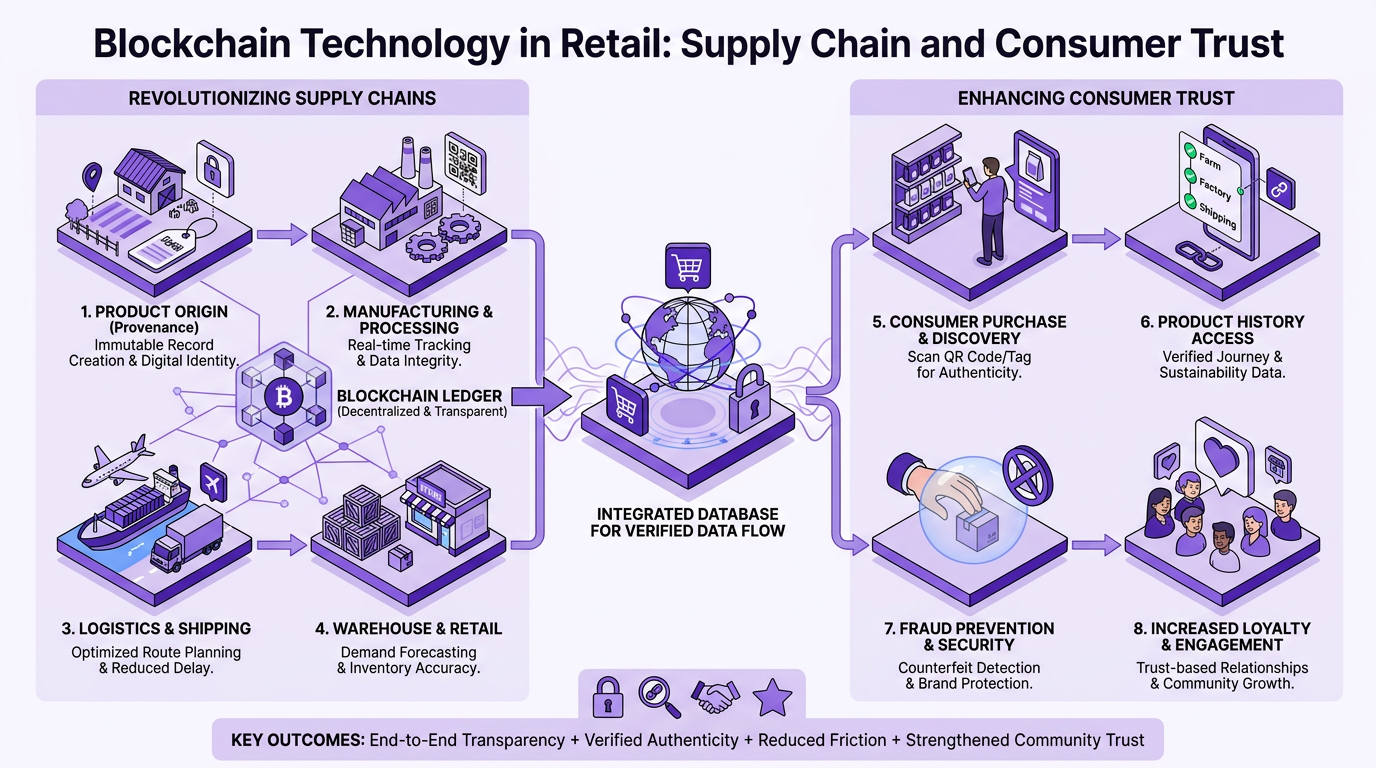
Blockchain Technology in Retail: Revolutionizing Supply Chains and Consumer Trust
Blockchain technology, often associated with cryptocurrencies, is rapidly proving its transformative potential across various industries, with retail being a prime candidate for disruption. Beyond simple payment processing, blockchain offers a robust framework for enhancing transparency, traceability, and trust throughout the entire retail supply chain, from sourcing raw materials to final consumer purchase. This integration is a crucial component of the broader shift towards
Decentralized Commerce, enabling retailers to build more resilient, efficient, and ethical operations while fostering deeper consumer confidence. By providing an immutable and verifiable record of every transaction and movement, blockchain addresses long-standing challenges in product authenticity, ethical sourcing, and operational efficiency.
Key Blockchain in Retail Statistics
• The global blockchain in retail market size is projected to reach USD 10.7 billion by 2028, growing at a CAGR of 67.8% from 2023.
• Over 60% of consumers are willing to pay more for products from brands that offer full transparency on their supply chain.
• Blockchain-powered traceability solutions can reduce supply chain fraud and counterfeiting by up to 25%.
• Major retailers like Walmart and Carrefour have successfully piloted blockchain for food traceability, reducing tracking time from days to seconds.
Enhancing Supply Chain Transparency and Traceability
One of the most significant applications of blockchain in retail is its ability to create an unalterable record of a product's journey through the supply chain. From the farm or factory to the store shelf, every step—sourcing, manufacturing, shipping, and distribution—can be logged on a blockchain. This provides unparalleled transparency, allowing retailers and consumers alike to verify the origin, authenticity, and ethical production of goods. This level of traceability is particularly valuable in industries prone to counterfeiting or those with complex global supply chains, such as luxury goods, pharmaceuticals, and food.
Combating Counterfeiting and Ensuring Authenticity
Counterfeit goods cost the global economy billions annually and erode consumer trust. Blockchain technology offers a powerful weapon against this. By assigning a unique digital identity (often an NFT or a QR code linked to a blockchain record) to each product, consumers can scan and verify its authenticity and provenance. This not only protects brands but also assures consumers they are purchasing genuine articles, a critical factor for high-value items. This concept is closely related to the secure transactions facilitated by
smart contracts in decentralized commerce.
| Blockchain Application | Retail Benefit | Impact on Trust | Implementation Difficulty |
|---|
| Supply Chain Tracking | Enhanced transparency, fraud reduction | High | Medium/High |
| Product Authenticity | Counterfeit prevention, brand protection | High | Medium |
| Loyalty Programs | Increased engagement, personalized rewards | Medium | Medium |
| Payment Processing | Faster settlements, lower fees | Medium | Low/Medium |
| Inventory Management | Real-time visibility, reduced waste | Medium | Medium |
Revolutionizing Payment Systems and Loyalty Programs
Beyond supply chain management, blockchain technology is also poised to transform retail payment systems and customer loyalty programs. Cryptocurrencies, facilitated by blockchain, offer faster and cheaper transaction processing, especially for international payments, by bypassing traditional banking intermediaries. This can lead to reduced operational costs for retailers and potentially lower prices for consumers.
Decentralized Loyalty and Rewards
Traditional loyalty programs often suffer from low engagement and limited flexibility. Blockchain-based loyalty programs, however, can issue tokenized rewards that are more flexible, transferable, and even tradable. These tokens can be used across multiple participating retailers, or even exchanged for other cryptocurrencies, offering greater value and utility to customers. This approach aligns perfectly with the principles of
decentralized finance (DeFi), bringing financial innovation to consumer rewards.
5-Step Framework for Implementing Blockchain in Retail Supply Chains
Identify Key Traceability Points — Pinpoint critical stages in your supply chain where data needs to be captured (e.g., raw material sourcing, manufacturing, packaging, shipping, retail distribution). Focus on areas with high risk of fraud or ethical concerns.
Select a Blockchain Platform — Choose a suitable blockchain (e.g., Hyperledger Fabric, Ethereum, VeChain) based on factors like privacy requirements, transaction volume, cost, and interoperability with existing systems. Consider private vs. public blockchains.
Integrate Data Capture Mechanisms — Implement technologies like QR codes, RFID tags, or IoT sensors at each identified traceability point. These mechanisms will record relevant data (e.g., date, location, temperature, batch number) onto the blockchain.
Develop Smart Contracts for Automation — Create smart contracts to automate processes such as payment release upon delivery, quality control checks, or compliance verification. These contracts ensure agreed-upon conditions are met without manual intervention.
Build User Interfaces and Analytics — Develop user-friendly dashboards for retailers to monitor supply chain data and provide consumer-facing interfaces (e.g., mobile apps) for product verification. Leverage blockchain data for advanced analytics to optimize operations.
Challenges and the Road Ahead
Despite its immense potential, the widespread adoption of blockchain in retail faces several challenges. The initial investment in technology and integration with existing legacy systems can be substantial. Scalability remains a concern for some public blockchains, potentially impacting transaction speed and cost for high-volume retail operations. Furthermore, regulatory clarity and industry-wide standardization are still evolving, which can deter some businesses. Educating consumers and employees about the benefits and usage of blockchain-powered solutions is also crucial for successful implementation.
The Role of Decentralized Marketplaces
Blockchain technology is also the backbone of
decentralized marketplaces, which offer an alternative to traditional e-commerce platforms. These marketplaces allow direct peer-to-peer transactions, reducing fees and increasing transparency. Retailers can leverage these platforms to reach new customer segments and experiment with new business models, further diversifying their sales channels within the broader decentralized commerce ecosystem.
Expert Insight: "The true value of blockchain in retail isn't just about tracking a product; it's about building an immutable narrative around that product. This narrative, from ethical sourcing to sustainable manufacturing, becomes a powerful tool for brand storytelling and consumer engagement. Retailers who embrace this transparency will not only gain trust but also unlock new levels of operational efficiency and competitive advantage."
Diagram: Blockchain-Powered Retail Supply Chain
[Raw Material Sourcing (Blockchain Record)] → [Manufacturing (Blockchain Record)] → [Quality Control (Smart Contract Verification)] → [Logistics & Shipping (IoT & Blockchain Tracking)] → [Retail Store (Inventory Update & Consumer Verification)] → [Consumer Purchase (Payment & Loyalty Token Issuance)]
Future Innovations and Impact
The future of blockchain in retail is dynamic and full of potential. We can expect to see increased adoption of NFTs for digital collectibles and tokenized physical assets, offering new revenue streams and customer engagement models. The integration of artificial intelligence (AI) with blockchain will enable more sophisticated predictive analytics for inventory management and demand forecasting. As blockchain technology matures and becomes more user-friendly, it will fundamentally reshape how retailers operate, fostering a more transparent, efficient, and trustworthy global retail landscape, ultimately driving the evolution of
Decentralized Commerce.
Personalized Shopping Experiences with Decentralized Identity
Decentralized identity solutions, built on blockchain, could empower consumers to control their personal data and share it selectively with retailers. This would enable highly personalized shopping experiences without compromising privacy, as consumers would grant permission for data usage rather than having it collected and stored by centralized entities. This shift could redefine customer relationship management in retail.
Frequently Asked Questions
How does blockchain improve supply chain transparency in retail?
Blockchain creates an immutable and verifiable record of every step a product takes, from origin to sale. This allows all participants, including consumers, to trace the product's journey, verify its authenticity, and ensure ethical sourcing.
Can blockchain prevent counterfeit products in retail?
Yes, by assigning unique digital identities (e.g., via NFTs or QR codes linked to blockchain records) to products, blockchain enables consumers and retailers to verify authenticity and provenance, making it significantly harder to introduce and sell counterfeit goods.
What are the benefits of blockchain for retail loyalty programs?
Blockchain can create tokenized loyalty rewards that are more flexible, transferable, and valuable to customers. These tokens can be used across multiple brands or even traded, increasing engagement and utility compared to traditional points systems.
Is blockchain technology only for large retail companies?
While large companies have led initial adoption, blockchain solutions are becoming more accessible and scalable for businesses of all sizes. Cloud-based blockchain-as-a-service (BaaS) offerings are lowering the barrier to entry for small and medium-sized retailers.
What are the main challenges for blockchain adoption in retail?
Challenges include the initial cost of implementation, integration with existing legacy systems, scalability concerns for high transaction volumes, regulatory uncertainty, and the need for industry-wide standardization and consumer education.
Key Takeaways
- Blockchain technology enhances transparency and traceability across the retail supply chain, combating counterfeiting and ensuring product authenticity.
- It revolutionizes payment systems by offering faster, cheaper transactions and transforms loyalty programs with tokenized, flexible rewards.
- Smart contracts automate agreements and verification processes, reducing fraud and increasing efficiency in retail operations.
- Despite challenges like integration costs and scalability, blockchain is poised to create a more trustworthy, efficient, and ethical retail ecosystem.
- The future of retail will see deeper integration of blockchain with AI and decentralized identity, driving personalized experiences and further advancing decentralized commerce.