Decentralized Autonomous Organizations (DAOs) in Commerce: A New Governance Model
Decentralized Autonomous Organizations (DAOs) in Commerce: A New Governance Model
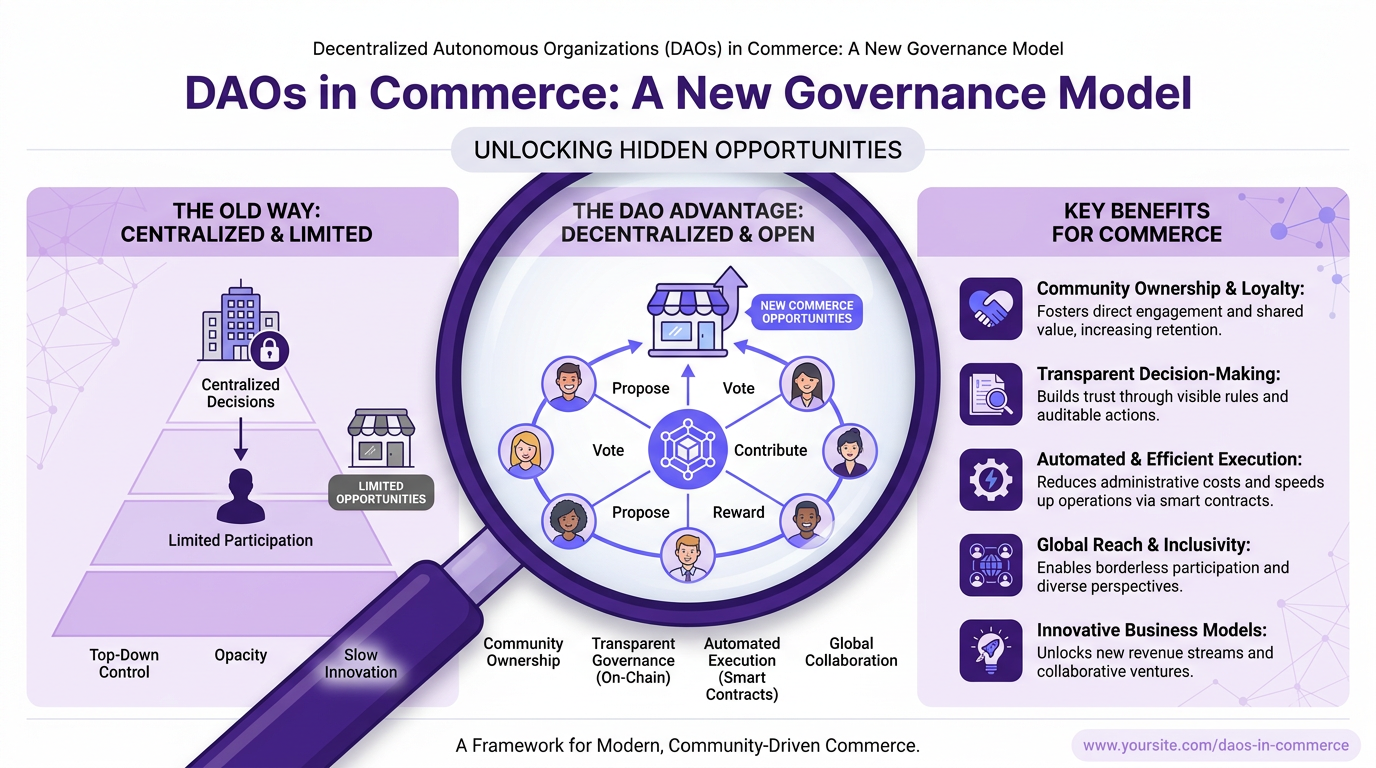
Decentralized Autonomous Organizations (DAOs) represent a revolutionary shift in how entities can be structured and governed, moving away from traditional hierarchical models towards a community-driven, transparent, and code-enforced framework. In the context of commerce, DAOs are not just a theoretical concept; they are actively reshaping how businesses operate, make decisions, and interact with their stakeholders. This innovative governance model is a critical component of the broader movement towards Decentralized Commerce, offering a path to truly democratic and censorship-resistant marketplaces and platforms. By embedding rules and decision-making processes directly into blockchain-based smart contracts, DAOs eliminate the need for central authorities, fostering a new era of collective ownership and participation.For any venture aiming to thrive in the decentralized future, understanding the mechanics and implications of DAOs is paramount. They offer a robust framework for managing everything from funding and product development to dispute resolution within a decentralized marketplace. This shift from corporate boards to token-holder voting empowers a global community, aligning incentives and driving collective value creation in ways previously unimaginable.
Key DAO Statistics in Commerce • The total value locked (TVL) in DAOs exceeded $10 billion in early 2023, indicating significant capital flow. • Over 3.5 million people are members of DAOs globally, with active participation growing rapidly. • 60% of new Web3 projects are exploring or implementing DAO governance structures. • DAOs can reduce operational overhead by up to 30% compared to traditional corporate structures due to automation.
The Evolution from Traditional Corporations to DAOs
Traditional corporations are characterized by centralized leadership, opaque decision-making processes, and a clear hierarchy. While effective for centuries, this model often leads to misaligned incentives between shareholders, employees, and customers. Decisions are made by a select few, and the broader community often has little to no say in the direction of the organization. This centralized control can also make them vulnerable to censorship, single points of failure, and corruption.DAOs emerge as a direct response to these limitations. They are internet-native organizations collectively owned and managed by their members. Decisions are made through proposals and voting, typically using governance tokens, and are automatically executed by smart contracts on a blockchain. This ensures transparency, immutability, and resistance to censorship, making them an ideal fit for the ethos of Decentralized Commerce.
Core Principles of DAO Governance
At the heart of DAO governance are several key principles:- Transparency: All proposals, votes, and treasury movements are recorded on a public blockchain, making them verifiable by anyone.
- Decentralization: No single entity has ultimate control. Power is distributed among token holders.
- Automation: Rules and agreements are enforced by smart contracts, reducing human error and bias.
- Community-Driven: Members actively participate in shaping the organization's future through voting and proposal submission.
- Censorship Resistance: Due to their distributed nature, DAOs are highly resistant to external interference or shutdown.
| Governance Model | Decision-Making | Transparency | Centralization | Efficiency | Adaptability |
|---|---|---|---|---|---|
| Traditional Corp. | Board of Directors | Low/Medium | High | Medium/High | Medium |
| DAO | Token Holder Voting | High | Low | Medium/High | High |
DAOs in Action: Reshaping Commercial Ventures
DAOs are finding diverse applications across the commercial spectrum, from managing investment funds to governing content platforms and even physical asset ownership. In Decentralized Commerce, DAOs can govern marketplaces, manage shared resources, or even collectively own and operate businesses. For example, a DAO could manage a decentralized e-commerce platform, where token holders vote on listing fees, dispute resolution mechanisms, or new feature development. This collective ownership fosters a strong sense of community and shared responsibility.5-Step Framework for Launching a Commercial DAO
The Impact on Stakeholder Engagement and Value Creation
One of the most significant advantages of DAOs in commerce is their ability to deeply engage stakeholders. Unlike traditional companies where employees are often disconnected from ownership and customers are merely consumers, DAOs turn everyone into a potential owner and decision-maker. Token holders, who can be customers, developers, or early adopters, have a direct financial and governance stake in the success of the platform or product. This alignment of incentives drives greater participation, innovation, and loyalty.Expert Insight: "The shift to DAO governance isn't just about decentralizing power; it's about decentralizing value creation. When every participant has a voice and a stake, the collective intelligence of the community can solve problems and innovate far faster than any centralized team. This is particularly potent for fostering truly resilient and user-centric Decentralized Commerce platforms."This model also allows for more transparent and equitable distribution of value. Revenue generated by a DAO-governed platform can be directed back to the community through token buybacks, grants for development, or direct distributions, fostering a virtuous cycle of growth and shared prosperity. This contrasts sharply with traditional models where profits primarily benefit a small group of shareholders.
Diagram: DAO Governance Flow [Community Member (Proposer)] → [Proposal Submission (Smart Contract)] → [Token Holders (Voting)] → [Quorum & Threshold Check] → [Smart Contract Execution (Automated Action)] → [Treasury/Platform Update]
Challenges and the Future of DAO Commerce
Despite their immense potential, DAOs face several challenges. Legal and regulatory uncertainty remains a significant hurdle, as existing laws are not designed for these novel organizational structures. Achieving true decentralization can be difficult, as initial token distribution or core developer influence can sometimes lead to de facto centralization. Scalability of decision-making, especially with large communities, and the risk of voter apathy are also concerns. Furthermore, ensuring robust security for smart contracts is paramount, as vulnerabilities can lead to catastrophic losses.However, ongoing innovation in legal frameworks, more sophisticated governance tooling, and the maturation of decentralized identity solutions are addressing these issues. The future of DAOs in commerce is likely to see them become the standard for many Web3 projects, particularly those focused on community ownership, open-source development, and transparent operations. As the world moves towards more open and permissionless systems, DAOs will be instrumental in building the next generation of Decentralized Commerce platforms, fostering a more equitable and efficient global economy.
Frequently Asked Questions
What is a Decentralized Autonomous Organization (DAO)?
A Decentralized Autonomous Organization (DAO) is an organization governed by rules encoded as transparent computer programs (smart contracts) on a blockchain, rather than by a central authority. Decisions are made collectively by its members through voting with governance tokens.How do DAOs differ from traditional companies in commerce?
DAOs differ by having decentralized governance, transparent operations recorded on a blockchain, and community-driven decision-making through token voting, contrasting with the hierarchical, centralized, and often opaque structures of traditional companies.What role do governance tokens play in a DAO?
Governance tokens grant holders the right to propose and vote on decisions affecting the DAO, such as treasury allocation, protocol upgrades, or new initiatives. The weight of a vote is typically proportional to the number of tokens held.What are the benefits of using DAOs in decentralized commerce?
Benefits include enhanced transparency, censorship resistance, community ownership and engagement, aligned incentives among stakeholders, and automated execution of decisions through smart contracts, leading to more efficient and equitable commerce platforms.What are the main challenges for DAOs in the commercial sector?
Key challenges include legal and regulatory uncertainty, achieving true decentralization, ensuring the scalability of decision-making, combating voter apathy, and securing smart contracts against potential vulnerabilities.Key Takeaways
- DAOs offer a revolutionary, transparent, and community-driven governance model for commercial ventures.
- They leverage blockchain and smart contracts to automate decision-making and eliminate central authorities, aligning with the principles of Decentralized Commerce.
- DAOs empower stakeholders with direct participation and ownership, fostering greater engagement and equitable value distribution.
- While facing challenges in regulation and scalability, DAOs are poised to become a dominant organizational structure in the Web3 economy.
- Their core principles of transparency, decentralization, and automation are critical for building resilient and user-centric decentralized platforms.