Decentralized Autonomous Organizations (DAOs) in E-commerce: A New Governance Model
The traditional e-commerce landscape, dominated by centralized platforms, often presents challenges related to opaque governance, high platform fees, and a lack of direct user influence.
Decentralized Autonomous Organizations (DAOs) offer a revolutionary alternative, introducing a new governance model for e-commerce that prioritizes transparency, community ownership, and automated decision-making. By leveraging blockchain technology, DAOs enable a collective of stakeholders – users, developers, and investors – to govern a platform or protocol through token-based voting, eliminating the need for a central authority. This paradigm shift is a core tenet of
Decentralized Commerce, promising a more equitable, efficient, and resilient digital marketplace where the community truly holds the reins.
Key DAO & E-commerce Statistics
• The total value locked (TVL) in DAOs across various sectors exceeded $10 billion in 2023, indicating significant capital commitment.
• 70% of crypto users believe DAOs will play a crucial role in the future of internet governance and digital economies.
• E-commerce platforms adopting decentralized governance models could see a 15-20% reduction in operational overhead due to automation.
• Community-governed platforms often report higher user engagement and loyalty, with up to 25% more active participants.
Understanding the DAO Structure in E-commerce
At its core, a DAO is an organization represented by rules encoded as a transparent computer program, controlled by the organization's members, and not influenced by a central government. In e-commerce, this translates to a marketplace or platform where decisions regarding fees, feature development, dispute resolution, and even marketing strategies are put to a vote among token holders. These tokens often represent ownership or voting power within the DAO, aligning the incentives of the community with the success of the platform.
From Centralized Control to Community Ownership
Traditional e-commerce giants operate with a top-down management structure, where decisions are made by a select few, often prioritizing shareholder profits over user interests. DAOs invert this model. Every token holder has a voice, and proposals are submitted, discussed, and voted upon by the community. This fosters a sense of collective ownership and ensures that the platform evolves in a way that benefits its users. This shift is fundamental to the ethos of
decentralized marketplaces.
| Governance Model | Decision-Making | Transparency | User Influence | Fee Structure |
|---|
| DAO (E-commerce) | Community Vote | High (on-chain) | Direct & Significant | Community-set, often lower |
| Centralized Platform | Executive Board | Low (internal) | Indirect & Limited | Fixed by platform |
| Cooperative Model | Member Vote | Medium (off-chain) | Direct & Moderate | Member-benefiting |
Benefits of DAOs in the E-commerce Ecosystem
The advantages of integrating DAOs into e-commerce are multifaceted, extending beyond just governance. They introduce a level of trust, efficiency, and innovation that centralized systems struggle to match. By removing intermediaries and automating processes through smart contracts, DAOs can significantly reduce operational costs and friction.
Enhanced Trust and Transparency
All rules, proposals, and voting results within a DAO are recorded on a public blockchain, making them fully transparent and auditable. This inherent transparency builds trust among participants, as there's no hidden agenda or opaque decision-making. Users can verify every action taken by the DAO, fostering a more honest and fair trading environment. This transparency is also crucial for
blockchain-powered supply chains, ensuring product authenticity.
6-Step DAO E-commerce Launch Framework
Define Core Purpose & Vision — Clearly articulate the problem your DAO-governed e-commerce platform solves and its unique value proposition. What kind of products or services will it offer? What makes it different from existing solutions?
Design Tokenomics & Governance Structure — Determine the utility of your governance token (e.g., voting rights, staking rewards, fee discounts). Establish voting mechanisms (e.g., quadratic voting, delegated voting) and quorum requirements for proposals.
Develop Smart Contracts & Platform Infrastructure — Build the underlying blockchain infrastructure, including smart contracts for governance, marketplace functionalities (listing, payments), and dispute resolution. Prioritize security audits.
Bootstrap Community & Initial Funding — Attract early adopters and contributors through community building efforts, potentially an initial token offering (IDO) or grants. Distribute governance tokens to align incentives.
Launch Minimum Viable Product (MVP) — Release a functional version of the platform with core features. Allow the community to propose and vote on initial parameters, such as transaction fees or listing policies.
Iterate & Decentralize Progressively — Continuously engage the community for feedback. Gradually transfer more control to the DAO as it matures, moving towards full decentralization. Encourage active participation in governance proposals.
Challenges and Considerations for DAO E-commerce
While promising, the implementation of DAOs in e-commerce is not without its challenges. The nascent nature of the technology means there are still hurdles to overcome, particularly around legal clarity, scalability, and user experience. The very decentralization that makes DAOs powerful can also introduce complexities.
Expert Insight: "The biggest hurdle for DAOs in e-commerce isn't technical; it's cultural. Shifting from passive consumers to active governors requires education, robust community tools, and well-designed tokenomics that truly incentivize participation. Without engaged members, a DAO is just a smart contract, not a living, breathing marketplace for Decentralized Commerce."
Legal and Regulatory Ambiguity
The legal status of DAOs remains largely undefined in many jurisdictions. This ambiguity can create challenges regarding liability, consumer protection, and regulatory compliance. As DAOs gain traction, clearer legal frameworks will be necessary to ensure their sustainable growth and integration into the broader economy.
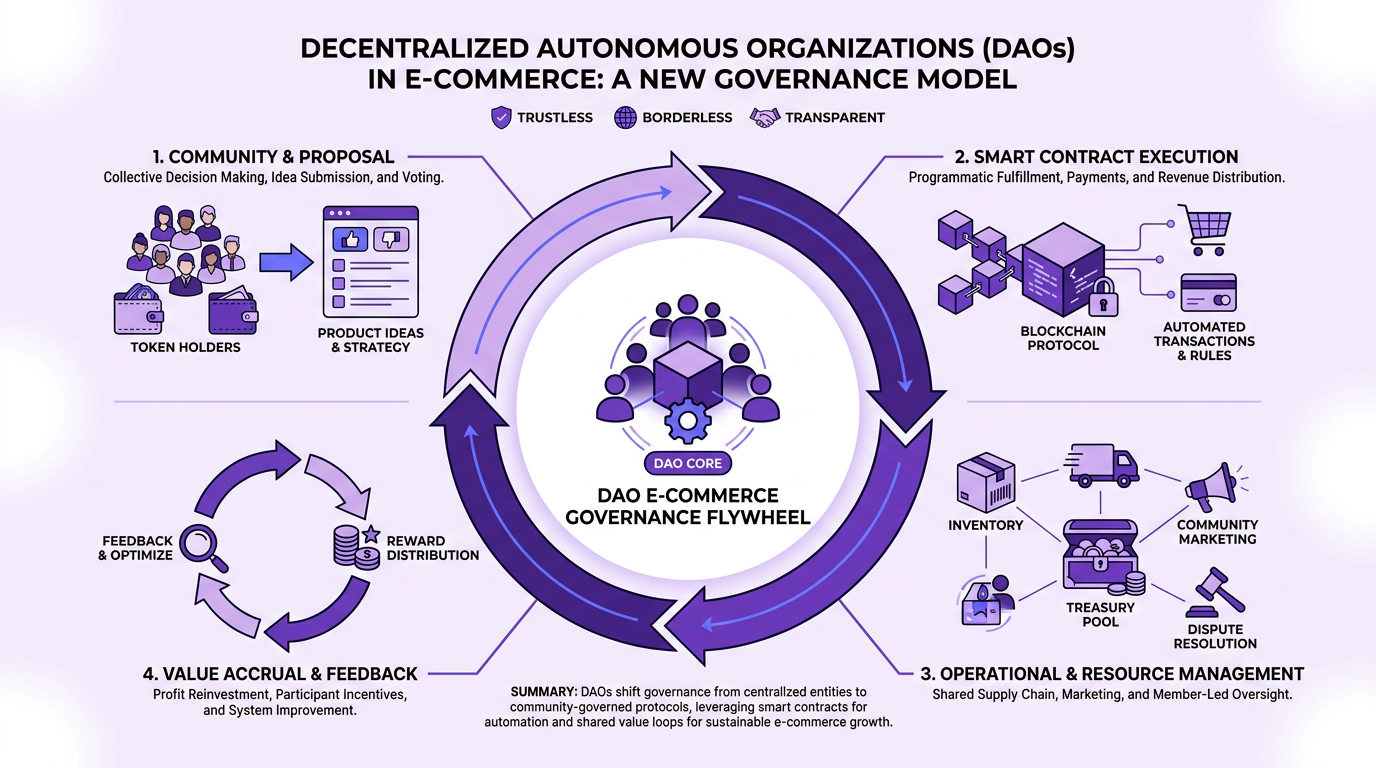
Diagram: DAO E-commerce Governance Cycle
[Community Proposes Idea] → [Token Holders Discuss & Refine] → [Formal Proposal Submitted] → [On-chain Voting Period] → [Smart Contract Executes Outcome] → [Platform Updates/Changes Implemented] → [Feedback Loop to Community]
User Experience and Scalability
Blockchain interactions can be complex for the average user, posing a barrier to entry. Designing intuitive interfaces and simplifying the governance process are crucial for mass adoption. Furthermore, current blockchain networks can face scalability issues, impacting transaction speeds and costs, which are critical factors for a smooth e-commerce experience. Solutions like layer-2 scaling and sharding are being developed to address these limitations.
The Future of E-commerce Governance
DAOs represent a significant evolution in how digital platforms can be governed. As the technology matures and user interfaces become more streamlined, we can expect to see a proliferation of DAO-governed e-commerce platforms. These platforms will likely foster niche communities, offer specialized products, and provide a more equitable distribution of value among participants. The success of DAOs in e-commerce will depend on their ability to balance decentralization with efficiency, ensuring robust security, and cultivating active, engaged communities. This innovative governance model is poised to be a driving force in the expansion of
Decentralized Commerce, creating a more democratic and user-centric online shopping experience.
Frequently Asked Questions
What is a Decentralized Autonomous Organization (DAO) in e-commerce?
A DAO in e-commerce is a marketplace or platform governed by a community of token holders through transparent, on-chain voting, rather than a central authority. Decisions on fees, features, and operations are made collectively by its members.
How do DAOs enhance trust in e-commerce?
DAOs enhance trust by making all governance rules, proposals, and voting results public and immutable on a blockchain. This transparency ensures that all actions are auditable and prevents hidden agendas, fostering a fair and honest trading environment.
What are the main benefits of a DAO-governed e-commerce platform?
Benefits include community ownership, enhanced transparency, reduced operational costs through automation, direct user influence over platform development, and a more equitable distribution of value among participants.
What challenges do DAOs face in the e-commerce sector?
Challenges include legal and regulatory ambiguity, the complexity of user experience for non-technical users, and scalability limitations of underlying blockchain networks. Overcoming these requires robust development and clear legal frameworks.
Key Takeaways
- DAOs offer a revolutionary governance model for e-commerce, shifting control from centralized entities to a community of token holders.
- Key benefits include enhanced transparency, increased trust, reduced operational costs, and direct user influence over platform evolution.
- Smart contracts automate decision-making and execution, making processes more efficient and reducing the need for intermediaries.
- Challenges such as legal ambiguity, user experience complexity, and scalability need to be addressed for widespread adoption.
- DAOs are a cornerstone of the Decentralized Commerce movement, promising a more democratic and user-centric future for online marketplaces.