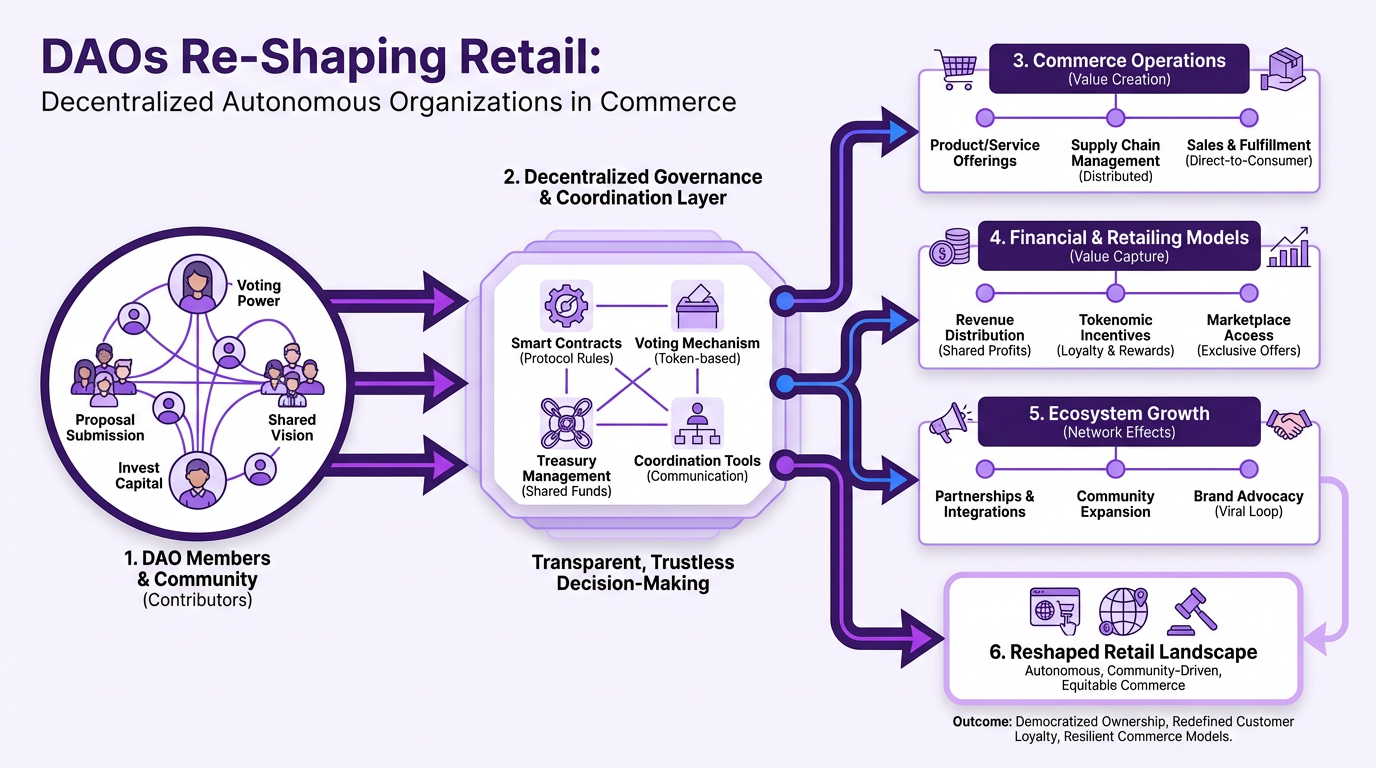
DAOs in Commerce: Decentralized Autonomous Organizations Reshaping Retail
DAOs in Commerce: Decentralized Autonomous Organizations Reshaping Retail
Decentralized Autonomous Organizations (DAOs) are emerging as a transformative force in commerce, offering a new paradigm for collective ownership, governance, and operation of businesses. By leveraging blockchain technology and smart contracts, DAOs enable communities to make decisions and manage resources transparently and autonomously, without the need for traditional hierarchical structures. This innovative approach is fundamentally reshaping how businesses are built, funded, and operated, making them a crucial element within the broader landscape of Decentralized Commerce Platforms.In commerce, DAOs can govern everything from product development and supply chains to marketing strategies and treasury management. They empower stakeholders – often token holders – to directly participate in the direction of the organization, fostering a sense of shared ownership and alignment of incentives. This article explores the mechanics, benefits, and strategic implications of integrating DAOs into the commercial sphere.
Key DAO in Commerce Statistics • The total treasury value managed by DAOs collectively exceeded $10 billion in 2022, demonstrating significant financial power. • Over 1.6 million unique addresses hold DAO governance tokens, indicating a growing base of participants. • A recent survey found that 45% of Web3 projects are exploring or implementing DAO governance models. • DAOs have shown the potential to reduce operational overhead by up to 20% by automating governance processes.
The Core Principles of DAOs in a Commercial Context
DAOs operate on a set of core principles that make them uniquely suited for decentralized commerce. Transparency is paramount, as all proposals, votes, and treasury movements are recorded on a public blockchain. This eliminates opacity and builds trust among participants. Automation, facilitated by smart contracts, ensures that decisions are executed without human intervention, reducing bias and increasing efficiency.Governance by Token Holders
The most distinctive feature of DAOs is their governance model. Unlike traditional companies where shareholders or a board of directors make decisions, in a DAO, governance is distributed among token holders. These tokens often grant voting rights, allowing members to propose changes, vote on initiatives, and allocate funds from the DAO's treasury. This direct democracy model aligns perfectly with the ethos of community-governed commerce platforms.| Aspect | DAO in Commerce | Traditional Company |
|---|---|---|
| Governance | Token holder voting | Board of Directors/Shareholders |
| Decision Making | Transparent, on-chain proposals | Centralized, often opaque |
| Structure | Flat, decentralized | Hierarchical, centralized |
| Funding | Token sales, treasury | Equity, debt, revenue |
| Trust Model | Trustless (code) | Trust-based (management) |
Strategic Applications of DAOs in Commerce
DAOs can be applied across various facets of commerce, creating innovative business models and enhancing existing ones. From managing NFT marketplace platforms to governing supply chains, the potential is vast. They can empower creators, streamline logistics, and even facilitate collective purchasing power.5-Step Framework for Launching a Commerce DAO
Challenges and the Future of DAOs in Commerce
While DAOs offer significant advantages, they also present challenges. Achieving consensus among a large, diverse group of token holders can be slow. Legal and regulatory frameworks for DAOs are still evolving, creating uncertainty. Furthermore, ensuring active and informed participation from all members is crucial for effective governance.Expert Insight: "The biggest hurdle for DAOs in commerce isn't technical, it's human coordination. While smart contracts automate execution, the initial design of governance parameters and the ongoing engagement of token holders require careful community building and incentive alignment. A DAO is only as strong as its active participants, not just its code."Despite these challenges, the trajectory for DAOs in commerce is one of rapid innovation. They are particularly well-suited for fostering sustainable Dcommerce models by enabling community-driven decisions that prioritize long-term ecological and social impact over short-term profits. Moreover, they can empower creator economy Dcommerce tools by giving creators direct ownership and governance over the platforms they use.
Diagram: DAO Commerce Decision Flow Community Member (Proposal) → Token Holders (Vote) → Smart Contract (Execution) → Treasury Allocation / Product Development / Marketing Campaign → Impact on Commerce Platform → Feedback Loop to Community Member
Frequently Asked Questions
What is a Decentralized Autonomous Organization (DAO) in commerce?
A DAO in commerce is an organization governed by code and community, not a central authority. It uses blockchain-based smart contracts to automate decision-making and treasury management, allowing token holders to vote on proposals related to the commerce platform's operations, development, and strategy.How do DAOs benefit commerce platforms?
DAOs bring transparency, efficiency, and community ownership to commerce platforms. They reduce reliance on intermediaries, lower operational costs through automation, and align incentives among users, fostering a more engaged and resilient ecosystem where decisions are made by the collective.What kind of decisions can a commerce DAO make?
A commerce DAO can make a wide range of decisions, including setting platform fees, approving new features, managing treasury funds, resolving disputes, forming partnerships, and even determining the platform's overall strategic direction. Any decision that can be codified into a smart contract can be governed by a DAO.Are DAOs legally recognized entities?
The legal status of DAOs is still evolving and varies by jurisdiction. Some regions are beginning to establish legal frameworks for DAOs, recognizing them as legitimate organizational structures. This is a critical area of development for the widespread adoption of DAOs in traditional commerce.What are the risks associated with DAOs in commerce?
Risks include potential vulnerabilities in smart contract code, challenges in achieving consensus among a large and diverse group of token holders, low voter participation, and regulatory uncertainty. Effective governance design and robust security audits are essential to mitigate these risks.Key Takeaways
- DAOs are revolutionizing commerce by enabling transparent, community-governed, and autonomously operated businesses on the blockchain.
- Their core principles include transparency, automation via smart contracts, and governance by token holders, fostering shared ownership and aligned incentives.
- DAOs can be strategically applied to various commercial aspects, from marketplace governance to supply chain management, creating innovative business models.
- Launching a commerce DAO involves defining a clear mission, designing robust tokenomics, developing secure smart contracts, building community, and progressively decentralizing.
- While facing challenges like consensus building and regulatory clarity, DAOs are poised to drive sustainable and creator-centric Dcommerce models, reshaping the future of retail.
Access Exclusive Dcommerce Brands and Digital Specialized Products
From Solana Deads to Blockchain Bobbles, discover the products defining the decentralized era.