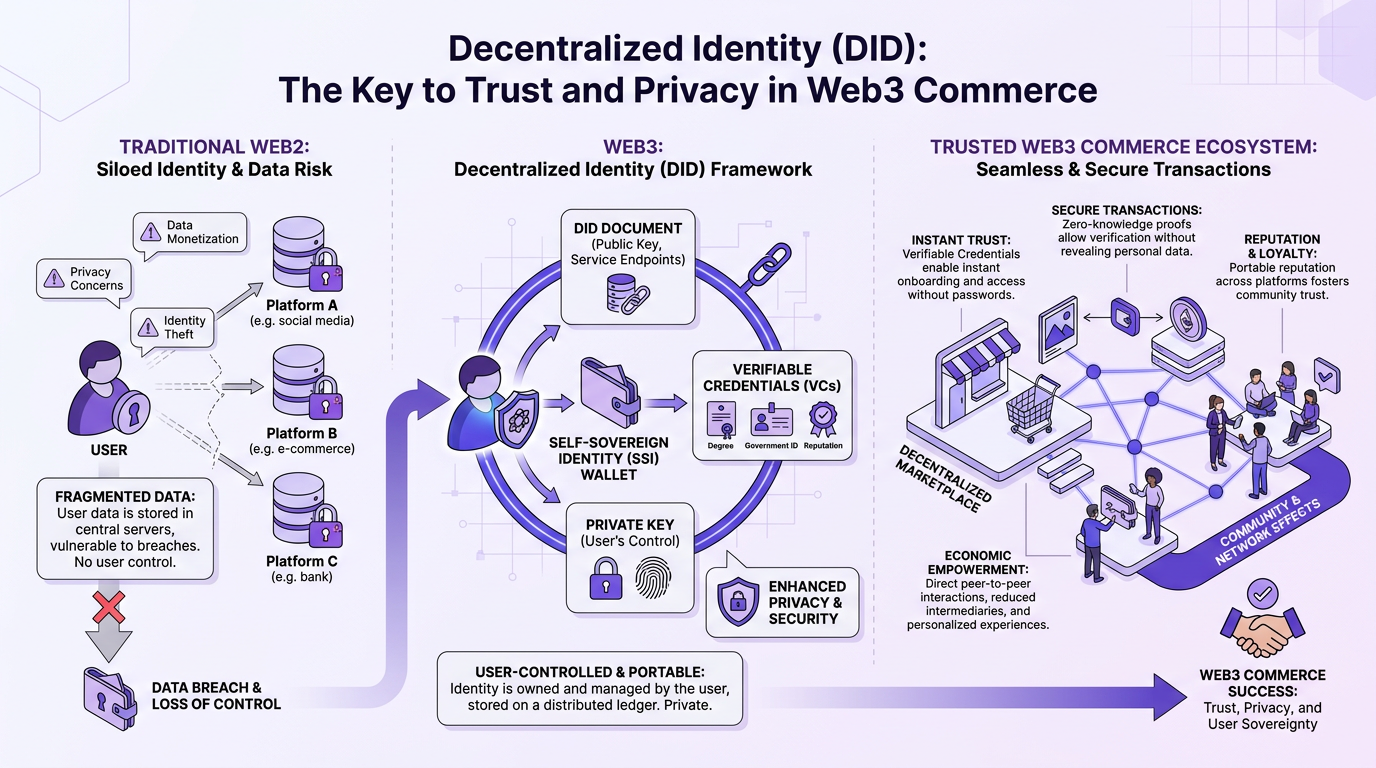
Decentralized Identity: The Key to Trust and Privacy in Web3 Commerce
Decentralized Identity: The Key to Trust and Privacy in Web3 Commerce
In the rapidly evolving landscape of Web3, the concept of identity is undergoing a profound transformation. Traditional online commerce relies heavily on centralized identity providers, where personal data is stored and managed by corporations, creating vulnerabilities and privacy concerns. Decentralized Commerce, however, demands a new paradigm: decentralized identity (DID). This innovative approach empowers individuals with sovereign control over their digital identities, enabling secure, private, and verifiable interactions without reliance on intermediaries. By shifting ownership of identity from institutions to individuals, DIDs are poised to unlock unprecedented levels of trust and privacy, fundamentally reshaping how we conduct transactions and establish credibility in the digital realm.Decentralized identity is not just a technical upgrade; it's a philosophical shift that aligns perfectly with the core tenets of decentralization – empowering users and minimizing reliance on centralized authorities. For any decentralized marketplace to truly flourish, participants need robust, self-sovereign ways to prove who they are, what they own, and what they're authorized to do, all while maintaining their privacy. This is where DIDs become indispensable, offering a foundational layer of trust for all Web3 interactions.
Key Decentralized Identity Statistics • 85% of consumers are concerned about their online privacy and data security. • The decentralized identity market is projected to grow from $1.2 billion in 2022 to $12.5 billion by 2027. • Over 60% of data breaches involve compromised credentials, highlighting the vulnerability of centralized identity systems. • Self-sovereign identity solutions can reduce identity fraud costs by up to 70%.
The Flaws of Centralized Identity Systems
For decades, our digital lives have been governed by centralized identity models. Whether it's logging into social media, online banking, or e-commerce platforms, we typically surrender our personal data to a third party. This model creates several critical vulnerabilities: single points of failure, data breaches, and a lack of user control over personal information. When a centralized database is compromised, millions of identities can be exposed, leading to financial fraud, identity theft, and a pervasive erosion of trust.Furthermore, these systems often lead to a fragmented digital identity, where users have dozens of different accounts, each with varying levels of personal information and security protocols. This complexity makes managing privacy a nightmare and often forces users to overshare data simply to access services. The need for a more secure, user-centric approach is paramount for the future of online interactions, especially as Decentralized Commerce gains traction.
How Decentralized Identity Works
Decentralized identity leverages blockchain technology to create unique, globally resolvable identifiers (DIDs) that are controlled by the individual, not an organization. These DIDs are stored on a decentralized ledger, making them tamper-proof and highly available. Users then collect verifiable credentials (VCs) – digital proofs of attributes (e.g., age, professional certifications, ownership of assets) issued by trusted entities. These VCs are cryptographically signed and can be selectively presented to verifiers without revealing unnecessary personal data.| Feature | Centralized Identity | Decentralized Identity (DID) |
|---|---|---|
| Control | Third-party (company, government) | Individual (self-sovereign) |
| Data Storage | Centralized databases | Distributed ledger, user's wallet |
| Privacy | Limited, data often overshared | Granular, selective disclosure |
| Security | Single point of failure, data breaches | Cryptographically secure, tamper-proof |
| Trust Model | Relies on intermediaries | Cryptographic proof, peer-to-peer |
Enhancing Trust and Privacy in Decentralized Commerce
For Decentralized Commerce to achieve mass adoption, participants need to trust each other and the platforms they use. Decentralized identity provides this crucial layer of trust without requiring a central authority. Buyers can prove their eligibility for certain purchases (e.g., age-restricted goods) without revealing their exact birthdate. Sellers can establish their reputation and verify product authenticity using DIDs and VCs, fostering a more secure and transparent trading environment. This is particularly relevant for blockchain-powered supply chains, where verifying the origin and authenticity of goods is paramount.4-Step Decentralized Identity Verification Framework
The Role of DIDs in Reputation and Governance
Beyond simple verification, decentralized identity plays a pivotal role in building reputation systems within Web3. In a decentralized environment, a user's DID can accumulate a history of verifiable interactions, transactions, and contributions. This allows for the creation of reputation scores that are owned and controlled by the individual, rather than being dictated by a platform. For instance, a seller in a decentralized marketplace could use their DID to prove a history of successful transactions and positive reviews, enhancing buyer confidence.Expert Insight: "The true power of decentralized identity isn't just about privacy; it's about enabling a new form of digital citizenship. When your reputation, credentials, and even your voting power in a DAO are tied to an identity you fully control, it fundamentally shifts the balance of power from platforms to people. This is the bedrock for truly equitable and functional decentralized autonomous organizations (DAOs)."Furthermore, DIDs are crucial for decentralized governance, particularly within Decentralized Autonomous Organizations (DAOs). By linking voting rights or participation privileges to a verified DID, DAOs can ensure that only legitimate, qualified members contribute to decision-making, preventing Sybil attacks and fostering more robust governance models. This integration of identity and governance is essential for the long-term viability and fairness of decentralized ecosystems.
Diagram: Decentralized Identity Ecosystem [User (DID Holder)] ←→ [Issuer (Issues VCs)] [User (DID Holder)] ←→ [Verifier (Requests VCs)] [User (DID Holder)] ←→ [Decentralized Ledger (DID Registry)] [Verifier] ←→ [Decentralized Ledger (VC Revocation/Status)]
Challenges and the Path Forward
While the promise of decentralized identity is immense, several challenges need to be addressed for widespread adoption. User experience remains a significant hurdle; managing private keys and understanding cryptographic concepts can be daunting for the average user. Interoperability standards between different DID methods and blockchain networks are also crucial for a seamless ecosystem. Additionally, regulatory clarity around self-sovereign identity and verifiable credentials is still evolving.However, ongoing development in user-friendly wallet interfaces, standardized protocols (like the W3C DID specification), and increasing awareness of privacy concerns are paving the way for DIDs to become a mainstream component of Web3. As the infrastructure for Decentralized Commerce matures, decentralized identity will be recognized not just as an optional feature, but as a fundamental requirement for building a truly secure, private, and user-centric digital economy.
Frequently Asked Questions
What is decentralized identity (DID)?
Decentralized identity (DID) is a self-sovereign identity system where individuals have complete control over their digital identities, using blockchain technology to create unique identifiers and manage verifiable credentials without relying on centralized authorities.How does DID enhance privacy in online transactions?
DID enhances privacy by allowing users to selectively disclose only the necessary information (via verifiable credentials) to prove an attribute, rather than sharing their entire personal data profile. This minimizes data exposure and reduces the risk of privacy breaches.What are verifiable credentials (VCs) in the context of DIDs?
Verifiable credentials (VCs) are cryptographically signed digital proofs of attributes (e.g., age, education, ownership) issued by trusted entities. They are stored in a user's digital wallet and can be presented to verifiers to prove specific claims without revealing underlying personal data.How do DIDs contribute to trust in decentralized commerce?
DIDs contribute to trust by providing a secure, tamper-proof, and user-controlled method for identity verification and reputation building. This allows buyers and sellers in decentralized marketplaces to establish credibility and verify information without needing a central intermediary.What are the main challenges for decentralized identity adoption?
Key challenges include improving user experience for managing DIDs and private keys, establishing broad interoperability standards across different DID methods, and navigating the evolving regulatory landscape surrounding self-sovereign identity.Key Takeaways
- Decentralized Identity (DID) empowers individuals with sovereign control over their digital identities, moving away from centralized systems.
- DIDs leverage blockchain to create unique, tamper-proof identifiers and enable selective disclosure of verifiable credentials (VCs).
- This technology is crucial for building trust, ensuring privacy, and combating fraud in the emerging landscape of Decentralized Commerce.
- DIDs are foundational for robust reputation systems and effective governance within decentralized autonomous organizations (DAOs).
- While challenges exist in user experience and interoperability, DIDs are essential for a secure and user-centric Web3 economy.