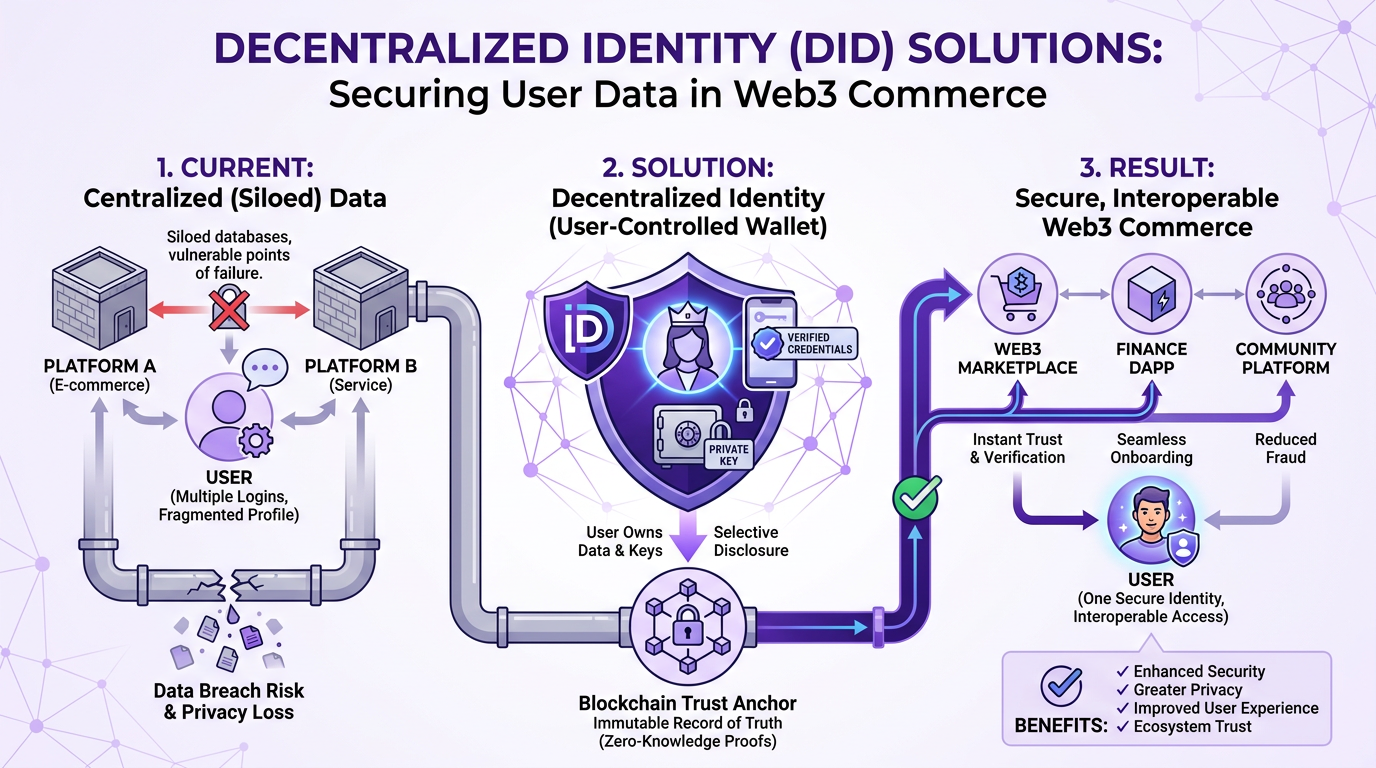
Decentralized Identity Solutions: Securing User Data in Web3 Commerce
Decentralized Identity Solutions: Securing User Data in Web3 Commerce
In the current digital landscape, our online identities are fragmented, controlled by various centralized entities, and vulnerable to breaches. This model poses significant risks to user privacy and security, especially as we move towards a more interconnected and data-driven world. Decentralized Commerce, with its emphasis on user autonomy and trustless interactions, necessitates a radical rethinking of identity management. This is where Decentralized Identity Solutions (DIDs) emerge as a critical component, offering a paradigm shift from centralized control to individual ownership of personal data.By leveraging blockchain technology and cryptographic proofs, DIDs empower users to manage their own digital identities, granting them selective control over what information they share, with whom, and for how long. This not only enhances privacy and security but also streamlines verification processes, reduces fraud, and fosters a more equitable and efficient online experience, which is foundational for the growth of any robust decentralized ecosystem.
Key Decentralized Identity Statistics • Over 80% of data breaches involve compromised credentials, highlighting the vulnerability of centralized identity systems. • The global decentralized identity market is projected to reach $15 billion by 2027, growing at a CAGR of over 70%. • A 2023 survey found that 68% of internet users are concerned about how companies use their personal data. • Implementing DIDs can reduce the average cost of a data breach by up to 20% by minimizing the attack surface.
The Flaws of Centralized Identity and the Rise of DIDs
Traditional identity systems, often referred to as Web2 identity, rely on central authorities like social media platforms, email providers, or government databases to store and verify user data. While convenient, this model creates honeypots of sensitive information, making them prime targets for cyberattacks. When these central databases are breached, millions of user identities can be compromised, leading to identity theft, financial fraud, and a significant erosion of trust.Decentralized Identity Solutions, in contrast, shift the control of identity back to the individual. Instead of a single entity holding all your data, DIDs allow users to create self-sovereign identities (SSIs) that are stored on a blockchain or other distributed ledger. Users then selectively present verifiable credentials (digital proofs of attributes like age, address, or qualifications) to service providers without revealing unnecessary personal information. This 'zero-knowledge proof' approach is a game-changer for privacy in decentralized applications.
How Decentralized Identity Works
At its core, a Decentralized Identity system involves:- Decentralized Identifiers (DIDs): Unique, globally resolvable identifiers that are owned and controlled by the individual, not by any central authority.
- Verifiable Credentials (VCs): Digital proofs of claims (e.g., "I am over 18," "I have a degree in X") issued by trusted entities (issuers) and cryptographically signed. Users store these VCs in their digital wallets.
- DID Resolvers: Mechanisms for looking up DID documents, which contain public keys and service endpoints associated with a DID.
- DID Wallets: Applications that allow users to store, manage, and present their DIDs and VCs.
| Identity System | Control | Data Storage | Privacy | Security | Verification Process |
|---|---|---|---|---|---|
| Centralized (Web2) | Service provider | Centralized databases | Low (all data shared) | Vulnerable to breaches | Relies on third-party trust |
| Decentralized (Web3) | User (self-sovereign) | Distributed ledger/User wallet | High (selective disclosure) | Enhanced, cryptographic | Cryptographic proof, user consent |
Enhancing Security and Privacy in Web3 Commerce
For Decentralized Commerce to truly flourish, robust security and privacy are non-negotiable. DIDs provide a powerful framework for achieving both. By minimizing the amount of personal data shared with merchants, the attack surface for data breaches is significantly reduced. Users no longer need to create new accounts and passwords for every platform, reducing password fatigue and the risk of credential stuffing attacks.Furthermore, the use of cryptographic signatures ensures the authenticity and integrity of verifiable credentials. When a user presents a VC, the relying party can cryptographically verify that it was issued by a trusted entity and has not been tampered with. This eliminates the need for intermediaries to verify identity, streamlining transactions and reducing associated costs and delays.
4-Step Decentralized Identity Integration Framework for Merchants
The Role of DIDs in Building Trustless Ecosystems
One of the core tenets of Web3 and Decentralized Commerce is the concept of "trustlessness" – the ability to interact and transact without needing to trust a central authority. Decentralized Identity Solutions are instrumental in achieving this by providing a verifiable and secure way for individuals to prove who they are or what attributes they possess, without revealing their entire identity.Expert Insight: "The shift to decentralized identity isn't just a technical upgrade; it's a philosophical one. It reclaims digital sovereignty for the individual. For decentralized commerce, this means moving beyond anonymous transactions to authenticated, yet private, interactions, fostering a new layer of trust that's built on cryptography, not corporate promises. This will unlock innovative business models that prioritize user privacy and data ownership above all else."This capability is crucial for various aspects of decentralized commerce, from secure payment processing and compliance with Know Your Customer (KYC) regulations to building reputation systems and facilitating secure access to decentralized autonomous organizations. By enabling verifiable, yet private, interactions, DIDs pave the way for a more secure, efficient, and user-centric digital economy.
Diagram: Decentralized Identity Flow for Commerce [User Creates DID & Wallet] → [Trusted Issuer Issues Verifiable Credential (e.g., Age Proof)] → [User Stores VC in Wallet] → [User Interacts with Decentralized Merchant] → [Merchant Requests Specific VC (e.g., Age Proof)] → [User Presents VC (Zero-Knowledge Proof)] → [Merchant Verifies VC Cryptographically] → [Transaction Approved]
Challenges and Future Outlook for Decentralized Identity
While the promise of Decentralized Identity Solutions is immense, challenges remain. These include achieving widespread adoption, ensuring interoperability across different DID systems, and navigating complex regulatory landscapes. User experience also needs to be streamlined to make DIDs accessible to a broader audience.However, ongoing developments in standards (like W3C DIDs and Verifiable Credentials) and the increasing focus on privacy in the digital realm suggest a bright future for DIDs. As Web3 technologies mature and the demand for self-sovereign identity grows, DIDs will become an indispensable part of the infrastructure underpinning secure and private decentralized commerce, empowering individuals and fostering a more trustworthy digital economy.
Frequently Asked Questions
What is a Decentralized Identifier (DID)?
A Decentralized Identifier (DID) is a unique, globally resolvable identifier that is owned and controlled by an individual, not by a central authority. It allows users to manage their own digital identity and selectively share information.How do Verifiable Credentials (VCs) enhance privacy?
Verifiable Credentials (VCs) enhance privacy by allowing users to prove specific attributes (e.g., age, qualification) without revealing their entire identity. This 'zero-knowledge proof' approach minimizes the amount of personal data shared with service providers.Why are Decentralized Identity Solutions important for Decentralized Commerce?
Decentralized Identity Solutions are crucial for Decentralized Commerce because they provide enhanced security, privacy, and trust. They empower users with self-sovereign control over their data, reduce fraud, streamline verification, and enable trustless interactions without relying on central intermediaries.Key Takeaways
- Decentralized Identity Solutions (DIDs) empower users with self-sovereign control over their digital identities, moving away from vulnerable centralized systems.
- DIDs leverage blockchain and cryptography to provide enhanced privacy, security, and verifiable authenticity for online interactions.
- Verifiable Credentials (VCs) allow users to selectively disclose specific attributes without revealing their full identity, crucial for privacy in Decentralized Commerce.
- The integration of DIDs streamlines verification processes, reduces fraud, and builds trust in trustless Web3 ecosystems.
- While challenges remain, DIDs are a foundational technology for the future of secure and user-centric decentralized commerce.