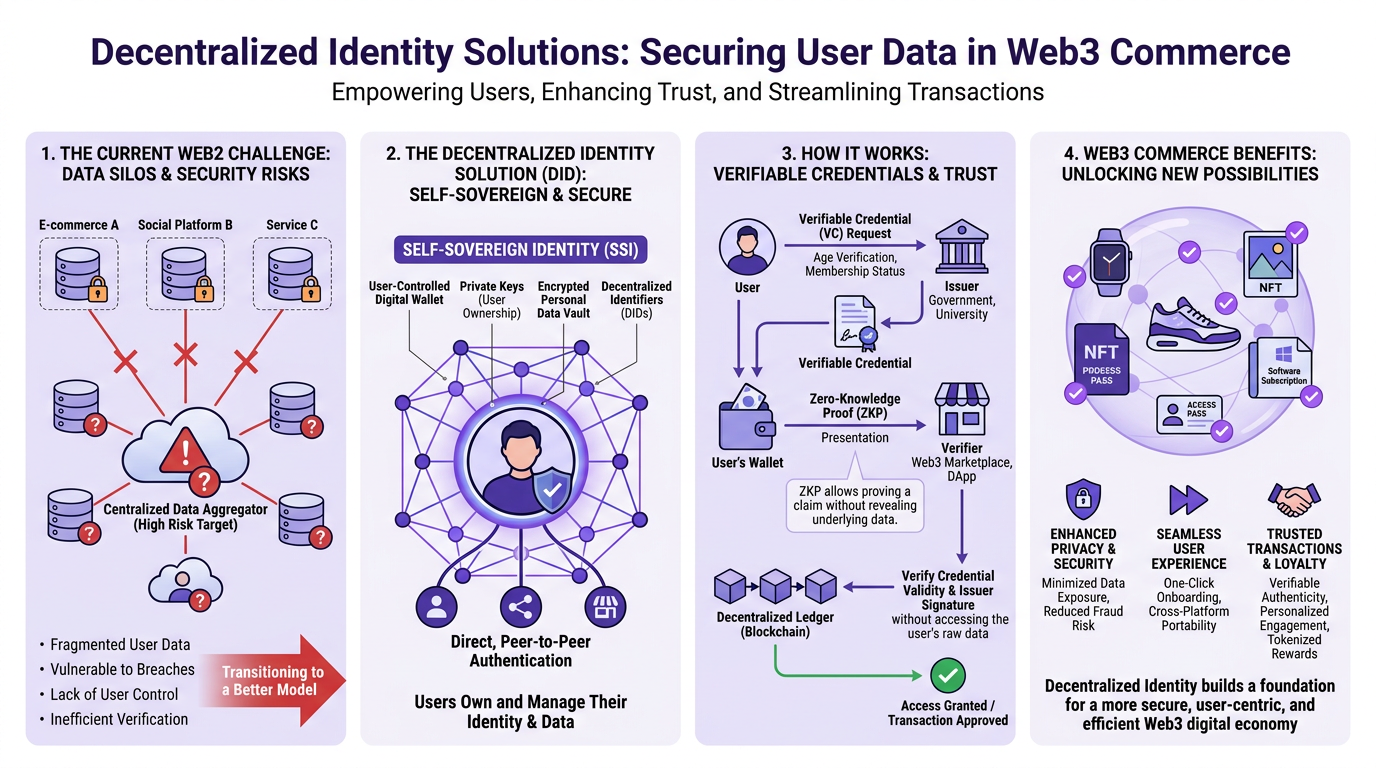
Decentralized Identity Solutions: Securing User Data in Web3 Commerce
Decentralized Identity Solutions: Securing User Data in Web3 Commerce
In the evolving landscape of Web3 and Decentralized Commerce, the concept of identity is undergoing a radical transformation. Traditional online commerce relies on centralized identity providers, where user data is stored and managed by a single entity, making it vulnerable to breaches and misuse. Decentralized Identity (DID) solutions offer a paradigm shift, empowering individuals with sovereign control over their digital identities. This move is crucial for fostering trust and privacy in a decentralized ecosystem, allowing users to selectively disclose information without relying on intermediaries, thereby enhancing security and user experience in a truly decentralized fashion.Key Decentralized Identity Statistics • The global decentralized identity market is projected to reach over $10 billion by 2028, growing at a CAGR of 70%. • 85% of consumers are concerned about their data privacy online, highlighting the need for DID solutions. • Data breaches cost companies an average of $4.35 million per incident in 2022, underscoring the financial incentive for better security. • Over 60% of Web3 projects are exploring or implementing some form of decentralized identity for user authentication and verification.
The Flaws of Centralized Identity and the Rise of DIDs
Centralized identity systems, prevalent across Web2, operate on a model where platforms like Google, Facebook, or traditional e-commerce sites hold vast amounts of user data. This creates honeypots for hackers and gives these entities immense power over user information. Users often have little control over how their data is used, shared, or monetized. This model is fundamentally incompatible with the ethos of decentralization, which champions user autonomy and privacy.Decentralized Identity addresses these issues by giving individuals ownership of their digital identifiers and the data associated with them. Instead of a company issuing and controlling your identity, you, the user, create and manage it on a blockchain or distributed ledger. This identity is cryptographically secured and verifiable, allowing you to prove aspects of your identity (e.g., age, residency, qualifications) without revealing unnecessary personal details.
Verifiable Credentials and Self-Sovereign Identity
At the core of DID are Verifiable Credentials (VCs) and the principle of Self-Sovereign Identity (SSI). VCs are digital attestations issued by trusted entities (e.g., a university issuing a degree, a government issuing a driver's license) that are cryptographically signed and stored on a user's digital wallet. The user then presents these VCs to verifiers (e.g., an online store, a lending platform) who can cryptographically confirm their authenticity without needing to contact the issuer directly or access a centralized database. This empowers users to control which credentials they share and with whom, embodying true data sovereignty.| Identity System | Control | Data Storage | Security Risk | Privacy Level |
|---|---|---|---|---|
| Centralized | Platform | Centralized DB | High (honeypot) | Low |
| Federated | Partial (via IdP) | Distributed (IdP) | Medium | Medium |
| Decentralized | User | User's Wallet | Low (no honeypot) | High |
How Decentralized Identity Works in Practice
Implementing Decentralized Identity typically involves several key components: a decentralized identifier (DID), a DID method, a DID document, and verifiable credentials. The DID is a unique identifier that is globally resolvable and cryptographically verifiable. The DID method specifies how DIDs are created, resolved, and updated on a specific blockchain or distributed ledger. The DID document contains public keys and service endpoints associated with the DID, enabling secure communication and verification.When a user interacts with a decentralized marketplace, instead of creating a new account with a username and password, they can present a verifiable credential from their digital wallet. For example, to prove they are over 18 for an age-restricted purchase, they can present a VC issued by a government authority, without revealing their exact birthdate or other personal details. The marketplace's smart contract can then verify the VC's authenticity and the age claim, granting access or completing the transaction.
4-Step Decentralized Identity Integration Framework
Benefits for Decentralized Commerce
Decentralized Identity is a cornerstone for the success of Decentralized Commerce. It addresses critical issues of trust, privacy, and security that often hinder mainstream adoption of Web3 applications. By empowering users with control over their data, DIDs reduce the risk of identity theft and data breaches, fostering a more secure online environment. This increased security, combined with enhanced privacy, builds greater confidence among consumers to engage in decentralized transactions.Expert Insight: "The shift to decentralized identity isn't just about privacy; it's about re-architecting the internet's trust layer. For decentralized commerce, this means moving beyond anonymous transactions to verifiable interactions where reputation can be built and proven without revealing sensitive personal data. It's the key to unlocking mainstream adoption by balancing privacy with accountability, a challenge traditional systems have consistently failed to meet."Furthermore, DIDs can streamline various processes. KYC (Know Your Customer) and AML (Anti-Money Laundering) compliance, often a cumbersome and intrusive process, can be simplified. Users can present a single, verified credential proving their identity without repeatedly submitting documents to different platforms. This not only improves user experience but also reduces operational costs for businesses.
Diagram: Decentralized Identity Flow in Commerce User (DID Holder) → Issuer (Issues VC) → User's Digital Wallet (Stores VC) → Verifier (Requests VC) → User (Presents VC) → Verifier (Verifies VC on Blockchain) → Access/Transaction Granted
Challenges and the Road Ahead
Despite its immense potential, Decentralized Identity faces challenges. Widespread adoption requires significant infrastructure development, standardization across different DID methods, and user education. The complexity of managing cryptographic keys and digital wallets can be a barrier for non-technical users. Regulatory frameworks also need to evolve to accommodate this new paradigm of identity management.However, ongoing efforts by organizations like the Decentralized Identity Foundation (DIF) and the W3C are driving standardization and interoperability. As blockchain technology matures and user interfaces become more intuitive, Decentralized Identity is poised to become a fundamental layer of Web3, enabling a more secure, private, and user-centric internet. This evolution is essential for the robust growth of a truly decentralized global economy.
Frequently Asked Questions
What is the main difference between centralized and decentralized identity?
Centralized identity means a single entity (like Google or a website) controls your data, making it a target for breaches. Decentralized identity gives you, the user, sovereign control over your data, allowing you to store and selectively share verifiable credentials without relying on intermediaries.How do Verifiable Credentials enhance privacy?
Verifiable Credentials allow you to prove specific attributes about yourself (e.g., age, qualification) without revealing the underlying sensitive data. You only share the minimum necessary information, cryptographically verified by an issuer, thus protecting your overall privacy.Is Decentralized Identity completely anonymous?
No, Decentralized Identity is not inherently anonymous. While it enhances privacy by giving users control over data disclosure, it enables verifiable interactions. Users can choose to reveal certain verified attributes, allowing for accountability and reputation building without full anonymity, which is crucial for trusted Decentralized Commerce interactions.Key Takeaways
- Decentralized Identity (DID) empowers users with sovereign control over their digital identities, moving away from vulnerable centralized systems.
- Verifiable Credentials (VCs) are cryptographically signed attestations that allow users to selectively prove aspects of their identity without revealing unnecessary personal data.
- DIDs enhance security by eliminating centralized data honeypots and improve privacy by giving users control over data sharing, crucial for trust in Web3 commerce.
- Integration of DIDs can streamline KYC/AML processes, improve user onboarding, and build verifiable reputation systems in decentralized applications.
- While challenges in adoption and standardization exist, DIDs are a foundational technology for a more secure, private, and user-centric future for Decentralized Commerce.