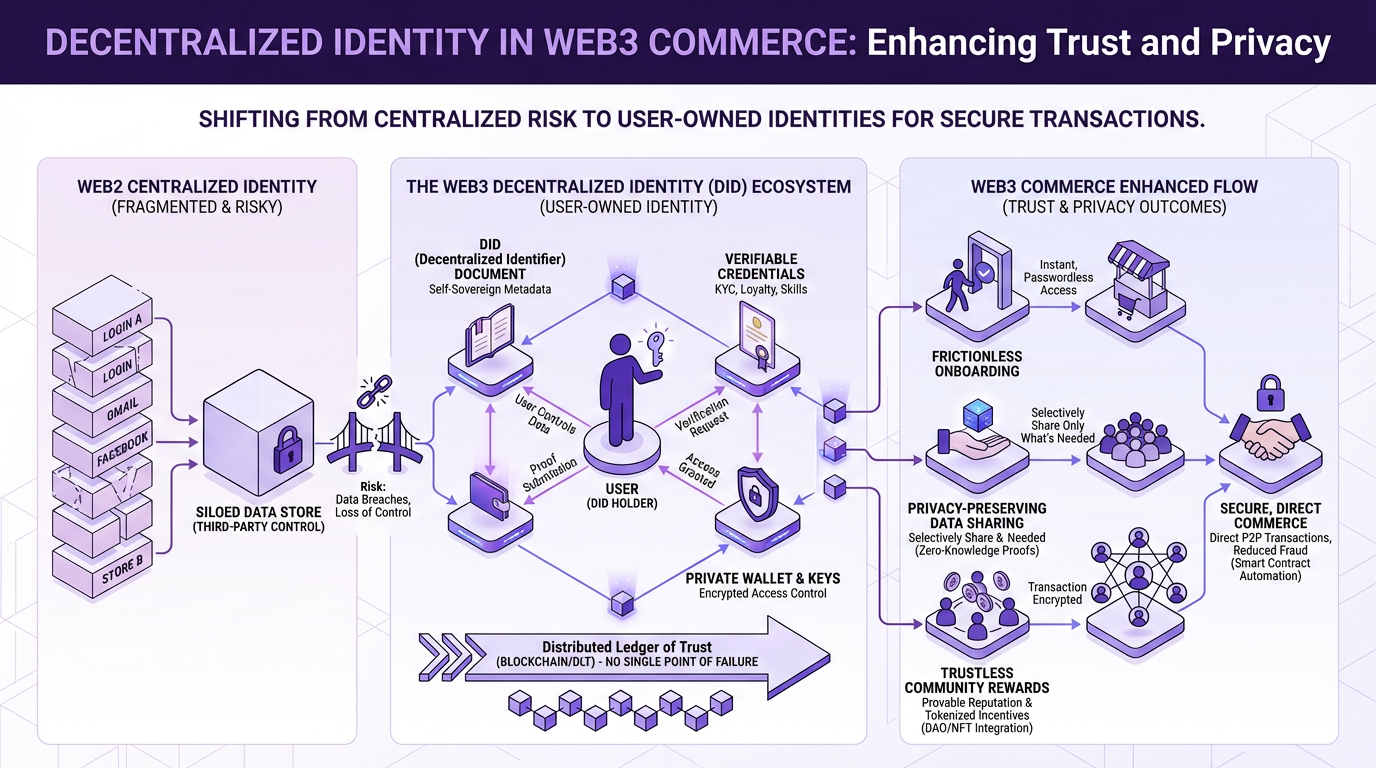
Decentralized Identity in Web3 Commerce: Enhancing Trust and Privacy
Decentralized Identity in Web3 Commerce: Enhancing Trust and Privacy
Decentralized Identity (DID) is emerging as a cornerstone technology for the next generation of online commerce, particularly within the burgeoning Web3 ecosystem. By shifting control of personal data from centralized entities to individual users, DID promises to revolutionize how trust, privacy, and security are managed in digital transactions. This paradigm shift is critical for the success of a truly decentralized commerce experience, where users maintain sovereignty over their digital footprint. As businesses explore the potential of a robust uni-fy dcommerce strategy, understanding the nuances of decentralized identity becomes paramount for building resilient and user-centric platforms.Traditional e-commerce models rely heavily on centralized identity providers, creating data silos and single points of failure that are ripe for breaches and misuse. Web3, with its emphasis on decentralization and user empowerment, offers a compelling alternative. Decentralized identity in Web3 commerce allows individuals to prove who they are, or specific attributes about themselves, without revealing unnecessary personal information to every service provider. This not only enhances privacy but also streamlines verification processes, reduces fraud, and fosters a more equitable digital economy.
Key Decentralized Identity Statistics • The global decentralized identity market is projected to reach over $20 billion by 2027, growing at a CAGR of 80% from 2022 (Source: MarketsandMarkets). • 70% of consumers are concerned about their data privacy online, making privacy-enhancing technologies like DID increasingly attractive (Source: PwC). • Data breaches cost companies an average of $4.35 million per incident in 2022, highlighting the financial imperative for stronger identity solutions (Source: IBM Security). • Over 100 million self-sovereign identity (SSI) credentials are expected to be issued annually by 2025 (Source: Gartner).
The Core Principles of Decentralized Identity (DID)
Decentralized Identity operates on a set of fundamental principles designed to empower the individual. At its heart is the concept of self-sovereign identity (SSI), where users own and control their digital identifiers and the data associated with them. This contrasts sharply with traditional models where platforms like Google or Facebook act as custodians of user identities. DIDs are typically managed on a blockchain or distributed ledger, providing an immutable and verifiable record of credentials without revealing the underlying personal data.How DIDs Work: Verifiable Credentials and DLTs
The technical backbone of DID involves Verifiable Credentials (VCs) and Distributed Ledger Technologies (DLTs). VCs are digital attestations of attributes (e.g., age, professional qualification, proof of purchase) issued by trusted entities (issuers) and presented by the user (holder) to a verifier. The integrity of these credentials is cryptographically secured and can be verified on a public DLT without exposing the full credential content. This selective disclosure is a game-changer for privacy in online transactions, allowing for granular control over what information is shared and with whom. For businesses building on Web3, integrating these verifiable credentials can significantly enhance trust in web3 payment gateways and customer onboarding.| Identity Management Model | Best For | Difficulty | ROI Potential |
|---|---|---|---|
| Centralized Identity | Quick setup, established infrastructure | Easy | Medium |
| Federated Identity | Single sign-on across partner sites | Medium | Medium-High |
| Decentralized Identity | Enhanced privacy, fraud reduction, user control | Hard | Very High |
Benefits for Web3 E-commerce Platforms
Implementing decentralized identity solutions offers a multitude of benefits for Web3 e-commerce platforms, ranging from enhanced security to improved user experience. By reducing reliance on third-party identity providers, platforms can mitigate risks associated with data breaches and regulatory compliance, while simultaneously building a stronger, more trustworthy relationship with their customer base. This shift is crucial for fostering a truly decentralized marketplace where users feel secure in their transactions and interactions.Reducing Fraud and Enhancing Security
One of the most significant advantages of DID in e-commerce is its potential to drastically reduce fraud. By enabling verifiable, tamper-proof credentials, platforms can ensure that users are who they claim to be, or that they meet specific criteria (e.g., age verification for restricted goods) without storing sensitive personal data. This cryptographic assurance makes it far more difficult for malicious actors to impersonate users or create fake accounts. Furthermore, the immutability of blockchain records provides an auditable trail for transactions, bolstering security and accountability. This level of security is a key differentiator for platforms looking to build robust decentralized marketplaces.5-Step DID Implementation Framework for E-commerce
Challenges and Future Outlook
While the promise of decentralized identity is immense, its widespread adoption in Web3 e-commerce faces several challenges. These include technical complexity, the need for robust interoperability standards, and the significant hurdle of user education and adoption. The current digital landscape is still heavily reliant on centralized systems, and transitioning users to a self-sovereign model requires a concerted effort from developers, businesses, and policymakers.Expert Insight: "The biggest hurdle for decentralized identity isn't the technology; it's the mental model shift required from both businesses and consumers. We've been conditioned to hand over our data freely. Convincing users that they can and should control their identity, and providing intuitive tools to do so, will be the true determinant of DID's success in Web3 commerce."Despite these challenges, the future of decentralized identity in Web3 commerce looks bright. As the Web3 ecosystem matures and user demand for privacy and control grows, DID solutions will become increasingly integral. Innovations in user-friendly wallet interfaces, standardized credential formats, and cross-chain compatibility will pave the way for a more seamless and secure digital identity experience. This evolution will be critical for the broader adoption of web3 e-commerce platforms and the realization of a truly decentralized internet.
Diagram: Decentralized Identity Flow in E-commerce [User (Holder)] → [Requests Credential from Issuer] → [Issuer Issues Verifiable Credential] → [User Stores VC in Wallet] → [User Presents VC to E-commerce Verifier] → [Verifier Confirms VC on DLT] → [Access Granted/Transaction Approved]
Frequently Asked Questions
What is the primary difference between centralized and decentralized identity in e-commerce?
Centralized identity relies on a single entity (like a social media platform) to manage user data, creating data silos and privacy risks. Decentralized identity empowers users to own and control their digital identifiers and data, sharing only what's necessary, verified on a distributed ledger.How does decentralized identity improve privacy for online shoppers?
Decentralized identity improves privacy by enabling selective disclosure. Users can prove specific attributes (e.g., being over 18) without revealing their exact birthdate or full identity, minimizing the personal data shared with merchants and reducing the risk of data breaches.Is decentralized identity secure against fraud?
Yes, decentralized identity significantly enhances security against fraud. By leveraging cryptographic proofs and blockchain immutability, verifiable credentials are tamper-proof and provide a robust mechanism for authenticating users and their attributes, making impersonation and fake accounts much harder to establish.What role do Verifiable Credentials play in decentralized identity?
Verifiable Credentials (VCs) are digital attestations of user attributes (e.g., age, address, qualifications) issued by trusted parties. They are cryptographically secured and can be verified on a blockchain, allowing users to prove facts about themselves without revealing underlying sensitive data.Can decentralized identity be integrated with existing e-commerce systems?
Integrating decentralized identity with existing e-commerce systems is possible but requires significant development. It often involves building bridges between traditional identity management systems and Web3 DID frameworks, or migrating to platforms designed with Web3 principles from the ground up.Key Takeaways
- Decentralized Identity (DID) shifts control of personal data to users, enhancing privacy and security in Web3 commerce.
- DIDs utilize Verifiable Credentials (VCs) and Distributed Ledger Technologies (DLTs) for secure, selective disclosure of user attributes.
- Benefits for e-commerce include reduced fraud, streamlined verification, and stronger customer trust.
- Implementing DID requires careful assessment of needs, framework selection, VC integration, and user education.
- While challenges exist, DID is poised to become a foundational technology for future Web3 e-commerce platforms, driving a more private and secure digital economy.