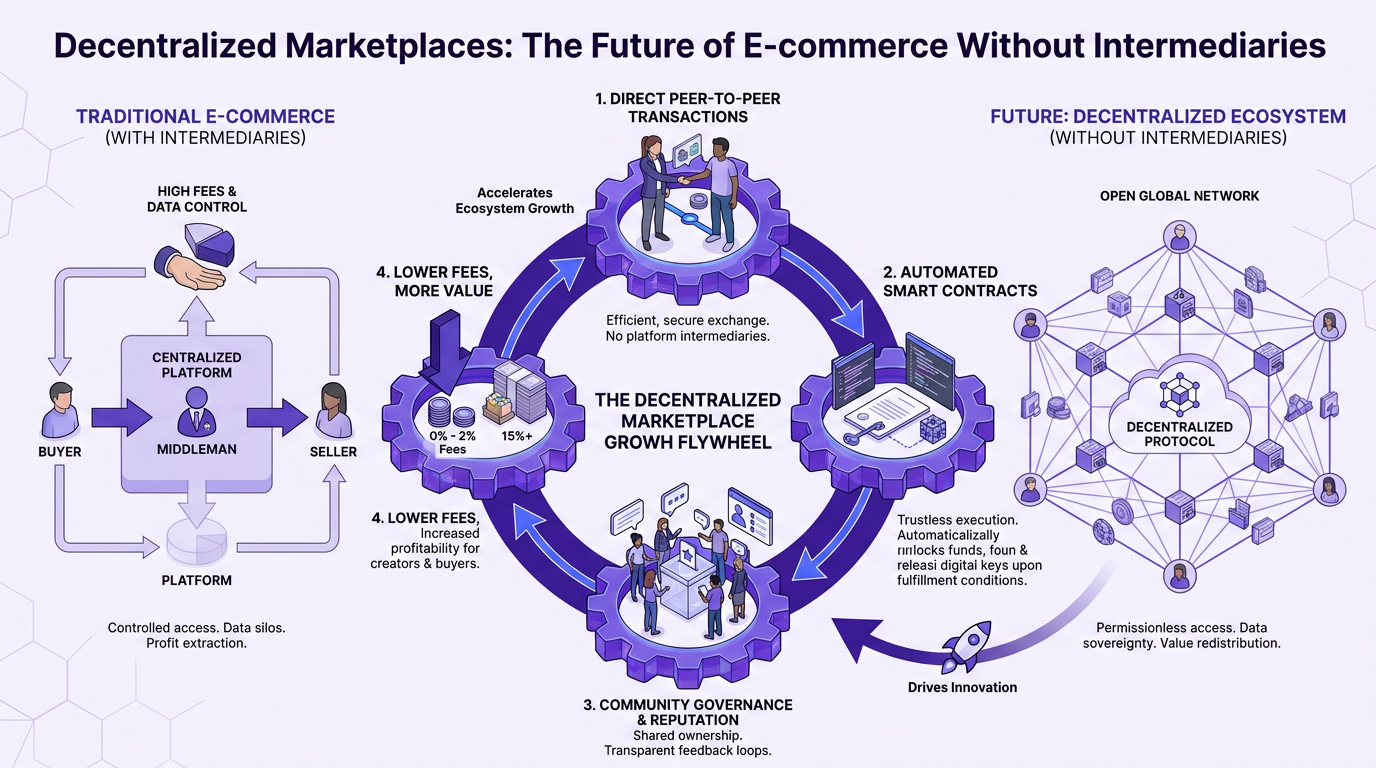
Decentralized Marketplaces: The Future of E-commerce Without Intermediaries
Decentralized marketplaces represent a paradigm shift in online commerce, moving away from centralized platforms like Amazon or eBay towards peer-to-peer (P2P) exchanges powered by blockchain technology. These platforms eliminate the need for intermediaries, allowing buyers and sellers to interact directly, reducing fees, increasing transparency, and enhancing user control. This fundamental change is a cornerstone of the broader movement towards
Decentralized Commerce, promising a more equitable and resilient global trading system. By leveraging the power of distributed ledgers, decentralized marketplaces aim to solve many of the problems inherent in traditional e-commerce, such as data privacy concerns, high transaction costs, and censorship.
Key Decentralized Marketplace Statistics
• The total value locked (TVL) in decentralized finance (DeFi) protocols, which often underpin these marketplaces, exceeded $100 billion in early 2024.
• Over 1.5 million unique active wallets interacted with decentralized applications (dApps) in Q4 2023, many of which are marketplaces.
• Average transaction fees on decentralized exchanges (DEXs), a form of marketplace, are often significantly lower than traditional financial institutions, ranging from 0.1% to 0.3%.
• The number of decentralized marketplace platforms has grown by over 50% year-over-year since 2020, indicating rapid innovation and adoption.
Understanding the Core Principles of Decentralized Marketplaces
Unlike their centralized counterparts, decentralized marketplaces operate on a distributed network, typically a blockchain. This means there's no single entity controlling the platform, no central server that can be shut down, and no single point of failure. Instead, the marketplace's rules and operations are governed by smart contracts, which automatically execute agreements between parties. This architecture ensures censorship resistance, as no central authority can block transactions or delist users based on arbitrary decisions.
How Blockchain Powers Trust and Transparency
Blockchain technology provides the immutable ledger that underpins decentralized marketplaces. Every transaction, every listing, and every review is recorded on the blockchain, creating a transparent and verifiable history. This transparency builds trust among participants, as all data is publicly auditable, albeit often pseudonymously. The use of
blockchain technology in retail is a prime example of how this distributed ledger can revolutionize consumer interactions, ensuring authenticity and provenance for goods.
| Feature | Decentralized Marketplace | Centralized Marketplace |
|---|
| Control | Community/Code | Single Entity/Corporation |
| Fees | Lower (network fees only) | Higher (platform fees, commissions) |
| Censorship | Resistant | Prone |
| Data Privacy | Enhanced (user-controlled) | Limited (platform-controlled) |
| Transparency | High (on-chain records) | Low (proprietary data) |
Advantages Over Traditional E-commerce Platforms
The benefits of decentralized marketplaces extend beyond just removing intermediaries. They offer a host of advantages that address long-standing issues in traditional e-commerce. Lower transaction fees are a significant draw, as sellers no longer pay hefty commissions to platform owners. Enhanced data privacy gives users more control over their personal information, reducing the risk of data breaches and unwanted marketing. Furthermore, the global and permissionless nature of these platforms means anyone with an internet connection can participate, fostering greater economic inclusion.
Empowering Sellers and Buyers
For sellers, decentralized marketplaces offer direct access to a global customer base without the constraints and rules imposed by centralized platforms. They can retain a larger share of their earnings and have more control over their product listings and customer interactions. Buyers benefit from potentially lower prices due to reduced overheads, greater transparency regarding product origins, and a more secure transaction environment thanks to smart contracts. This shift in power dynamics is a core tenet of
decentralized finance (DeFi), extending its principles to physical and digital goods.
4-Step Framework for Participating in a Decentralized Marketplace
Set Up a Web3 Wallet — Choose a non-custodial wallet (e.g., MetaMask, Trust Wallet) that supports the blockchain network of your chosen marketplace. Securely back up your seed phrase.
Acquire Cryptocurrency — Purchase the native cryptocurrency or stablecoins required for transactions on the marketplace. This will cover purchase costs and network transaction fees (gas).
Connect to the Marketplace dApp — Navigate to the decentralized marketplace's website and connect your Web3 wallet. This grants the dApp permission to interact with your wallet for transactions.
Transact Securely — Browse listings, make offers, or list your own items. All transactions will be facilitated by smart contracts, ensuring funds are held in escrow until conditions (e.g., delivery confirmation) are met. Always verify contract addresses and transaction details before confirming.
Challenges and the Path to Mainstream Adoption
Despite their promise, decentralized marketplaces face significant hurdles. User experience (UX) is often more complex than traditional platforms, requiring users to manage cryptocurrency wallets and understand blockchain concepts. Scalability remains an issue for some networks, leading to slower transaction times and higher fees during peak periods. Regulatory uncertainty also poses a challenge, as governments grapple with how to classify and oversee these new forms of commerce. Furthermore, dispute resolution mechanisms are still evolving, often relying on community governance or specialized arbitration protocols rather than traditional legal systems.
The Role of Decentralized Autonomous Organizations (DAOs)
Many decentralized marketplaces are governed by Decentralized Autonomous Organizations (DAOs). These organizations use smart contracts to automate decision-making processes, allowing token holders to vote on key proposals, such as platform upgrades, fee structures, or dispute resolutions. This community-driven governance model aligns with the ethos of decentralization, ensuring that the marketplace evolves in a way that benefits its users rather than a single corporate entity. The integration of
decentralized applications (dApps) within these DAOs is crucial for their functionality.
Expert Insight: "The biggest challenge for decentralized marketplaces isn't the technology itself, but the user onboarding. We need to abstract away the complexities of crypto wallets, gas fees, and seed phrases. Once the user experience is as seamless as Amazon, but with the added benefits of true ownership and privacy, that's when we'll see mass adoption. It's about making decentralization invisible to the end-user, while still delivering its core advantages."
Diagram: Decentralized Marketplace Transaction Flow
[Buyer Connects Wallet] → [Buyer Selects Item & Initiates Purchase] → [Smart Contract Locks Funds] → [Seller Ships Item] → [Delivery Confirmed (via Oracle/Manual)] → [Smart Contract Releases Funds to Seller] → [Transaction Recorded on Blockchain]
Future Outlook and Innovation
The future of decentralized marketplaces is bright, with continuous innovation addressing current limitations. Layer-2 scaling solutions are improving transaction speeds and reducing costs. Enhanced identity solutions are emerging to balance privacy with accountability. Furthermore, the integration of non-fungible tokens (NFTs) is expanding the scope of what can be traded, from digital art to tokenized real-world assets. As these technologies mature and user interfaces become more intuitive, decentralized marketplaces are poised to disrupt traditional e-commerce and create a more open, fair, and efficient global trading environment. This evolution is central to the vision of a truly
Decentralized Commerce ecosystem.
The Rise of Specialized Decentralized Marketplaces
Beyond general-purpose marketplaces, we are seeing the emergence of highly specialized decentralized platforms. These include marketplaces for specific types of NFTs (e.g., art, gaming assets), decentralized freelance platforms, and even decentralized data marketplaces where users can sell their own data directly. This specialization allows for tailored features and governance models that cater to the unique needs of niche communities, further driving innovation and adoption within the decentralized space.
Frequently Asked Questions
What is a decentralized marketplace?
A decentralized marketplace is an online platform that allows buyers and sellers to connect and transact directly, without a central intermediary. It operates on a blockchain, using smart contracts to automate agreements and ensure transparency and security.
How do decentralized marketplaces differ from traditional e-commerce sites?
They differ primarily in their architecture: decentralized marketplaces have no central authority, offering lower fees, enhanced privacy, censorship resistance, and greater user control, whereas traditional sites are controlled by a single company.
Are transactions on decentralized marketplaces secure?
Yes, transactions are highly secure due to the use of blockchain technology and smart contracts. Funds are typically held in escrow by a smart contract until all agreed-upon conditions are met, reducing the risk of fraud and ensuring immutable records.
What are the main challenges for decentralized marketplaces?
Key challenges include user experience complexity, blockchain scalability issues, regulatory uncertainty, and the evolving nature of dispute resolution mechanisms. These factors currently hinder mainstream adoption.
Do I need cryptocurrency to use a decentralized marketplace?
Yes, typically you need cryptocurrency (or stablecoins) to pay for goods/services and to cover network transaction fees (gas). You also need a Web3 wallet to interact with the marketplace's decentralized application (dApp).
Key Takeaways
- Decentralized marketplaces remove intermediaries, enabling direct peer-to-peer transactions on a blockchain.
- They offer advantages like lower fees, enhanced data privacy, censorship resistance, and increased transparency compared to traditional e-commerce.
- Smart contracts are fundamental, automating agreements and ensuring secure, trustless transactions.
- Key challenges include user experience complexity, scalability, and regulatory clarity, which are being addressed by ongoing innovation.
- The future involves specialized marketplaces, improved interoperability, and a shift towards community-governed platforms via DAOs.