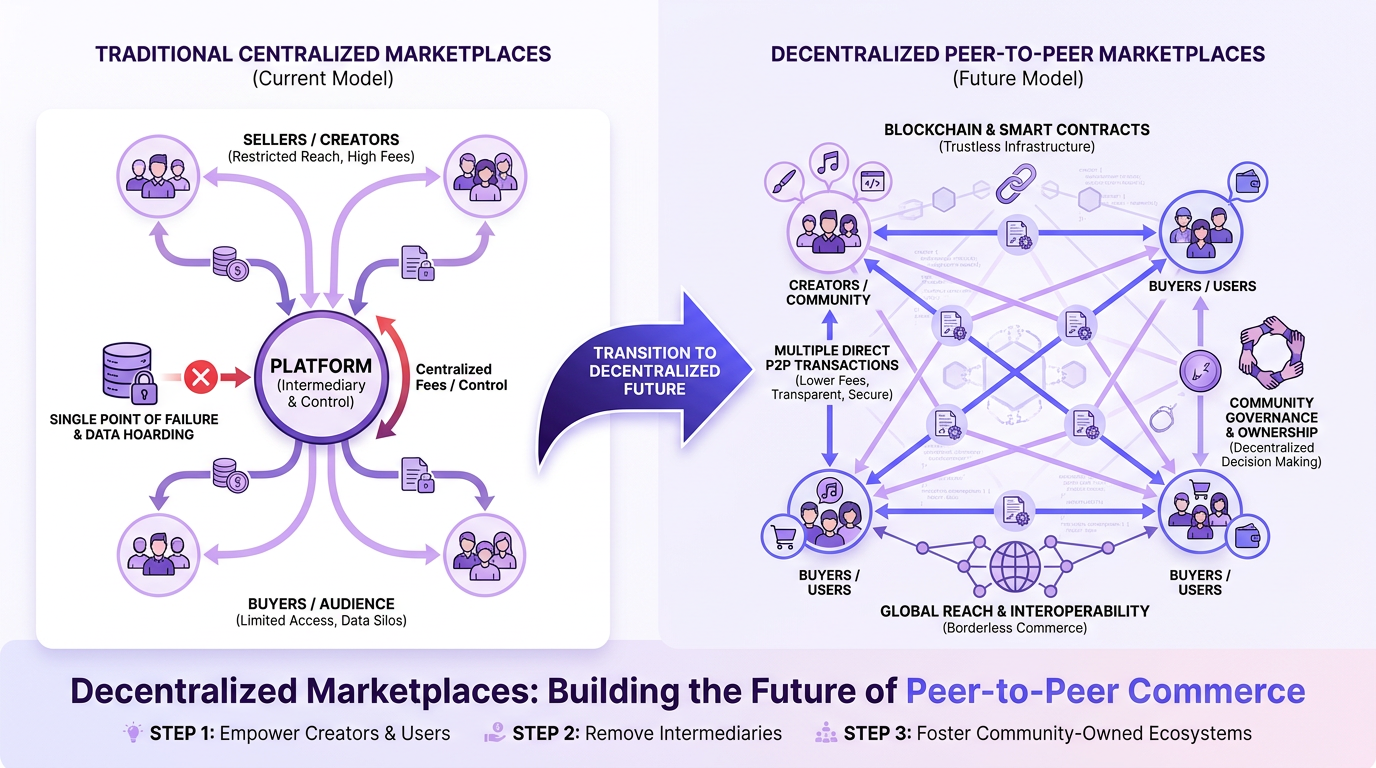
Decentralized Marketplaces: Building the Future of Peer-to-Peer Commerce
Decentralized marketplaces represent a paradigm shift from traditional e-commerce platforms like Amazon or eBay. Instead of a central entity controlling transactions, data, and user interactions, these platforms leverage blockchain technology to enable direct peer-to-peer (P2P) exchanges. This fundamental architectural difference fosters greater transparency, reduces fees, enhances security, and gives users more control over their data and transactions. For businesses and consumers looking to engage in truly open and equitable
Decentralized Commerce, understanding the mechanics and benefits of these marketplaces is crucial.
Key Decentralized Marketplace Statistics
• The total value locked (TVL) in decentralized finance (DeFi) protocols, many of which underpin marketplaces, exceeded $100 billion in early 2024.
• Over 1.5 million unique active wallets interacted with decentralized applications (dApps) in Q4 2023, a significant portion engaging with marketplaces.
• Transaction fees on leading decentralized exchanges (DEXs), a form of marketplace, are often 50-80% lower than traditional financial intermediaries.
• User data breaches on centralized platforms continue to drive interest, with 78% of internet users expressing concern over online privacy.
The Core Principles of Decentralized Marketplaces
Unlike their centralized counterparts, decentralized marketplaces operate without a single point of control. This means no single company dictates terms, censors listings, or holds user funds. Instead, they rely on smart contracts and blockchain networks to automate rules, manage escrow, and facilitate transactions. This architecture inherently promotes censorship resistance and reduces the risk of data breaches, as user data is often stored on the blockchain or encrypted and controlled by the user.
How Decentralization Empowers Users and Sellers
In a decentralized marketplace, sellers gain greater autonomy over their products and pricing, free from the often-onerous fees and restrictive policies of centralized platforms. Buyers benefit from enhanced privacy, verifiable product authenticity (especially when integrated with
decentralized supply chain solutions), and a direct connection to sellers. This direct interaction fosters a more community-driven and equitable trading environment, aligning perfectly with the ethos of
Decentralized Commerce.
| Feature Comparison | Centralized Marketplace | Decentralized Marketplace |
|---|
| Control | Single entity | Community/Smart Contracts |
| Fees | High (10-30%+) | Low (0-5%) |
| Censorship | Possible | Resistant |
| Data Ownership | Platform | User |
| Trust | Intermediary-based | Trustless (code-based) |
| Dispute Resolution | Platform's discretion | Smart contract arbitration/DAO |
Building and Participating in Decentralized Marketplaces
Creating a decentralized marketplace involves developing smart contracts that define the rules for listing, buying, selling, and dispute resolution. These contracts are then deployed on a blockchain, forming the backbone of the platform. Users interact with these contracts through decentralized applications (dApps) that provide a user-friendly interface. Participation typically requires a cryptocurrency wallet to manage digital assets and interact with the smart contracts.
6-Step Framework for Launching a Decentralized Marketplace
Define Niche & Value Proposition — Identify the specific goods or services your marketplace will offer and how it differentiates itself from existing solutions (both centralized and decentralized). What problem are you solving?
Select Blockchain & Smart Contract Platform — Choose a suitable blockchain (e.g., Ethereum, Polygon, Solana) and smart contract language (e.g., Solidity). Consider scalability, transaction costs, and developer ecosystem.
Develop Core Smart Contracts — Build the foundational smart contracts for listing items, managing user profiles, facilitating transactions (including escrow), and handling dispute resolution. Security auditing is paramount.
Design and Develop User Interface (DApp) — Create an intuitive front-end application that allows users to easily browse, list, buy, and sell. This DApp will interact directly with your deployed smart contracts.
Implement Decentralized Identity & Storage — Integrate solutions for decentralized identity (e.g., ENS, DID) and decentralized storage (e.g., IPFS, Arweave) to enhance user privacy and data ownership.
Launch, Market & Foster Community — Deploy the marketplace, engage with potential users, and build a strong community. Decentralized governance mechanisms (DAOs) can be introduced to allow community input on future development.
Challenges and Opportunities in the Decentralized Landscape
While decentralized marketplaces offer significant advantages, they also face challenges. User experience can be more complex for those unfamiliar with blockchain technology, scalability issues can arise on certain networks, and regulatory clarity is still evolving. However, these challenges are being actively addressed by ongoing innovation in the blockchain space.
Overcoming Hurdles for Mass Adoption
Expert Insight: "The biggest hurdle for decentralized marketplaces isn't the technology itself, but the user experience. We need to abstract away the blockchain complexities for the average user. Think of it like the early internet – cumbersome. As wallets become more intuitive, gas fees decrease, and onboarding processes simplify, we'll see an explosion in adoption. It's about making 'decentralized' feel 'normal'."
Opportunities abound in niche markets, digital collectibles (NFTs), and services where trust and transparency are paramount. The integration of
decentralized finance (DeFi) elements, such as lending and borrowing against marketplace assets, further expands their potential. As the infrastructure matures, decentralized marketplaces are set to become a cornerstone of the broader digital economy.
Diagram: Decentralized Marketplace Ecosystem
[Seller] ↔ [Smart Contract (Listing/Escrow)] ↔ [Buyer]
↑ ↓
[Blockchain Network] ↔ [Decentralized Storage] ↔ [Decentralized Identity]
↑ ↓
[Community Governance (DAO)]
The Role of Governance and Community
Many decentralized marketplaces are moving towards decentralized autonomous organizations (DAOs) for governance. This means that the community of users and token holders can vote on key decisions, such as platform fees, feature development, and dispute resolution mechanisms. This model ensures that the marketplace truly serves its participants, rather than a corporate entity, embodying the spirit of
Decentralized Commerce.
Frequently Asked Questions
How do decentralized marketplaces handle payments?
Payments in decentralized marketplaces are typically handled using cryptocurrencies and smart contracts. Funds are often held in an escrow smart contract until both parties fulfill their obligations, after which the funds are automatically released to the seller.
What are the main advantages of using a decentralized marketplace over a centralized one?
Key advantages include lower fees, increased transparency, enhanced security through blockchain technology, greater user control over data, censorship resistance, and direct peer-to-peer interactions without intermediaries.
Are decentralized marketplaces anonymous?
While transactions on a blockchain are pseudonymous (linked to a wallet address, not directly to a real-world identity), true anonymity depends on how users manage their wallet addresses and interact with other services. Solutions like
decentralized identity aim to give users more control over their verifiable credentials.
What kind of products or services can be sold on decentralized marketplaces?
Decentralized marketplaces can host a wide range of products and services, including digital goods (NFTs, software licenses), physical goods, freelance services, and even real estate. The underlying technology is flexible enough to support almost any type of transaction.
Key Takeaways
- Decentralized marketplaces leverage blockchain and smart contracts to enable direct peer-to-peer commerce without central intermediaries.
- They offer benefits like lower fees, increased transparency, enhanced security, and greater user control compared to centralized platforms.
- Building a decentralized marketplace requires careful planning, smart contract development, and a focus on user experience.
- Challenges include user adoption and scalability, but ongoing innovation is addressing these issues.
- Community governance through DAOs is a growing trend, ensuring marketplaces serve their participants.