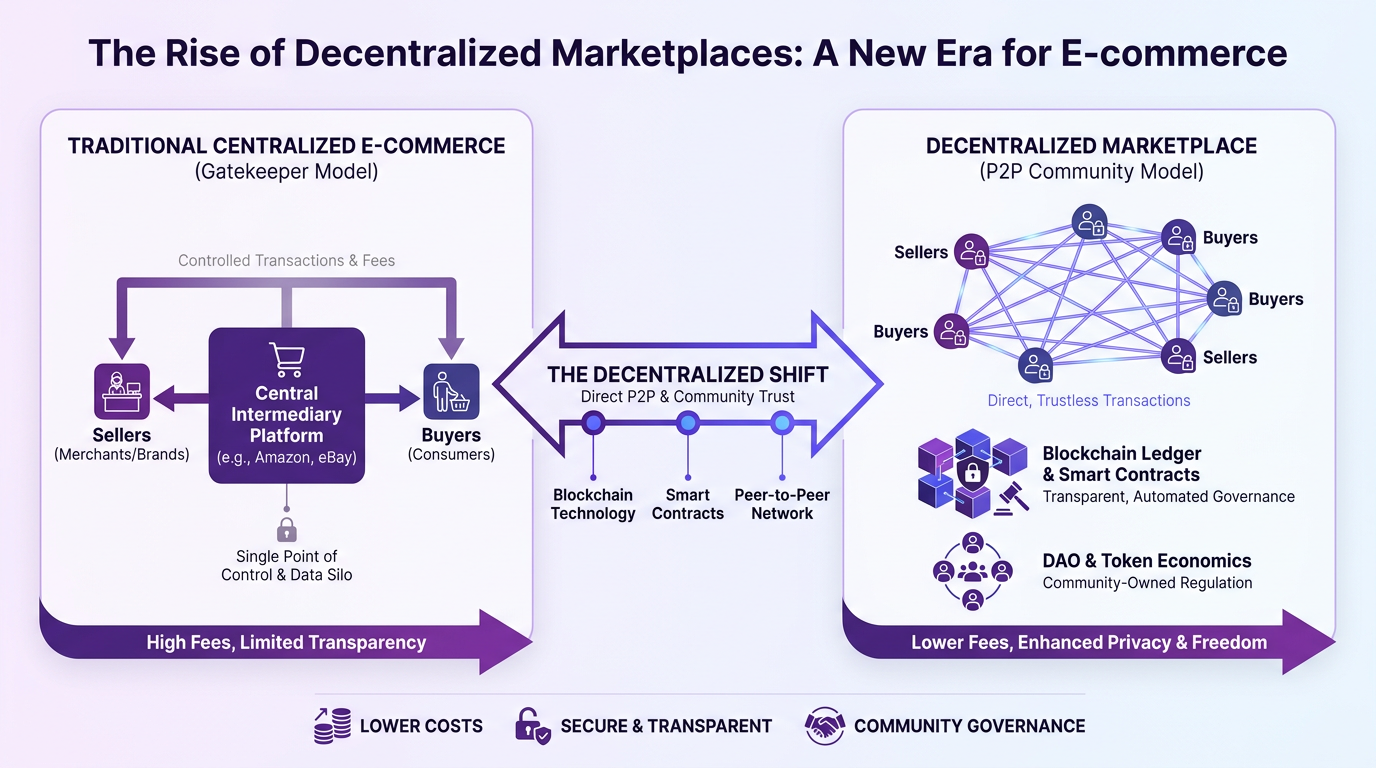
The Rise of Decentralized Marketplaces: A New Era for E-commerce
Decentralized marketplaces are emerging as a revolutionary alternative to traditional e-commerce giants, promising a future where transactions are peer-to-peer, transparent, and free from central control. Built on blockchain technology, these platforms empower sellers and buyers by removing intermediaries, reducing fees, and enhancing data privacy. This shift is a core component of the broader movement towards
Decentralized Commerce, offering a more equitable and resilient online trading environment. As consumers and businesses increasingly seek greater autonomy and security, decentralized marketplaces are poised to redefine the digital shopping experience, fostering direct connections and fairer terms for all participants.
Key Decentralized Marketplace Statistics
• The global market for decentralized applications (dApps), which include marketplaces, is projected to grow significantly, with some estimates reaching over $100 billion by 2027.
• Transaction volumes on leading NFT marketplaces, a form of decentralized commerce, exceeded $25 billion in 2021.
• Over 60% of blockchain users express interest in using decentralized platforms for online shopping to avoid high fees and data exploitation.
• The average commission fee on traditional e-commerce platforms can range from 5% to 20%, while decentralized alternatives aim for significantly lower or zero platform fees.
Eliminating Intermediaries: The Core Advantage
Traditional e-commerce platforms like Amazon or eBay act as central authorities, controlling listings, payments, and dispute resolution. While convenient, this model often comes with high transaction fees, strict content policies, and the risk of account suspension. Decentralized marketplaces, in contrast, operate on a peer-to-peer basis, leveraging blockchain and smart contracts to facilitate direct interactions between buyers and sellers. This fundamental shift eliminates the need for a middleman, leading to lower costs and greater autonomy for users. This is a critical distinction when considering the future of
web3 commerce.
How Peer-to-Peer Transactions Work
In a decentralized marketplace, when a buyer makes a purchase, the payment (often in cryptocurrency) is held in a smart contract escrow. Once the seller fulfills the order and the buyer confirms receipt, the smart contract automatically releases the funds. This entire process is transparently recorded on the blockchain, ensuring trust without a central arbiter. Disputes, while still possible, are often handled through community-governed arbitration mechanisms rather than a single corporate entity.
| Feature | Decentralized Marketplaces | Traditional E-commerce |
|---|
| Fees | Low to Zero | High (5-20%+) |
| Control | User/Community-governed | Centralized Platform |
| Data | User-owned, Private | Platform-owned, Monetized |
| Censorship | Resistant | Prone |
| Payments | Crypto-native, Global | Fiat-centric, Regional |
Enhanced Security and Data Privacy
Data breaches and privacy concerns are rampant in centralized systems. Decentralized marketplaces offer a robust solution by distributing data across a network and often employing cryptographic techniques to protect user identities. Instead of storing sensitive personal and financial information on a single server, user data is either encrypted on the blockchain or managed through
decentralized identity solutions, giving individuals greater control over what information they share and with whom. This architecture significantly reduces the attack surface for hackers and protects users from corporate data exploitation.
Protecting User Data with Blockchain
Blockchain's inherent security features, such as immutability and cryptographic hashing, make it incredibly difficult for malicious actors to tamper with transaction records or user data. Furthermore, many decentralized marketplaces encourage the use of pseudonymous identities, allowing users to transact without revealing their real-world identities unless absolutely necessary. This focus on privacy and security builds a stronger foundation of trust, which is paramount for the widespread adoption of
Decentralized Commerce.
4-Step Secure Transaction Framework on Decentralized Marketplaces
Connect Wallet — Users connect their cryptocurrency wallet (e.g., MetaMask) to the marketplace, which serves as their identity and payment method, without needing to create a traditional account.
Select Product & Initiate Smart Contract — The buyer selects an item, and a smart contract is automatically generated, outlining the terms of the sale (price, delivery, etc.). Payment is sent to the contract's escrow.
Seller Fulfillment & Buyer Confirmation — The seller ships the product. Upon receipt, the buyer inspects the item and confirms satisfaction within the marketplace interface.
Automated Fund Release — Once buyer confirmation is received (or a predefined escrow period expires without dispute), the smart contract automatically releases the payment from escrow to the seller's wallet.
Global Reach and Censorship Resistance
Traditional e-commerce platforms are often subject to national regulations and corporate policies that can restrict who can sell or buy, and what can be sold. Decentralized marketplaces, by their very nature, are global and censorship-resistant. They operate across borders without a central governing body that can arbitrarily shut down accounts or remove listings. This open access fosters a truly global economy, allowing individuals from anywhere in the world to participate in commerce, provided they have an internet connection and access to cryptocurrency.
Expert Insight: "The true power of decentralized marketplaces lies in their borderless nature. They democratize access to global markets for small businesses and artisans who might otherwise be excluded by geopolitical barriers or prohibitive platform fees. This isn't just about technology; it's about economic empowerment on a global scale, fostering a more inclusive and resilient trading ecosystem."
This resistance to censorship is particularly appealing to creators and businesses in regions with restrictive internet policies or those dealing in niche products that might be deemed controversial by centralized platforms. It ensures that commerce remains open and accessible to all, aligning with the principles of
decentralized autonomous organizations (DAOs) that often govern these platforms.
Diagram: Decentralized Marketplace Ecosystem Flow
[Buyer Wallet] → [Smart Contract Escrow] ← [Seller Wallet]
↑ ↓
[Product Listing (IPFS)] ← [Decentralized Storage] → [Community Governance/Dispute Resolution]
Challenges and Future Outlook
Despite their numerous advantages, decentralized marketplaces face challenges. User experience can be more complex for those unfamiliar with cryptocurrencies and blockchain wallets. Scalability issues on some blockchains can lead to slower transaction times and higher fees during peak usage. Regulatory uncertainty also poses a hurdle, as governments grapple with how to classify and oversee these new forms of commerce. However, ongoing developments in
blockchain technology, such as layer-2 scaling solutions and more user-friendly interfaces, are rapidly addressing these concerns. As the infrastructure matures and adoption grows, decentralized marketplaces are set to become a dominant force in the evolution of online commerce, offering a more fair, transparent, and secure alternative to the status quo.
Frequently Asked Questions
What makes a marketplace "decentralized"?
A marketplace is decentralized because it operates on a blockchain network without a central authority controlling transactions, data, or governance. Instead, it relies on peer-to-peer interactions, smart contracts, and often community consensus for decision-making, contrasting sharply with traditional centralized platforms.
Are transactions on decentralized marketplaces truly anonymous?
Transactions are typically pseudonymous, meaning they are linked to a wallet address rather than a real-world identity. While the wallet address itself is public, connecting it to an individual's real identity requires additional information. Many platforms also integrate
decentralized identity solutions for enhanced privacy.
How are disputes resolved in a decentralized marketplace?
Disputes are often resolved through community-governed arbitration systems. Participants can submit evidence, and a panel of elected or randomly selected community members reviews the case and votes on a resolution, which is then enforced by a smart contract. This replaces the need for a centralized customer service department.
What types of products can be sold on decentralized marketplaces?
Decentralized marketplaces can host a wide range of products, from physical goods to digital assets like NFTs, software licenses, and services. The nature of the blockchain allows for flexible listing types, though some platforms may specialize in certain categories.
Key Takeaways
- Decentralized marketplaces eliminate intermediaries, leading to lower fees and direct peer-to-peer transactions.
- They offer enhanced security and data privacy through blockchain's cryptographic features and user-controlled identity.
- These platforms provide global reach and censorship resistance, fostering a more inclusive economic environment.
- Smart contracts automate transaction processes, ensuring trust and efficiency without central oversight.
- While facing challenges like user experience and scalability, ongoing technological advancements are paving the way for their widespread adoption in Decentralized Commerce.