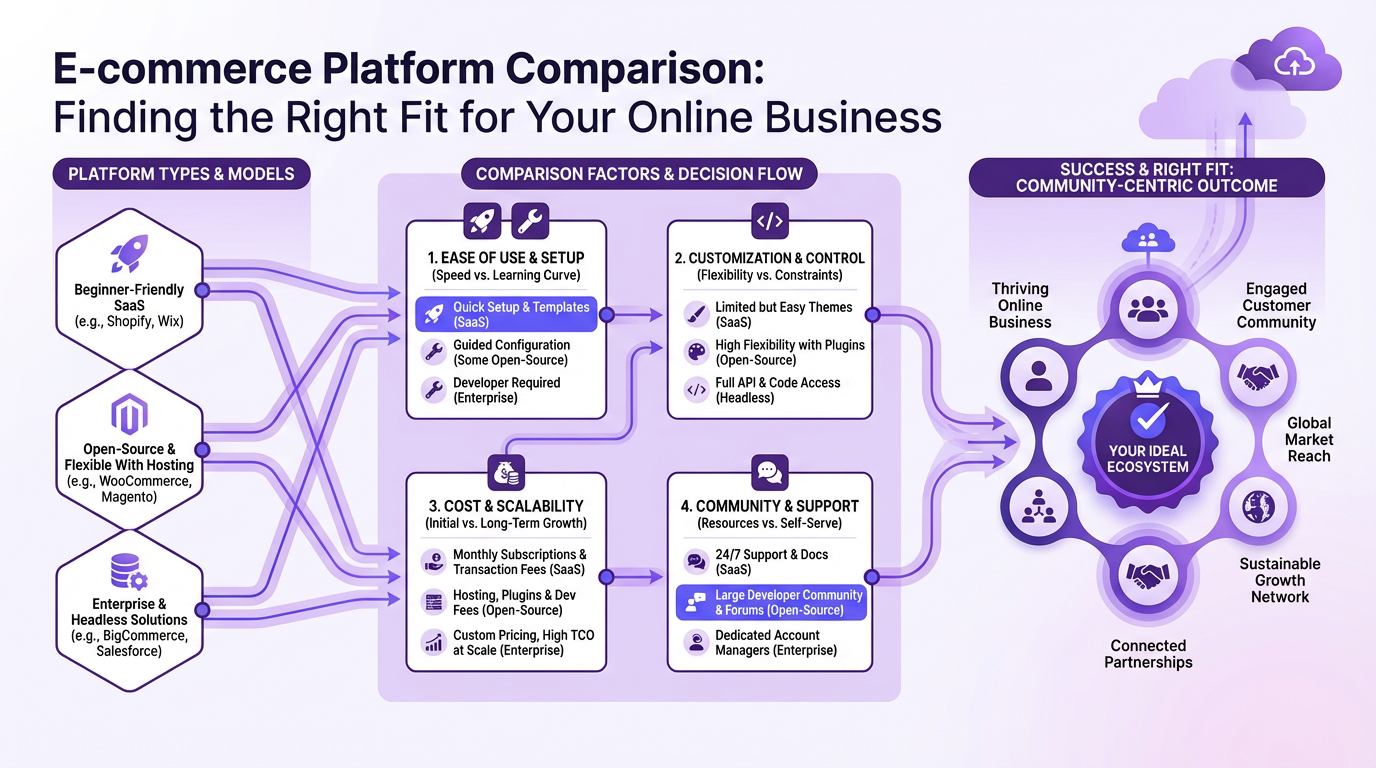
E-commerce Platform Comparison: Finding the Right Fit for Your Online Business
E-commerce Platform Comparison: Finding the Right Fit for Your Online Business
Navigating the vast landscape of online selling can be daunting, especially when it comes to selecting the ideal platform. An effective e-commerce platform comparison is not just about listing features; it's about understanding how each solution aligns with your specific business model, growth aspirations, and technical capabilities. From startups to established enterprises, the right platform can significantly impact operational efficiency, customer experience, and ultimately, profitability. This guide aims to demystify the selection process, offering a structured approach to comparing leading E-commerce Platform Solutions.The choice of an e-commerce platform is a foundational decision that can dictate the flexibility, scalability, and cost-effectiveness of your online store for years to come. A thorough comparison goes beyond surface-level pricing, delving into aspects like customization options, integration capabilities, SEO features, and customer support. By understanding these critical differentiators, businesses can avoid common pitfalls and invest in a solution that truly supports their long-term vision.
Key E-commerce Platform Statistics • Shopify holds approximately 28% of the e-commerce platform market share in the US. (Statista) • WooCommerce powers over 30% of all online stores globally. (BuiltWith) • Businesses using e-commerce platforms with advanced analytics see a 15% increase in conversion rates. (Adobe) • The average e-commerce website features 15 third-party integrations. (Statista)
Core Criteria for E-commerce Platform Comparison
To conduct a meaningful e-commerce platform comparison, it's essential to establish a consistent set of criteria. These criteria should reflect the diverse needs of online businesses, encompassing everything from initial setup to ongoing maintenance and growth. Ignoring any of these aspects can lead to unexpected challenges down the line.Essential Comparison Factors
- Ease of Use & Setup: How quickly and easily can a non-technical user launch and manage a store? This includes dashboard intuitiveness, product uploading, and theme customization.
- Scalability: Can the platform handle increased traffic, product catalog expansion, and higher transaction volumes without performance degradation or requiring a complete overhaul?
- Features & Functionality: Evaluate built-in features like inventory management, payment gateways, shipping options, SEO tools, and marketing capabilities. Consider if essential features require expensive add-ons.
- Customization & Design: Assess the flexibility to customize the store's appearance and functionality to match brand identity. This includes theme options, code access, and app/plugin ecosystems.
- Pricing & Costs: Beyond monthly subscription fees, factor in transaction fees, app costs, hosting (for self-hosted solutions), and potential development expenses. Consider the total cost of ownership.
- Support & Community: What kind of customer support is available (24/7, email, phone)? Is there an active community forum or extensive documentation?
- Integrations: How well does the platform integrate with third-party tools like CRM, ERP, accounting software, email marketing, and social media?
- Security: What security measures are in place (SSL certificates, PCI compliance, fraud protection)?
| Platform Type | Best For | Difficulty | ROI Potential |
|---|---|---|---|
| SaaS (e.g., Shopify) | Beginners, quick launch, managed hosting | Easy | High |
| Open-Source (e.g., WooCommerce) | Customization, technical users, budget-conscious | Medium | Very High |
| Enterprise (e.g., Magento) | Large businesses, complex needs, high traffic | Hard | Very High |
| Website Builder (e.g., Squarespace) | Creative businesses, simple stores, integrated website | Easy | Medium |
Deep Dive into Popular E-commerce Platforms
Let's examine some of the most prominent E-commerce Platform Solutions and their typical use cases. Understanding their core philosophies and target audiences can significantly narrow down your choices. For those just starting out, a website builder for e-commerce might be a good entry point, offering simplicity and integrated design tools.Shopify: The All-in-One Solution
Shopify is renowned for its user-friendliness and comprehensive feature set, making it a top choice for businesses of all sizes, especially those seeking a managed solution. It offers robust tools for product management, marketing, payments, and shipping, all within an intuitive interface. Its extensive app store allows for significant customization without needing to delve into code.WooCommerce: The WordPress Powerhouse
As a free, open-source plugin for WordPress, WooCommerce offers unparalleled flexibility and control. It's ideal for businesses already familiar with WordPress or those requiring deep customization and ownership of their data. While the plugin itself is free, users are responsible for hosting, security, and maintenance, which can add to the complexity and cost.BigCommerce: Scalability for Growth
BigCommerce is often lauded for its robust built-in features and scalability, catering to businesses that anticipate significant growth or already have a substantial product catalog. It offers advanced SEO tools, multi-channel selling capabilities, and a flexible API, making it suitable for more complex operations. Its pricing tiers are often based on sales volume.Squarespace & Wix: Design-First Simplicity
These platforms are excellent for creatives, small businesses, and individuals who prioritize stunning design and ease of use. While they offer solid e-commerce functionalities, their core strength lies in their website building capabilities. They are generally less flexible for highly complex e-commerce operations but excel at providing beautiful, integrated online presences.6-Step E-commerce Platform Comparison Framework
The Role of Integrations and Ecosystems
Beyond the core platform features, the strength of its ecosystem – particularly its app store and integration capabilities – is a critical factor in an e-commerce platform comparison. A rich ecosystem allows you to extend functionality without custom development, connecting your store to essential tools for marketing, accounting, customer service, and fulfillment. This is especially important for businesses looking to streamline operations and leverage existing software investments.Expert Insight: "Many businesses make the mistake of choosing a platform based solely on its out-of-the-box features, only to find themselves limited when they need specialized functionality. The true power of a modern e-commerce platform lies in its API and app ecosystem. A platform with a vibrant marketplace of integrations will allow you to adapt and grow without being locked into proprietary solutions. Always check for robust API documentation and a healthy app store."For those looking to build a new online presence, understanding how to create an e-commerce website often begins with selecting the right platform that offers the necessary integrations for a complete business solution. This ensures that your online store is not an isolated entity but a central hub for all your digital operations.
Diagram: E-commerce Platform Selection Matrix [Business Needs (Features, Budget, Scale)] → [Platform A (Pros/Cons)] → [Platform B (Pros/Cons)] → [Platform C (Pros/Cons)] → [Weighted Scoring & Decision] → [Implementation]
Future-Proofing Your E-commerce Investment
An e-commerce platform comparison should always consider the long-term viability and future-proofing of your chosen solution. The digital commerce landscape evolves rapidly, with new technologies and consumer expectations emerging constantly. A platform that offers regular updates, embraces new payment methods, and supports emerging sales channels (like social commerce or headless commerce) will serve your business better in the long run.Consider the platform's commitment to innovation and its community support. A platform with a strong developer community often means more available integrations and faster adaptation to new trends. Ultimately, the goal is to choose a platform that not only meets your current needs but also provides a solid foundation for future growth and adaptation.
Frequently Asked Questions
What is the main difference between SaaS and open-source e-commerce platforms?
SaaS (Software as a Service) platforms like Shopify are hosted and maintained by the provider, offering ease of use and managed security. Open-source platforms like WooCommerce require you to manage hosting, security, and updates yourself, offering greater control and customization but demanding more technical expertise.How important are transaction fees when comparing platforms?
Transaction fees can significantly impact your profitability, especially for businesses with high sales volumes. Some platforms charge their own transaction fees in addition to payment gateway fees, while others waive them if you use their native payment processor. Always factor these into your total cost analysis.Can I migrate my existing products and customer data to a new platform?
Yes, most e-commerce platforms offer tools or services for migrating existing product catalogs, customer data, and order history. However, the complexity and cost can vary, so it's an important consideration if you're moving from an existing store.What role does SEO play in e-commerce platform selection?
SEO capabilities are crucial for driving organic traffic. When comparing platforms, look for features like customizable URLs, meta tags, sitemaps, and integrations with SEO tools. A platform that makes it easy to optimize for search engines can significantly boost your online visibility.Key Takeaways
- A thorough e-commerce platform comparison is essential for selecting a solution that aligns with business goals, budget, and technical capabilities.
- Key comparison criteria include ease of use, scalability, features, pricing, customization, support, and integrations.
- SaaS platforms (e.g., Shopify) offer simplicity and managed services, while open-source options (e.g., WooCommerce) provide greater control and customization.
- Always consider the total cost of ownership, including subscription fees, transaction fees, and app/plugin expenses.
- Prioritize platforms with robust ecosystems and strong integration capabilities to future-proof your online store.