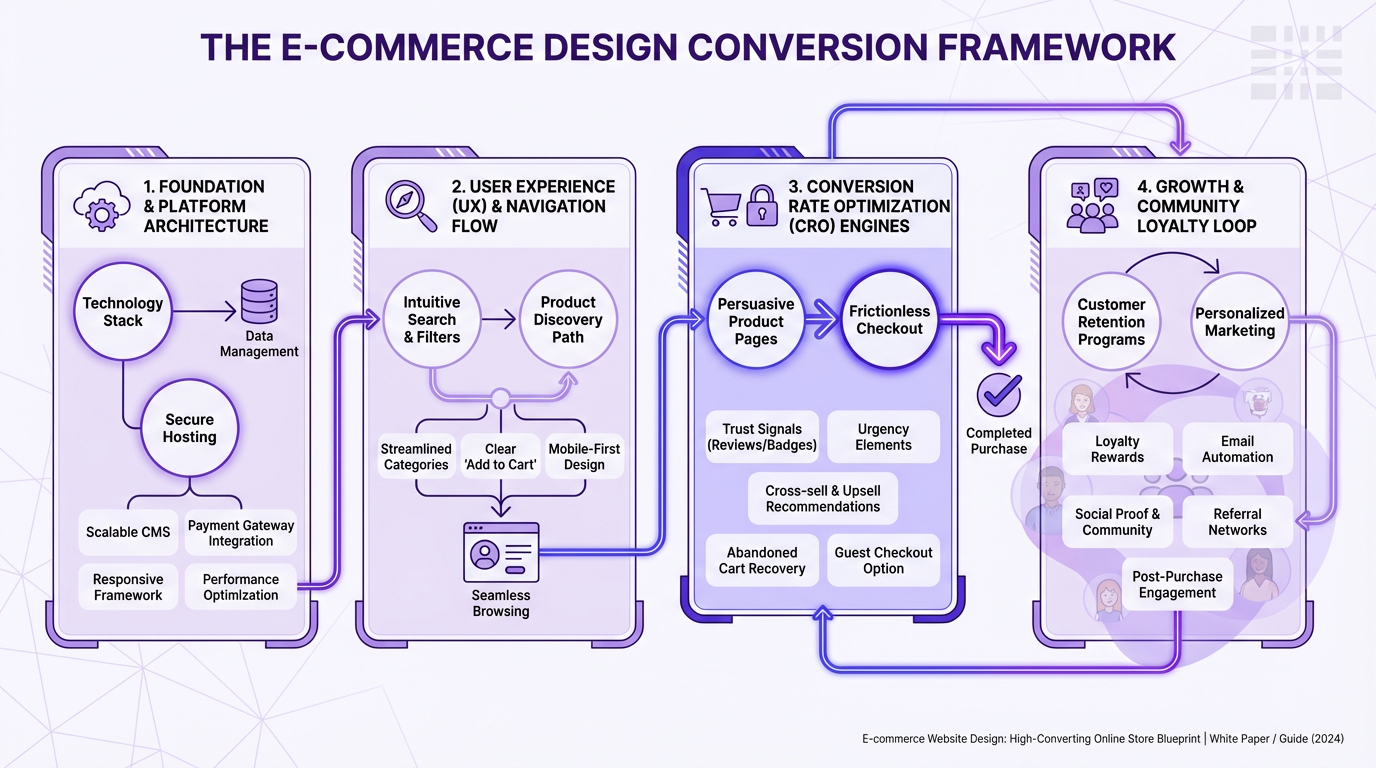
The Definitive Guide to E-commerce Website Design: Building a High-Converting Online Store
The Definitive Guide to E-commerce Website Design: Building a High-Converting Online Store
Table of Contents
- Introduction: The Foundation of Digital Commerce
- Understanding the Pillars of Effective E-commerce Website Design
- Choosing Your E-commerce Platform: Builders vs. Custom Solutions
- The Uni-fy 7-Step E-commerce Design & Launch Framework
- Optimizing for User Experience and Conversion
- Advanced Strategies for E-commerce Growth
- Industry Trends and Future-Proofing Your Online Store
- Frequently Asked Questions
- Related Guides
Introduction: The Foundation of Digital Commerce
In today's hyper-connected world, a compelling e-commerce website design is not merely an option; it's the bedrock of any successful online retail venture. It's the digital storefront, the sales associate, and the customer service representative, all rolled into one. For businesses, from burgeoning startups to established enterprises, the quality of their online presence directly correlates with their ability to attract, engage, and convert customers. This comprehensive guide will dissect every facet of e-commerce website design, providing actionable insights to help you build a robust, user-friendly, and profitable online store.We'll delve into the critical elements that transform a simple digital presence into a high-converting sales machine. From selecting the right platform to crafting an intuitive user experience and implementing advanced growth strategies, this article serves as your definitive resource. Whether you're a small business owner exploring a small business website builder or an entrepreneur considering a sophisticated custom e-commerce website development, understanding the nuances of design is paramount. A well-designed e-commerce site isn't just about aesthetics; it's about functionality, security, and ultimately, driving revenue.
Key E-commerce Design Statistics • 93% of consumers consider visual appearance to be the key deciding factor in a purchasing decision (Stanford University & Adobe). • 88% of online consumers are less likely to return to a site after a bad experience (Amazon Web Services). • E-commerce sales are projected to reach $8.1 trillion globally by 2026 (Statista). • Mobile commerce accounts for 79% of all e-commerce sales (Statista).
Understanding the Pillars of Effective E-commerce Website Design
Effective e-commerce website design transcends mere visual appeal. It's a strategic blend of aesthetics, functionality, and user psychology, all aimed at guiding a visitor seamlessly from browsing to purchase. The core pillars include intuitive navigation, responsive design, compelling product presentation, and a streamlined checkout process. Each element plays a crucial role in shaping the customer journey and influencing conversion rates.User Experience (UX) and User Interface (UI) Design
UX and UI are often conflated, but they represent distinct yet interdependent aspects of design. UI focuses on the visual and interactive elements of a site—buttons, icons, typography, color schemes—while UX encompasses the entire user journey, ensuring it's logical, efficient, and enjoyable. A superior UX minimizes friction, reduces bounce rates, and fosters trust. This means clear calls to action, easy-to-find product information, and a consistent brand voice throughout the site.- Intuitive Navigation: Customers should never have to guess where to go next. Clear categories, search functionality, and breadcrumbs are essential.
- Mobile Responsiveness: With the majority of online shopping now happening on mobile devices, a site must adapt flawlessly to any screen size. This isn't just a preference; it's a necessity for SEO and user satisfaction.
- Speed and Performance: Slow loading times are a conversion killer. Optimizing images, leveraging caching, and choosing a reliable hosting provider are critical.
Choosing Your E-commerce Platform: Builders vs. Custom Solutions
Selecting the right platform is perhaps the most foundational decision in e-commerce website design. This choice dictates your flexibility, scalability, and the overall cost of ownership. Broadly, options fall into two categories: all-in-one online store builders and custom-developed solutions.Online Store Builders: Accessibility and Speed
Platforms like Shopify, BigCommerce, and Wix E-commerce offer comprehensive tools for creating an online store without extensive coding knowledge. They provide pre-built e-commerce website templates and a vast array of online store themes, making it easier for small businesses to get started quickly. Many online store builder reviews highlight their ease of use and integrated features for payments, shipping, and marketing.Expert Insight: "Don't underestimate the power of a well-chosen template. While custom development offers ultimate flexibility, a premium, well-optimized theme from a reputable builder can provide 80% of the functionality and aesthetic appeal of a custom site at a fraction of the cost and time. Focus on customizing it to reflect your brand, not reinventing the wheel."
Custom E-commerce Website Development: Unparalleled Control
For businesses with unique requirements, complex integrations, or a need for absolute control over every aspect of their site, custom e-commerce website development is the preferred route. This often involves platforms like Magento, WooCommerce (on WordPress), or bespoke solutions built from scratch. While more expensive and time-consuming, it offers limitless possibilities for scalability and differentiation.| Strategy | Best For | Difficulty | ROI Potential |
|---|---|---|---|
| SaaS E-commerce Builders (e.g., Shopify) | Small to medium businesses, quick launch, dropshipping | Easy | Medium/High |
| Open-Source Platforms (e.g., WooCommerce) | Businesses needing more control, budget-conscious, existing WordPress users | Medium | High |
| Custom E-commerce Development | Large enterprises, unique business models, complex integrations | Hard | Very High |
The Uni-fy 7-Step E-commerce Design & Launch Framework
Building a successful e-commerce website requires a structured approach. This framework guides you through the essential stages, ensuring no critical step is overlooked in your e-commerce website design journey.A Structured Approach to Building Your Online Store
Optimizing for User Experience and Conversion
An aesthetically pleasing e-commerce website design is only half the battle. The other, equally crucial half, is ensuring it converts visitors into paying customers. This involves meticulous attention to user experience (UX) and implementing conversion rate optimization (CRO) best practices.Key Elements for High Conversion
Optimizing for conversion means making the path to purchase as smooth and enticing as possible. This includes clear product photography, persuasive copy, transparent pricing, and robust customer support options. For businesses leveraging a dropshipping platform, clear communication about shipping times and return policies is especially critical.- High-Quality Product Imagery and Video: Visuals sell. Invest in professional photos and consider 360-degree views or product videos.
- Detailed Product Descriptions: Go beyond features; highlight benefits and solve customer pain points. Include specifications, materials, and sizing guides.
- Customer Reviews and Testimonials: Social proof builds trust. Integrate review systems prominently on product pages.
- Clear Calls to Action (CTAs): Buttons like "Add to Cart" or "Buy Now" should be prominent, action-oriented, and visually distinct.
- Streamlined Checkout Process: Minimize steps, offer guest checkout, and clearly display progress. Unexpected costs are the leading cause of cart abandonment.
Diagram: E-commerce Conversion Funnel [Traffic Acquisition] → [Homepage/Category Page] → [Product Page] → [Add to Cart] → [Checkout Process] → [Purchase Confirmation] → [Customer Retention Loop]
Advanced Strategies for E-commerce Growth
Once your core e-commerce website design is established, the focus shifts to sustained growth. This involves leveraging advanced techniques in marketing, personalization, and continuous improvement. It's about moving beyond the initial setup and actively scaling your digital presence.Leveraging Data and Personalization
Modern e-commerce thrives on data. Analyzing customer behavior, purchase patterns, and site interactions allows for highly targeted marketing and personalized experiences. This can include dynamic product recommendations, personalized email campaigns, and tailored promotions. Integrating analytics tools from the outset is non-negotiable.- SEO Optimization: Ensure your product pages and categories are optimized for search engines to drive organic traffic. This includes keyword research, meta descriptions, and structured data.
- Email Marketing Automation: Build customer relationships and drive repeat purchases through automated email sequences for abandoned carts, welcome series, and post-purchase follow-ups.
- Social Media Integration: Seamlessly connect your online store with social platforms for marketing, customer service, and direct sales opportunities.
- A/B Testing: Continuously test different elements of your site—button colors, headlines, product image layouts—to identify what resonates best with your audience and improves conversion rates.
Industry Trends and Future-Proofing Your Online Store
The e-commerce landscape is in constant flux, driven by technological advancements and evolving consumer expectations. To ensure your e-commerce website design remains competitive and relevant, it's crucial to stay abreast of emerging trends and build a site that can adapt.Embracing Innovation for Long-Term Success
Trends like AI-powered personalization, augmented reality (AR) for product visualization, voice commerce, and headless commerce are reshaping how consumers interact with online stores. While not every trend is suitable for every business, understanding their potential impact allows for strategic planning and incremental adoption.- AI and Machine Learning: Used for personalized recommendations, chatbots for customer service, and predictive analytics.
- Augmented Reality (AR): Allows customers to virtually 'try on' products or see how furniture looks in their home, significantly reducing return rates.
- Voice Search Optimization: As voice assistants become more prevalent, optimizing product descriptions for natural language queries will be increasingly important.
- Sustainability and Ethical Sourcing: Consumers are increasingly prioritizing brands with strong ethical and environmental commitments. Highlight these aspects in your design and messaging.
Frequently Asked Questions
What is the most important aspect of e-commerce website design?
The most important aspect of e-commerce website design is user experience (UX). An intuitive, fast, and mobile-responsive design that guides customers effortlessly from browsing to checkout is paramount for conversion and customer satisfaction, regardless of aesthetic appeal.How much does it cost to design an e-commerce website?
The cost of e-commerce website design varies widely, ranging from a few hundred dollars for a basic site using a small business website builder and a pre-made template to tens of thousands (or even hundreds of thousands) for complex, custom-developed platforms with extensive features and integrations.What are the essential features every e-commerce website needs?
Every e-commerce website needs a secure payment gateway, clear product pages with high-quality images and descriptions, intuitive navigation, a shopping cart, customer accounts, search functionality, and mobile responsiveness. Customer reviews and robust security (SSL certificate) are also critical.How can I make my e-commerce website stand out?
To make your e-commerce website stand out, focus on a unique brand story, exceptional product photography, personalized customer experiences, and a distinctive visual identity. Offering unique products or a niche market focus, combined with strong e-commerce marketing strategies, also helps differentiate your brand.What is the role of SEO in e-commerce website design?
SEO is integral to e-commerce website design as it ensures your products and store are discoverable by potential customers through search engines. Proper SEO involves optimizing product descriptions, category pages, site structure, and technical elements to rank higher in search results, driving organic traffic and sales.Related Guides
- Small Business Website Builder - Comprehensive guide to small business website builder
- Online Store Builder Reviews - Comprehensive guide to online store builder reviews
- Online Store Themes - Comprehensive guide to online store themes
- E-commerce Website Templates - Comprehensive guide to e-commerce website templates
- Dropshipping Platform - Comprehensive guide to dropshipping platform
- Online Store Design Inspiration - Comprehensive guide to online store design inspiration
- Custom E-commerce Website Development - Comprehensive guide to custom e-commerce website development
- E-commerce Business Plan - Comprehensive guide to e-commerce business plan
- E-commerce Marketing Strategies - Comprehensive guide to e-commerce marketing strategies