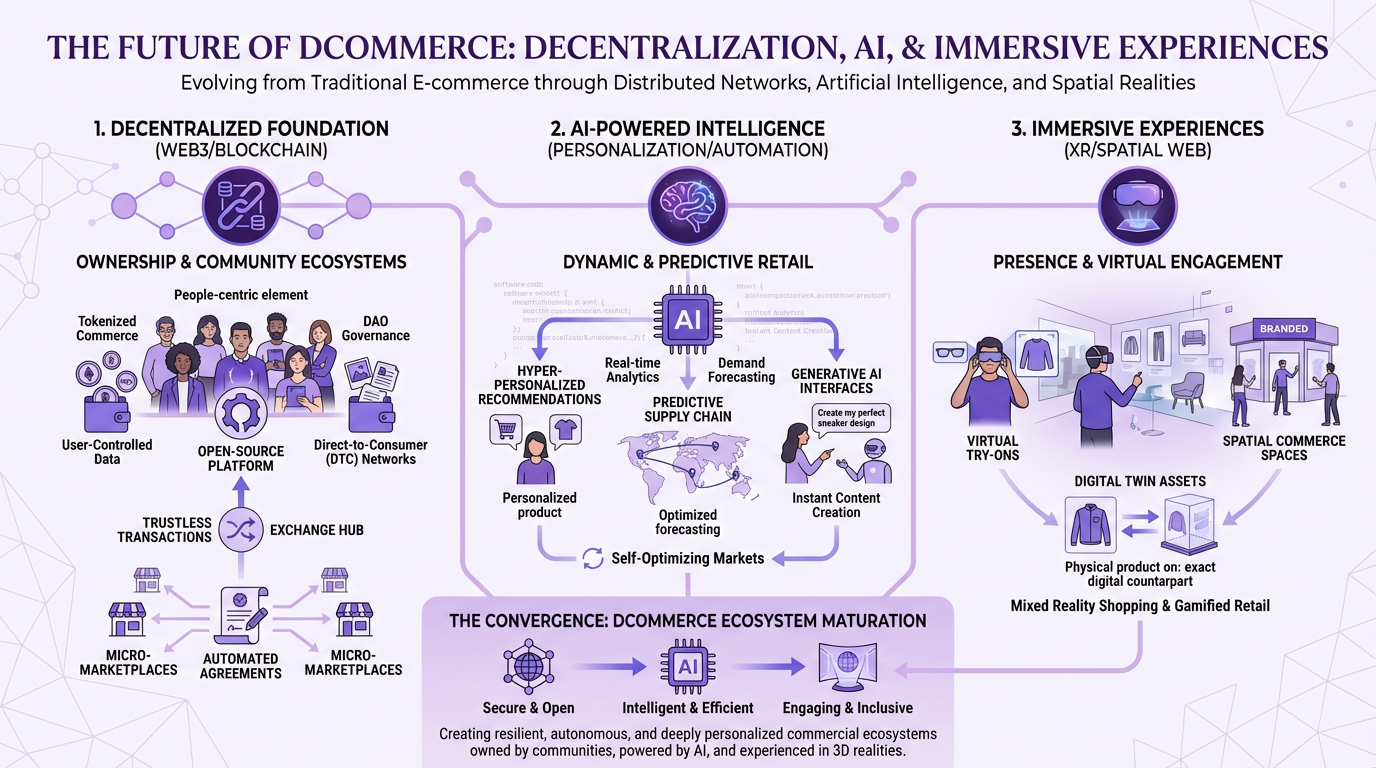
The Future of Dcommerce: Decentralization, AI, and Immersive Experiences
The landscape of digital commerce is undergoing a profound transformation, driven by advancements in blockchain technology, artificial intelligence, and immersive digital experiences. This evolution is giving rise to Dcommerce, or decentralized commerce, a paradigm shift that promises greater transparency, security, and user control. As we look ahead, understanding the trajectory of Dcommerce is crucial for businesses aiming to stay competitive and innovative. The future isn't just about new payment methods; it's about re-architecting the very foundations of how transactions occur and value is exchanged online. Businesses exploring these cutting-edge
Dcommerce Platforms are positioning themselves at the forefront of this digital revolution.
Key Dcommerce Future Statistics
• The global blockchain market, a foundational technology for Dcommerce, is projected to reach over $163 billion by 2029, growing at a CAGR of 56.3% from 2022.
• Over 70% of consumers are willing to pay more for products from brands that offer transparent and ethical supply chains, a core promise of Dcommerce.
• The metaverse market, which will heavily influence immersive Dcommerce experiences, is estimated to reach $678.8 billion by 2030.
• AI in e-commerce is expected to drive $340 billion in revenue by 2027, enhancing personalization and operational efficiency within Dcommerce ecosystems.
The Rise of Decentralized Infrastructure
At the heart of the future of Dcommerce lies the continued development and adoption of decentralized infrastructure. This means moving away from centralized intermediaries that currently control most online transactions and data. Blockchain technology provides the backbone for this shift, enabling peer-to-peer interactions without the need for trusted third parties. This fundamental change impacts everything from supply chain management to payment processing and data ownership.
Blockchain's Expanding Role Beyond Payments
While often associated with cryptocurrencies, blockchain's utility in Dcommerce extends far beyond simple transactions. It enables verifiable ownership of digital assets, immutable transaction records, and transparent supply chains. This transparency is critical for building trust, especially in a world increasingly concerned with product authenticity and ethical sourcing. The integration of
Blockchain in commerce is not just a theoretical concept; it's becoming a practical reality for many forward-thinking enterprises.
| Blockchain Application | Best For | Difficulty | ROI Potential |
|---|
| Supply Chain Tracking | Verifying product origin & authenticity | Medium | Very High |
| Digital Asset Ownership | NFTs, virtual goods, intellectual property | Medium | High |
| Decentralized Identity | Secure user authentication & privacy | Hard | High |
| Smart Contracts | Automated agreements & escrow services | Medium | Medium |
Artificial Intelligence and Personalization in Dcommerce
Artificial intelligence will play an increasingly vital role in shaping the future of Dcommerce, enhancing personalization, optimizing operations, and improving the overall user experience. Unlike traditional e-commerce where AI often serves centralized platforms, in Dcommerce, AI can be leveraged in a more distributed and privacy-preserving manner.
AI-Powered Discovery and Recommendation Engines
Future Dcommerce platforms will utilize AI to create highly personalized shopping experiences, recommending products and services based on individual preferences, past behavior, and even biometric data (with user consent). These AI systems will be more sophisticated, capable of understanding nuanced user intent and adapting dynamically. This level of personalization will be crucial for improving
User experience Dcommerce platforms offer.
5-Step AI Integration Framework for Dcommerce
Data Decentralization Strategy — Define how user data will be stored and accessed in a privacy-preserving, decentralized manner, ensuring users retain control over their information. This is foundational for ethical AI deployment.
AI Model Selection & Training — Choose appropriate AI models (e.g., recommendation engines, fraud detection) and train them on aggregated, anonymized, or federated data sets to maintain privacy while achieving accuracy.
Smart Contract Integration — Embed AI-driven logic into smart contracts to automate processes like dynamic pricing, personalized discounts, or dispute resolution based on AI analysis.
User Interface Layer Development — Design intuitive interfaces that leverage AI for personalized product discovery, virtual assistants, and seamless interaction within the Dcommerce environment.
Continuous Optimization & Feedback Loops — Implement mechanisms for ongoing AI model refinement based on user interactions and feedback, ensuring the system evolves with user needs and market trends.
Immersive Experiences and the Metaverse
The convergence of Dcommerce with immersive technologies like virtual reality (VR), augmented reality (AR), and the nascent metaverse represents a significant frontier. These technologies promise to transform how consumers interact with products and brands, moving beyond flat 2D interfaces to rich, interactive 3D environments.
Expert Insight: "The true potential of Dcommerce isn't just about removing intermediaries; it's about creating entirely new forms of value exchange and interaction. Imagine owning a unique digital fashion item as an NFT, wearing it in a metaverse social space, and then being able to 'burn' it to receive a physical, custom-made counterpart. This blurs the lines between digital and physical ownership in ways traditional e-commerce can't touch."
Virtual Showrooms and Digital Assets
Future Dcommerce platforms will feature virtual showrooms where customers can explore products in 3D, try on clothing using AR, or even test drive virtual vehicles. The concept of digital ownership, facilitated by NFTs and decentralized identity, will allow users to truly own and trade virtual goods, creating entirely new economies within these immersive spaces. This will profoundly impact how businesses approach
Marketing Dcommerce platforms.
Diagram: Dcommerce Immersive Experience Flow
[User Enters Metaverse/VR Store] → [Browse Digital Assets (NFTs) & Physical Products (AR)] → [Interact with AI Assistant for Personalization] → [Execute Decentralized Transaction via Smart Contract] → [Receive Digital Asset &/or Physical Product Delivery] → [Feedback Loop to AI/Platform Optimization]
Regulatory Evolution and Scalability
As Dcommerce matures, the regulatory landscape will inevitably evolve to address new challenges related to digital asset ownership, cross-border transactions, and consumer protection in decentralized environments. Simultaneously, achieving scalability will be paramount for widespread adoption, ensuring that these platforms can handle a massive volume of transactions efficiently and cost-effectively.
Navigating the Regulatory Frontier
Governments and international bodies are beginning to grapple with how to regulate decentralized technologies without stifling innovation. The future will likely see a blend of self-regulation within Dcommerce communities and targeted legislative frameworks that provide clarity and protection. Understanding the evolving
Regulatory landscape Dcommerce operates within will be critical for platform builders and users alike.
Frequently Asked Questions
What is the primary driver of the future of Dcommerce?
The primary driver is the ongoing shift towards decentralization, enabled by blockchain technology, which aims to remove intermediaries, enhance transparency, and give users more control over their data and transactions. This fundamental change underpins many of the innovations seen in the Dcommerce space.
How will AI impact Dcommerce in the coming years?
AI will significantly enhance personalization, optimize operational efficiencies, and improve user experience in Dcommerce. It will power more sophisticated recommendation engines, fraud detection systems, and automated customer service, often operating in a privacy-preserving manner within decentralized frameworks.
What role do immersive technologies play in future Dcommerce?
Immersive technologies like VR, AR, and the metaverse will transform Dcommerce by creating interactive 3D shopping experiences, virtual showrooms, and new economies for digital assets. They will allow consumers to engage with products and brands in more engaging and personalized ways than traditional 2D interfaces.
Will Dcommerce replace traditional e-commerce entirely?
While Dcommerce offers significant advantages, it is more likely to complement and integrate with traditional e-commerce rather than entirely replace it in the short to medium term. Traditional e-commerce will continue to serve a broad market, while Dcommerce will cater to users seeking greater decentralization, transparency, and ownership, particularly for digital assets and specialized goods.
Key Takeaways
- The future of Dcommerce is characterized by a fundamental shift to decentralized infrastructure, powered by blockchain, offering enhanced transparency and user control.
- Artificial intelligence will drive hyper-personalization and operational efficiency, with a focus on privacy-preserving data handling within decentralized systems.
- Immersive technologies like VR, AR, and the metaverse will create new interactive shopping experiences and economies for digital assets.
- Regulatory frameworks will evolve to accommodate decentralized commerce, requiring platforms to adapt while maintaining innovation.
- Scalability solutions will be crucial for the widespread adoption and long-term success of Dcommerce platforms.