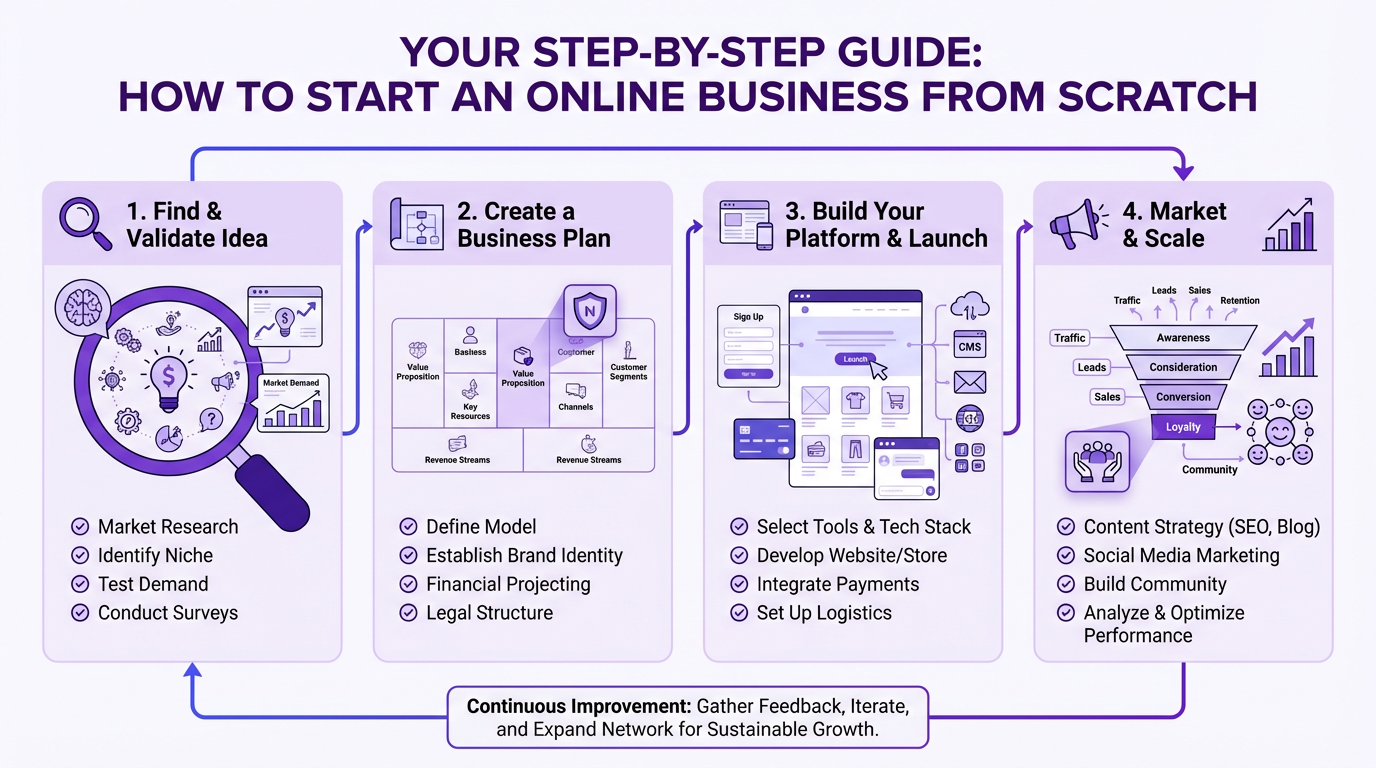
Your Step-by-Step Guide: How to Start an Online Business from Scratch
Embarking on the journey of
how to start an online business can seem daunting, but with a structured approach, it's an achievable goal for anyone with an idea and determination. The digital landscape offers unprecedented opportunities for entrepreneurs to reach global audiences, establish brands, and generate income without the traditional overheads of brick-and-mortar stores. This comprehensive guide will walk you through the essential steps, from conceptualization to launch and beyond, providing a clear roadmap for building a successful online venture and laying a solid foundation in
Online Business & E-commerce Fundamentals.
Key Online Business Startup Statistics
• 32% of small businesses in the US are exclusively online (Statista, 2023).
• The average startup cost for an online business is significantly lower than a traditional one, often ranging from $100 to $5,000 (Small Business Administration).
• 80% of new online businesses fail within the first 18 months, often due to poor planning or lack of market fit (Forbes).
• Over 50% of online businesses are started by individuals working from home (FlexJobs).
Phase 1: Idea Generation and Validation
The initial phase of starting an online business is critical for long-term success. It involves more than just having a good idea; it requires rigorous validation to ensure there's a genuine market need and a viable path to profitability. This is where many
ecommerce business ideas either take flight or are refined.
Identifying Your Niche and Target Audience
Before anything else, pinpoint what problem your business will solve or what unique value it will offer. Research your potential customers – their demographics, psychographics, pain points, and online behavior. A well-defined niche allows for targeted marketing and a stronger connection with your audience.
| Startup Task | Description | Difficulty | Impact on Success |
|---|
| Niche Research | Identifying underserved markets/problems | Medium | Very High |
| Competitor Analysis | Understanding existing solutions & gaps | Medium | High |
| Business Plan | Outlining strategy, finances, operations | Hard | Very High |
| Legal Setup | Registering business, licenses, permits | Medium | High |
Phase 2: Business Planning and Legal Structure
Once your idea is validated, formalizing your business plan and legal structure is essential. This provides a blueprint for your operations, financial projections, and ensures compliance with regulations. Neglecting this phase can lead to significant challenges down the line.
The 7-Step Online Business Launch Framework
Define Your Business Model — Decide if you'll sell products (physical or digital), services, or content. This impacts everything from platform choice to marketing.
Conduct Thorough Market Research — Understand your target audience, competitors, and market demand. Use tools like Google Trends and keyword planners.
Create a Detailed Business Plan — Outline your mission, products/services, marketing strategy, operational plan, and financial projections. This is your roadmap.
Choose Your Business Name & Legal Structure — Select a memorable name, check its availability, and register your business (e.g., sole proprietorship, LLC). Obtain necessary licenses and permits.
Build Your Online Presence — This includes selecting an e-commerce platform (e.g., best e-commerce platform for startups), designing your website, and setting up social media profiles.
Develop Your Products/Services — Create or source your offerings. For physical products, consider inventory, ecommerce shipping solutions, and supplier relationships.
Implement Marketing & Launch Strategy — Plan how you'll attract customers. This includes SEO, content marketing, social media, and paid advertising. Prepare for your official launch.
Phase 3: Building Your Online Presence
Your online presence is the storefront of your digital business. This involves selecting the right platforms, designing an intuitive user experience, and ensuring your site is secure and optimized for search engines. For those focused on selling, this is where the rubber meets the road for
selling products online.
Expert Insight: "Don't fall into the trap of 'build it and they will come.' A beautiful website with no marketing strategy is just an expensive hobby. Focus on solving a real problem for a specific audience, then relentlessly promote your solution where that audience spends their time online. Marketing isn't an afterthought; it's integrated from day one."
Website Development and E-commerce Platform Selection
Choosing the right e-commerce platform is a pivotal decision. Factors to consider include ease of use, scalability, features (e.g., inventory management, payment gateways), pricing, and customer support. Platforms range from simple website builders to robust enterprise solutions. Ensuring
online store security best practices is also paramount.
Diagram: Online Business Setup Flow
[Idea & Niche] → [Business Plan & Legal] → [Platform Selection & Website Build] → [Product/Service Development] → [Marketing & Launch] → [Analyze & Optimize]
Phase 4: Marketing and Launch
Even the best product or service won't sell itself. Effective marketing is crucial for attracting your first customers and building brand awareness. This involves a multi-faceted approach, leveraging various digital channels to reach your target audience.
Digital Marketing Strategies for New Online Businesses
Start with a clear marketing plan that outlines your target audience, messaging, and chosen channels. SEO (Search Engine Optimization) helps your site appear in search results, content marketing builds authority, social media engages your audience, and email marketing nurtures leads. Consider
multi-channel selling strategies to broaden your reach.
Phase 5: Post-Launch Optimization and Growth
Launching your business is just the beginning. Continuous monitoring, analysis, and optimization are essential for sustained growth. This involves tracking key performance indicators (KPIs), gathering customer feedback, and adapting your strategies as needed.
Analyzing Performance and Scaling Your Business
Regularly review your website analytics, sales data, and marketing campaign performance. Identify what's working and what isn't. Use this data to refine your offerings, improve your customer experience, and explore new growth opportunities, such as expanding product lines or entering new markets. This iterative process is fundamental to mastering Online Business & E-commerce Fundamentals.
Frequently Asked Questions
What are the absolute minimum requirements to start an online business?
The absolute minimum requirements include a validated idea, a chosen business name, a basic website or social media presence, and a way to accept payments. Legal registration and a detailed business plan, while highly recommended, can sometimes follow initial validation.
How much capital do I need to start an online business?
The capital needed varies significantly. Some online businesses, like freelancing or affiliate marketing, can start with less than $100. E-commerce stores with inventory might require a few thousand dollars, while complex software-as-a-service (SaaS) ventures could need much more.
Is it necessary to have a business plan for an online business?
While not legally mandatory for all structures, a business plan is highly recommended. It serves as a strategic roadmap, helping you define your goals, understand your market, plan your finances, and anticipate challenges, significantly increasing your chances of success.
How long does it typically take to start an online business?
The timeline varies widely based on complexity. A simple online service or dropshipping store might be set up in a few weeks. A more complex e-commerce site with custom products and extensive marketing could take several months to a year to fully launch and gain traction.
Key Takeaways
- Starting an online business requires a structured approach, beginning with thorough idea validation.
- A comprehensive business plan and proper legal setup are non-negotiable for long-term stability.
- Building a robust online presence, including platform selection and website design, is crucial.
- Effective digital marketing is essential for attracting customers and driving sales.
- Continuous analysis and optimization are key to sustained growth and adapting to market changes.