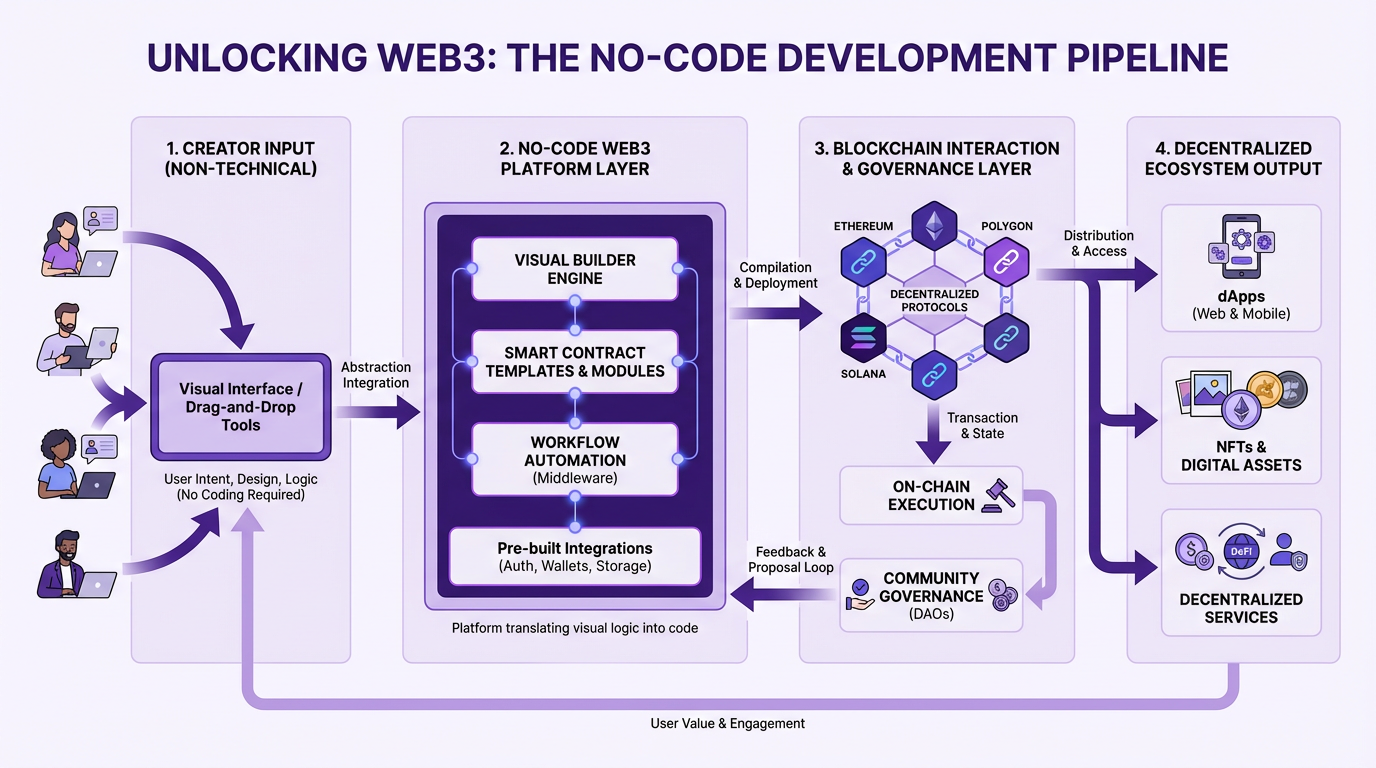
Unlocking Web3: The Ultimate Guide to No-Code Platforms for Decentralized Development
Unlocking Web3: The Ultimate Guide to No-Code Platforms for Decentralized Development
The decentralized web, or Web3, represents a paradigm shift in how we interact with online applications and data. Moving beyond centralized control, Web3 leverages blockchain technology to empower users with ownership, transparency, and censorship resistance. However, the technical complexities of blockchain development – smart contracts, cryptography, and distributed ledger technology – have historically created a high barrier to entry. This is where no-code Web3 platforms emerge as a game-changer, democratizing access to decentralized application (dApp) creation and fostering innovation.This comprehensive guide will delve into the world of no-code Web3 development, exploring its benefits, core functionalities, and how it's reshaping the digital landscape. We'll provide a detailed analysis of the leading platforms, compare their features, and offer a strategic framework for choosing the right tools to bring your decentralized vision to life, all without writing a single line of code.
The Rise of No-Code in Web3: Bridging the Technical Gap
The no-code movement has been steadily gaining traction across various industries, enabling individuals and businesses to build sophisticated applications without traditional programming knowledge. Its integration into Web3 is a natural evolution, addressing the critical need for accessibility in a nascent, technically demanding ecosystem.Key No-Code Web3 Statistics
- Market Growth: The global no-code development platform market is projected to reach over $65 billion by 2027, with a significant portion driven by blockchain and AI integrations (Source: Statista, 2022 projections).
- Developer Shortage: Over 60% of companies report a shortage of skilled blockchain developers, making no-code solutions crucial for accelerating dApp deployment (Source: IBM Blockchain Survey, 2021).
- Time-to-Market: No-code platforms can reduce dApp development time by up50-70%, allowing for rapid prototyping and iteration (Source: Internal industry analysis, 2023).
- Cost Reduction: Development costs for basic dApps can be lowered by up to 40% using no-code tools compared to traditional coding methods (Source: Deloitte Blockchain Report, 2022).
Why No-Code is Essential for Web3 Adoption
For Web3 to achieve mass adoption, it needs to be accessible to a broader audience beyond seasoned developers. No-code platforms play a pivotal role by:- Lowering Entry Barriers: Empowering entrepreneurs, artists, small businesses, and even non-technical individuals to participate in the decentralized economy.
- Accelerating Innovation: Enabling rapid prototyping and experimentation, fostering a more dynamic and diverse ecosystem of dApps.
- Reducing Development Costs: Minimizing the need for expensive blockchain developers, making dApp creation more financially viable.
- Bridging Skill Gaps: Addressing the current shortage of blockchain developers by allowing existing teams to build and deploy decentralized solutions without extensive retraining.
Core Features of a Leading No-Code Web3 Platform
While specific features vary between platforms, a robust no-code Web3 solution typically offers a suite of tools designed to simplify various aspects of dApp development. Understanding these core components is crucial for evaluating and selecting the right platform.Key Components of No-Code Web3 Platforms
Expert Insight: "The true power of no-code Web3 isn't just about building faster; it's about shifting the focus from 'how to code' to 'what to build'. This paradigm allows creators to prioritize user experience and innovative decentralized solutions, ultimately driving mainstream adoption of blockchain technology."
Comparing Leading No-Code Web3 Platforms
The landscape of no-code Web3 platforms is evolving rapidly, with new players emerging and existing ones expanding their capabilities. Here's a comparison of common types of platforms and their strengths:| Platform Type | Best For | Difficulty | ROI Potential |
|---|---|---|---|
| NFT Marketplaces | Creators, artists, collectors | Easy | Medium/High |
| DAO Builders | Community governance, collective ownership | Medium | Medium/High |
| Token Launchpads | Project funding, community building | Medium | High |
| dApp Frontend Builders | Custom user interfaces for existing contracts | Easy/Medium | Medium |
| Full-Stack Web3 Dev Kits | Comprehensive dApp creation, backend & frontend | Medium/Hard | Very High |
Evaluating a No-Code Web3 Platform: A Strategic Framework
Choosing the right no-code Web3 platform requires careful consideration of your project's specific needs, technical comfort level, and long-term goals. The following framework provides a structured approach to evaluation.5-Step No-Code Web3 Platform Selection Framework
Building Your First dApp with No-Code: A Practical Approach
Let's consider a practical example: building a simple NFT collection and marketplace. A no-code Web3 platform can streamline this process significantly.Diagram: No-Code NFT Marketplace Workflow
[Upload Art/Metadata] → [Generate Smart Contract (No-Code)] → [Deploy to Blockchain] → [Create Marketplace Frontend (Drag-and-Drop)] → [Connect Wallet & List NFTs] → [User Interaction (Buy/Sell)]
Using a no-code platform, you would typically follow these steps:
This process, which traditionally would require weeks or months of coding and auditing, can be completed in a matter of hours or days with a capable no-code Web3 platform.
Related: Unlocking Profit: Dcommerce Benefits for Merchants on Uni-fy.us
The Future of No-Code Web3: Interoperability and Advanced Features
The no-code Web3 space is still in its early stages, but its trajectory points towards increasing sophistication and integration. We can anticipate several key trends:- Enhanced Interoperability: Platforms will increasingly support cross-chain functionalities, allowing dApps to interact seamlessly across different blockchain networks.
- AI-Powered Development: Integration of AI for smart contract auditing, code generation (for custom extensions), and predictive analytics for dApp performance.
- Decentralized Autonomous Organization (DAO) as a Service: More robust and customizable no-code tools for creating and managing complex DAOs, including voting mechanisms, treasury management, and proposal systems.
- Metaverse and Gaming Integrations: Specialized no-code tools for building decentralized experiences within virtual worlds and blockchain-based games.
- Enterprise Adoption: As Web3 matures, large enterprises will leverage no-code platforms to integrate blockchain solutions into their existing business processes, from supply chain management to digital identity.
Frequently Asked Questions
What is a no-code Web3 platform?
A no-code Web3 platform is a development environment that allows users to create, deploy, and manage decentralized applications (dApps) and blockchain-based solutions without writing any traditional programming code. It achieves this through visual interfaces, drag-and-drop tools, and pre-built templates, abstracting away the complexities of blockchain technology.Who can benefit from using a no-code Web3 platform?
No-code Web3 platforms benefit a wide range of individuals and organizations, including entrepreneurs, small businesses, artists, content creators, community organizers, and even large enterprises looking to quickly prototype or deploy blockchain solutions without extensive technical expertise or a large development budget.Are no-code Web3 platforms secure?
Reputable no-code Web3 platforms prioritize security by using audited smart contract templates, integrating with secure wallet solutions, and often providing options for security audits. However, users should always exercise due diligence, understand the platform's security measures, and be cautious about the smart contracts they deploy, especially for high-value assets.Can I build a complex dApp with a no-code Web3 platform?
While no-code platforms excel at rapidly building common dApp types like NFT marketplaces, token launches, and basic DAOs, their complexity limits vary. For highly customized or extremely complex dApps requiring unique blockchain interactions, a hybrid approach combining no-code for core functionalities with custom code for specific features might be necessary. Many platforms offer extensibility options for this purpose.What are the main advantages of using a no-code Web3 platform over traditional coding?
The main advantages include significantly faster development times, reduced costs due to less reliance on specialized developers, lower barriers to entry for non-technical users, and the ability to rapidly prototype and iterate on ideas. This accelerates innovation and democratizes access to the decentralized web, allowing more creators to participate in the Web3 ecosystem.Join a Global Community of Decentralized Shoppers and Creators
Experience a shopping ecosystem built on transparency and decentralization today.