Empowering Direct Trade: The Rise of Peer-to-Peer Commerce Solutions
Empowering Direct Trade: The Rise of Peer-to-Peer Commerce Solutions
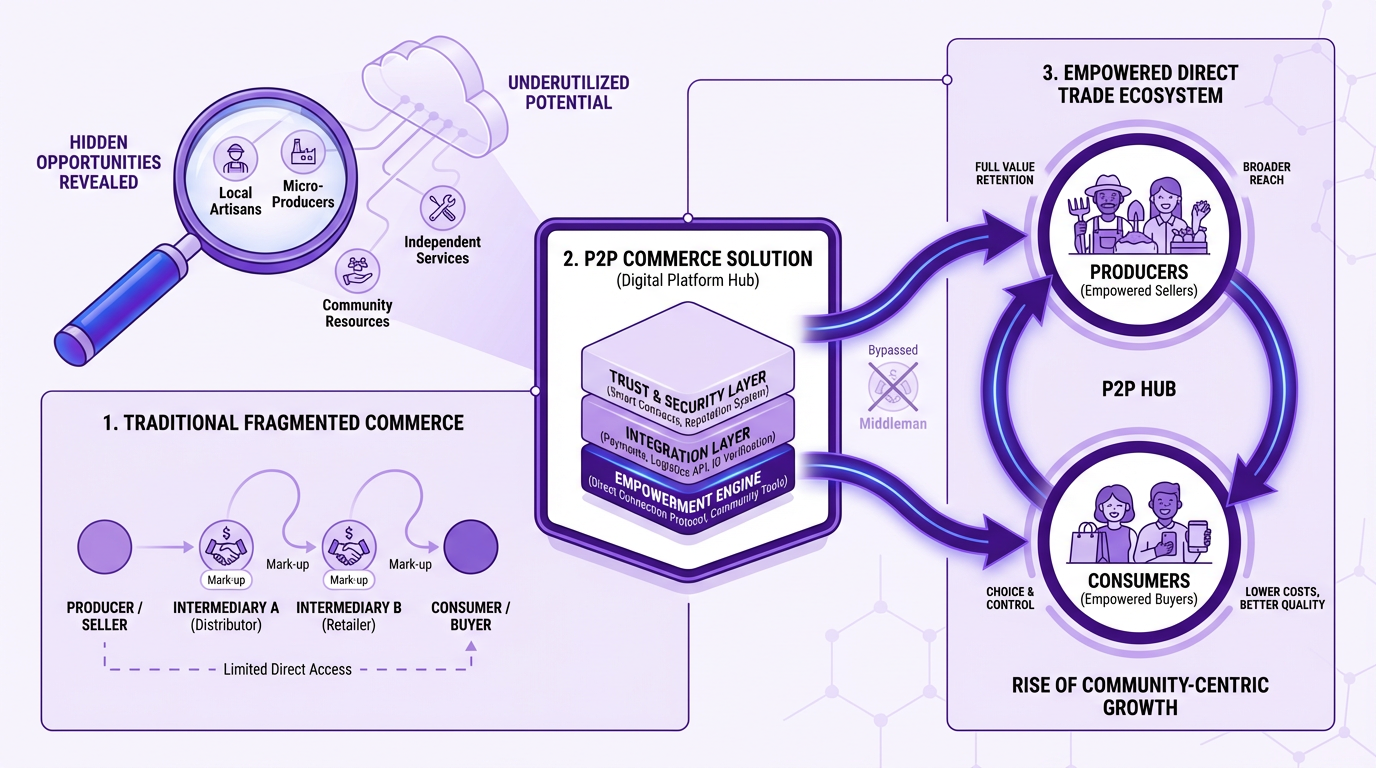
Peer-to-peer (P2P) commerce solutions are fundamentally reshaping how individuals and businesses interact, facilitating direct transactions without the need for traditional intermediaries. This model, deeply rooted in the principles of decentralization, empowers users by giving them greater control over their exchanges, reducing costs, and fostering trust through transparent, auditable processes. As a critical component of the broader movement towards Decentralized Commerce Platforms, P2P solutions are not just a technological advancement but a philosophical shift towards a more equitable and efficient global marketplace.Historically, P2P systems gained prominence in file sharing, but their application in commerce is far more transformative. By leveraging blockchain technology, modern P2P commerce solutions can ensure secure payments, verifiable product information, and immutable transaction records. This article explores the mechanics, benefits, and strategic considerations for implementing and engaging with these powerful direct trade systems.
Key Peer-to-Peer Commerce Statistics • Global P2P crypto transaction volume increased by over 50% in 2021, indicating growing adoption for direct exchanges. • P2P lending platforms processed over $250 billion in loans globally by 2020, demonstrating the viability of direct financial interactions. • Studies show that P2P marketplaces can reduce transaction fees by up to 90% compared to traditional platforms. • Over 30% of consumers express a preference for direct-to-consumer (D2C) models, a trend P2P commerce naturally extends.
The Mechanics of Peer-to-Peer Commerce
At its core, peer-to-peer commerce eliminates the central authority that typically facilitates transactions in traditional e-commerce. Instead, buyers and sellers connect directly, often through a decentralized network or protocol. This direct connection is secured and verified by cryptographic methods and, increasingly, by blockchain technology. The absence of a middleman translates to lower fees, faster settlements, and enhanced privacy.Blockchain's Role in P2P Trust
Blockchain technology is a game-changer for P2P commerce. It provides an immutable ledger for recording transactions, ensuring transparency and preventing fraud. Smart contracts, self-executing agreements stored on the blockchain, automate the terms of trade, from payment release upon delivery to dispute resolution. This creates a trustless environment where participants don't need to trust each other or a third party, only the code.| Feature | Peer-to-Peer Commerce | Traditional E-commerce |
|---|---|---|
| Intermediary | Minimal/None | Centralized platform |
| Transaction Fees | Low/Zero (network fees only) | High (platform commission) |
| Control | User-centric | Platform-centric |
| Transparency | High (blockchain) | Moderate (platform's discretion) |
| Payment Method | Primarily crypto | Fiat, credit cards |
Benefits and Challenges of P2P Commerce Solutions
The advantages of peer-to-peer commerce are compelling. Beyond cost reduction, P2P solutions offer increased censorship resistance, meaning transactions cannot be easily blocked or reversed by a central authority. They also foster greater financial inclusion, allowing individuals in underserved regions to participate in global trade without needing traditional banking infrastructure. This aligns well with the principles of community-governed commerce platforms.5-Step P2P Commerce Implementation Framework
The Future of Direct Trade and P2P Solutions
As the digital economy evolves, peer-to-peer commerce solutions are poised for significant growth. They offer a powerful alternative to centralized marketplaces, particularly for niche markets and communities seeking greater autonomy. The integration of NFT marketplace platforms often leverages P2P principles for direct creator-to-collector sales, bypassing traditional galleries.Expert Insight: "The real innovation in P2P commerce isn't just about removing the middleman; it's about re-establishing trust through technology rather than institutions. When you empower individuals to transact directly, you unlock economic potential that was previously stifled by fees, regulations, and censorship. This is the essence of true economic freedom in the digital age."Furthermore, the development of decentralized storefront builders will make it even easier for individuals and small businesses to launch their own P2P-enabled shops, further democratizing access to global markets. The emphasis on privacy-preserving Dcommerce will also drive innovation in how P2P transactions are conducted, ensuring user data remains protected.
Diagram: P2P Commerce Transaction Flow Buyer (Wallet) → Smart Contract (Escrow) → Seller (Wallet) → Product/Service Delivery → Buyer Confirmation → Smart Contract (Release Funds) → Seller Receives Payment
Frequently Asked Questions
How do peer-to-peer commerce solutions ensure trust without a central authority?
P2P commerce solutions leverage blockchain technology and smart contracts to establish trust. Transactions are recorded immutably on a public ledger, and smart contracts automatically execute terms, holding funds in escrow until conditions are met, eliminating the need for a trusted third party.What are the main advantages of P2P commerce for sellers?
For sellers, P2P commerce offers lower transaction fees, direct access to buyers, greater control over their listings and data, faster payment settlements, and increased resistance to censorship or platform restrictions, leading to potentially higher profit margins.Are P2P commerce transactions truly anonymous?
While P2P transactions on public blockchains are pseudonymous (wallet addresses are visible, but not directly linked to real-world identities), they are not entirely anonymous. Enhanced privacy features and zero-knowledge proofs are being developed to offer more robust privacy-preserving Dcommerce options.What types of goods or services are best suited for P2P commerce?
P2P commerce is well-suited for a wide range of goods and services, including digital assets (like NFTs), cryptocurrencies, unique physical products, and freelance services. Its direct nature is particularly beneficial for niche markets and direct-to-consumer models.How are disputes resolved in a P2P commerce environment?
Dispute resolution in P2P commerce often involves smart contracts with predefined arbitration mechanisms. This can range from community-voted arbitration (as seen in some DAOs) to multi-signature escrow accounts requiring agreement from a neutral third party or a predefined set of conditions to release funds.Key Takeaways
- Peer-to-peer commerce solutions empower direct trade by removing intermediaries, reducing costs, and enhancing user control.
- Blockchain technology and smart contracts are fundamental to P2P commerce, providing trustless security, transparency, and automated transaction execution.
- Key benefits include lower fees, increased censorship resistance, and greater financial inclusion, while challenges involve scalability and user education.
- A successful P2P implementation requires defining a niche, selecting robust decentralized infrastructure, developing secure smart contracts, building user-friendly interfaces, and fostering community governance.
- P2P commerce is set to grow significantly, especially for digital assets and niche markets, driving a more equitable and efficient global economy.
Join a Global Community of Decentralized Shoppers and Creators
Experience a shopping ecosystem built on transparency and decentralization today.