Empowering Direct Trade: The Rise of Peer-to-Peer Commerce Solutions
Empowering Direct Trade: The Rise of Peer-to-Peer Commerce Solutions
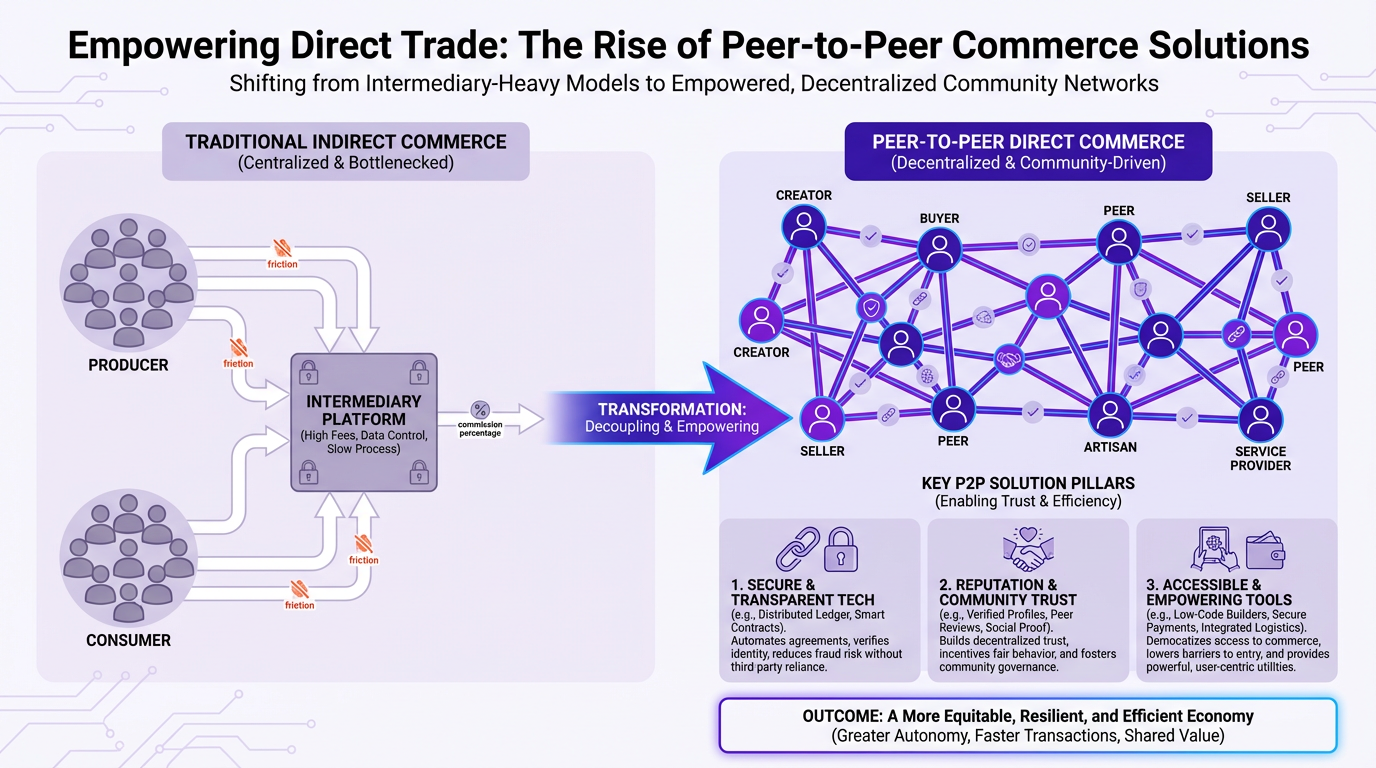
Peer-to-peer (P2P) commerce solutions are fundamentally reshaping how individuals and businesses interact and transact, cutting out traditional intermediaries and fostering direct connections. By leveraging decentralized technologies, P2P commerce empowers participants with greater control over their assets, data, and transactions, ushering in an era of truly equitable trade. This approach is a cornerstone of the broader movement towards Decentralized Commerce Platforms, emphasizing autonomy and trustless interactions.In a P2P commerce model, buyers and sellers connect directly, often facilitated by blockchain-based protocols that ensure transparency and security without the need for a central authority. This not only reduces transaction costs but also mitigates the risks associated with data breaches and censorship inherent in centralized systems. As the demand for more secure, private, and efficient online trade grows, P2P commerce solutions are becoming increasingly vital for a resilient digital economy.
Key Peer-to-Peer Commerce Statistics • Global P2P crypto trading volume exceeded $100 billion in 2022, demonstrating significant user adoption in decentralized finance. • Over 60% of consumers express a preference for direct-to-consumer (D2C) models, aligning with the direct nature of P2P commerce. • P2P platforms can reduce transaction fees by an average of 5-15% compared to traditional e-commerce marketplaces. • The number of active users on P2P trading platforms grew by 45% year-over-year in emerging markets, highlighting global demand.
The Foundational Principles of P2P Commerce
Peer-to-peer commerce is built upon principles of direct interaction, transparency, and censorship resistance. Unlike traditional commerce, where platforms act as gatekeepers, P2P solutions enable individuals to exchange goods, services, or digital assets directly with one another. This directness is often facilitated by smart contracts on a blockchain, which automate the terms of an agreement and ensure its execution without human intervention.This model inherently promotes greater privacy and data ownership. Users maintain control over their personal information and transaction history, rather than relinquishing it to a centralized entity. This aligns perfectly with the concept of Self-sovereign identity in Dcommerce, where individuals control their digital presence and data access.
Advantages Over Centralized Models
The advantages of P2P commerce over traditional centralized models are multifaceted. Reduced fees are a primary draw, as the absence of intermediaries means lower commissions and processing charges. Increased security is another significant benefit, as transactions are often cryptographically secured and immutable on a blockchain, reducing the risk of fraud and chargebacks. Furthermore, P2P platforms are inherently more resilient to single points of failure or censorship, making them ideal for truly global and unrestricted trade.| Feature | Peer-to-Peer Commerce | Centralized Commerce |
|---|---|---|
| Intermediaries | None (direct trade) | Required (platform, payment processor) |
| Fees | Low to none | High (commissions, processing) |
| Censorship Resistance | High | Low (platform can delist/ban) |
| Data Ownership | User-controlled | Platform-controlled |
| Transaction Speed | Varies (blockchain dependent) | Fast (centralized servers) |
Implementing P2P Commerce Solutions
Implementing P2P commerce solutions involves selecting the right technological stack and designing a user experience that balances decentralization with usability. Many P2P platforms are built on existing blockchain networks, leveraging their security and consensus mechanisms. The choice of blockchain impacts factors like transaction speed, cost, and the types of assets that can be traded.Key technical components include smart contracts for escrow and dispute resolution, decentralized identity protocols for user authentication, and decentralized storage solutions for product listings and media. The user interface must be intuitive, guiding users through the process of listing, discovering, and transacting in a P2P environment. This often requires a careful balance between technical sophistication and user-friendliness, especially for those new to Web3 commerce platforms.
5-Step P2P Commerce Implementation Framework
Security, Privacy, and Trust in P2P Environments
While P2P commerce inherently offers enhanced security through blockchain technology, specific measures are crucial to build trust and protect users. Smart contract audits are paramount to prevent vulnerabilities that could lead to loss of funds. Decentralized dispute resolution mechanisms, often involving community arbitrators or predefined smart contract logic, provide a fair process for resolving disagreements between parties.Privacy is another critical aspect. P2P solutions can be designed to minimize the exposure of personal data, utilizing techniques like zero-knowledge proofs or simply avoiding the collection of unnecessary information. This focus on Privacy-preserving Dcommerce is a key differentiator and a major draw for users concerned about their digital footprint.
Expert Insight: "The biggest hurdle for widespread P2P commerce adoption isn't the technology; it's the user experience and the perception of trust. While blockchain offers trustlessness, users still need confidence in the platform's ability to resolve issues and protect their assets. A well-designed dispute resolution system and clear communication are often more impactful than raw technical innovation in driving adoption for Decentralized Commerce Platforms."Reputation systems, often built on immutable blockchain records, can also play a vital role in P2P environments. These systems allow users to rate and review their transaction partners, fostering a self-regulating community where trustworthy behavior is rewarded. This creates a powerful incentive for good conduct without relying on a central authority.
Diagram: P2P Transaction Lifecycle [Buyer & Seller Connect] → [Agreement via Smart Contract] → [Funds Escrowed (Smart Contract)] → [Goods/Services Delivered] → [Buyer Confirms Receipt] → [Funds Released to Seller] → [Reputation Update]
The Future Landscape of P2P Commerce
The future of peer-to-peer commerce solutions is dynamic and expansive. We anticipate a proliferation of specialized P2P marketplaces catering to niche interests, from digital art to local services. The integration of advanced features like AI-powered matching algorithms and personalized recommendations, all while maintaining decentralized principles, will enhance user experience.Furthermore, the development of Cross-chain Dcommerce solutions will enable P2P transactions across different blockchain networks, significantly expanding the reach and liquidity of these platforms. As regulatory frameworks evolve and user familiarity with decentralized technologies grows, P2P commerce is poised to become a dominant force in global trade, offering a more equitable, efficient, and user-centric alternative to traditional models.
Frequently Asked Questions
What makes peer-to-peer commerce more secure than traditional online shopping?
Peer-to-peer commerce often uses blockchain technology and smart contracts, which cryptographically secure transactions and automate agreements without intermediaries. This reduces the risk of fraud, data breaches, and censorship, as trust is placed in code rather than a central entity.Can P2P commerce solutions handle large transaction volumes?
Scalability is an ongoing area of development in P2P commerce. While early blockchain networks faced limitations, newer layer-2 solutions and alternative blockchain protocols are designed for high transaction throughput, making P2P commerce increasingly viable for larger volumes.How do P2P commerce platforms address disputes between buyers and sellers?
P2P platforms typically employ decentralized dispute resolution mechanisms. These can involve community-elected arbitrators, pre-programmed smart contract logic, or a combination of both, ensuring a fair and transparent process for resolving disagreements without a central authority.Key Takeaways
- Peer-to-peer commerce solutions enable direct, transparent, and censorship-resistant trade by leveraging decentralized technologies.
- They offer significant advantages over centralized models, including reduced fees, enhanced security, and greater user control over data and assets.
- Successful implementation requires careful selection of blockchain technologies, robust smart contract development, and a focus on user-friendly interfaces.
- Security and trust are built through smart contract audits, decentralized dispute resolution, and privacy-preserving features.
- The future of P2P commerce includes specialized marketplaces, cross-chain interoperability, and advanced AI integration, driving a more equitable global trade landscape.