Performance Marketing vs. Affiliate Marketing: Understanding the Nuances
Performance Marketing vs. Affiliate Marketing: Understanding the Nuances
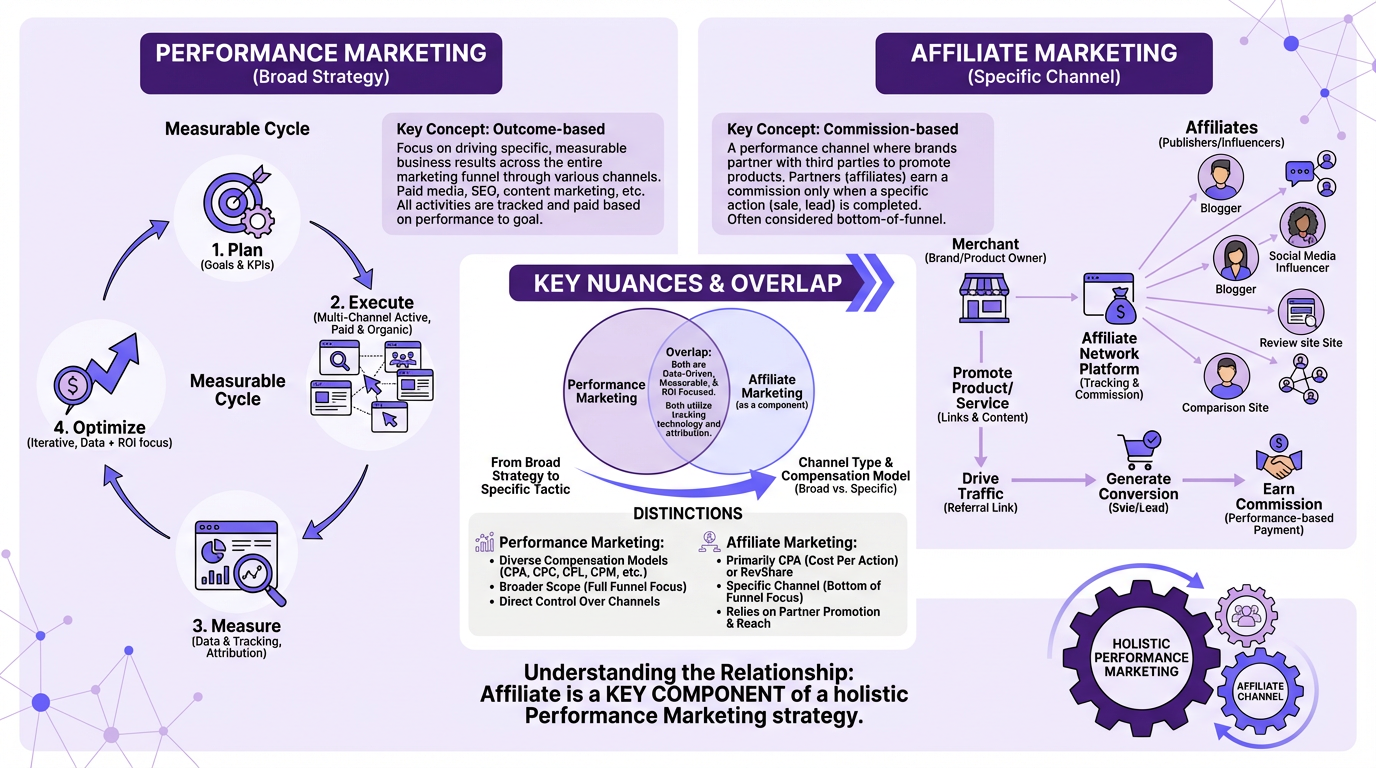
In the dynamic world of digital advertising, terms like "performance marketing" and "affiliate marketing" are often used interchangeably, leading to confusion. While closely related and sharing fundamental principles, they are distinct disciplines with different scopes, strategies, and implications for businesses and marketers. Grasping the nuances between performance marketing and affiliate marketing is crucial for anyone navigating the complex landscape of modern advertising and understanding the broader Affiliate Marketing Trends that shape the industry.At its core, performance marketing is an umbrella term for online marketing and advertising programs where advertisers pay marketing companies or publishers when specific actions are completed, such as a sale, lead, click, or app install. Affiliate marketing, on the other hand, is a subset of performance marketing, specifically focusing on partnerships where affiliates promote products or services and earn a commission for successful conversions.
Key Performance Marketing Statistics • The global performance marketing industry is projected to reach $26.7 billion by 2027. • 79% of brands use affiliate marketing as a performance marketing strategy. • Companies that invest in performance marketing see an average ROI of 12:1. • Over 70% of marketers report that performance marketing is effective in driving sales and leads.
Performance Marketing: The Broader Landscape
Performance marketing encompasses a wide array of digital marketing channels and strategies where payment is contingent on measurable results. This results-driven approach minimizes risk for advertisers, as they only pay for tangible outcomes. It's a strategic mindset that prioritizes measurable ROI across all campaigns. Key channels within performance marketing include:- Search Engine Marketing (SEM): Paid ads on search engines (e.g., Google Ads, Bing Ads) where advertisers pay per click (PPC).
- Social Media Advertising: Paid campaigns on platforms like Facebook, Instagram, LinkedIn, where payment can be per click, impression, or conversion.
- Native Advertising: Ads that blend seamlessly with the surrounding content, often paid per click or impression.
- Display Advertising: Banner ads on websites, typically paid per impression or click.
- Affiliate Marketing: As discussed, a specific model where third-party publishers (affiliates) promote products and earn commission on sales or leads.
Core Principles of Performance Marketing
The defining characteristic of performance marketing is its focus on measurable actions and a pay-for-performance model. This requires robust tracking and analytics to attribute conversions accurately. It's about optimizing campaigns in real-time based on data to achieve the best possible return on investment.| Channel | Payment Model | Primary Goal | Risk for Advertiser |
|---|---|---|---|
| SEM (PPC) | Cost Per Click (CPC) | Traffic, Leads, Sales | Low (only pay for clicks) |
| Social Ads | CPC, CPM, CPA | Awareness, Engagement, Sales | Medium (can optimize) |
| Affiliate Marketing | Cost Per Action (CPA) | Sales, Leads | Very Low (only pay for conversions) |
| Display Ads | CPM, CPC | Awareness, Retargeting | Medium (can be optimized) |
Affiliate Marketing: A Specialized Performance Channel
Affiliate marketing is a specific type of performance marketing where a business rewards one or more affiliates for each visitor or customer brought by the affiliate's own marketing efforts. It's characterized by a partnership model where affiliates act as external sales agents or promoters. The payment model is almost exclusively based on a specific action, typically a sale (Cost Per Sale - CPS) or a lead (Cost Per Lead - CPL), making it one of the lowest-risk forms of advertising for merchants. This focus on direct conversions makes it a powerful component of many successful affiliate marketing strategies.The 4-Step Affiliate Marketing Cycle
Key Differences and Overlaps
The primary distinction lies in scope. All affiliate marketing is performance marketing, but not all performance marketing is affiliate marketing. Performance marketing is the overarching strategy of paying for results across various channels, while affiliate marketing is a specific method within that strategy, relying on a network of external partners. Both emphasize data, tracking, and optimization, but affiliate marketing adds the layer of partner relationship management.Expert Insight: "Many businesses mistakenly view affiliate marketing as a standalone tactic. It's far more effective when integrated into a broader performance marketing strategy. Think of it as a highly specialized, low-risk sales channel that can amplify your overall reach and conversion rates, especially when combined with other data-driven efforts like paid search and social. The synergy is where the real power lies."
Strategic Implications for Businesses
For businesses, understanding this distinction helps in allocating budgets and resources effectively. A business might run a performance marketing campaign that includes PPC ads, social media ads, and an affiliate program. Each component is managed with a performance mindset, but the affiliate program requires specific management of partners, commission structures, and fraud prevention. This integrated approach is vital for navigating the complex Affiliate Marketing Trends of today.The Integrated Performance Marketing Ecosystem
Diagram: Performance Marketing Ecosystem with Affiliate Integration [Overall Marketing Strategy] → [Performance Marketing Channels (SEM, Social, Display, Native)] → [Affiliate Marketing Program (Publishers, Networks, Tracking)] → [Customer Conversion] → [Data Analysis & Optimization] → [Feedback Loop to Strategy]
The Evolution of Both Disciplines
Both performance marketing and affiliate marketing are continually evolving. Performance marketing is becoming more sophisticated with AI-driven optimization, advanced attribution models, and programmatic advertising. Affiliate marketing is seeing growth in influencer collaborations, mobile-first strategies, and deeper integration with content marketing. The common thread is an increasing reliance on data and technology to drive measurable results and adapt to changing consumer behaviors. This continuous evolution is a hallmark of the current Affiliate Marketing Trends.Frequently Asked Questions
Is affiliate marketing always considered performance marketing?
Yes, affiliate marketing is inherently a form of performance marketing. Affiliates are paid only when a specific, measurable action (like a sale or lead) occurs, directly aligning with the pay-for-performance model that defines performance marketing.What are the main benefits of performance marketing for advertisers?
The main benefits include reduced risk (only paying for results), measurable ROI, scalability, and the ability to optimize campaigns in real-time based on data. It ensures marketing spend is directly tied to business objectives.Can I run a performance marketing campaign without an affiliate program?
Absolutely. A business can run a successful performance marketing campaign using channels like paid search, social media ads, or display advertising without incorporating an affiliate program. Affiliate marketing is one powerful component within the broader performance marketing framework, not a prerequisite.How do attribution models fit into performance and affiliate marketing?
Attribution models are critical for both. They determine which touchpoint or channel receives credit for a conversion. In performance marketing, this helps optimize budget allocation across various channels. In affiliate marketing, it ensures affiliates are accurately compensated for the sales or leads they generate, often using last-click attribution.Key Takeaways
- Performance marketing is a broad strategy where advertisers pay for measurable results (clicks, leads, sales).
- Affiliate marketing is a specific subset of performance marketing, focusing on third-party partners earning commissions for conversions.
- All affiliate marketing is performance marketing, but not all performance marketing is affiliate marketing.
- Both disciplines rely heavily on data, tracking, and optimization to achieve high ROI.
- Understanding the distinction helps businesses strategically allocate resources and manage campaigns effectively.