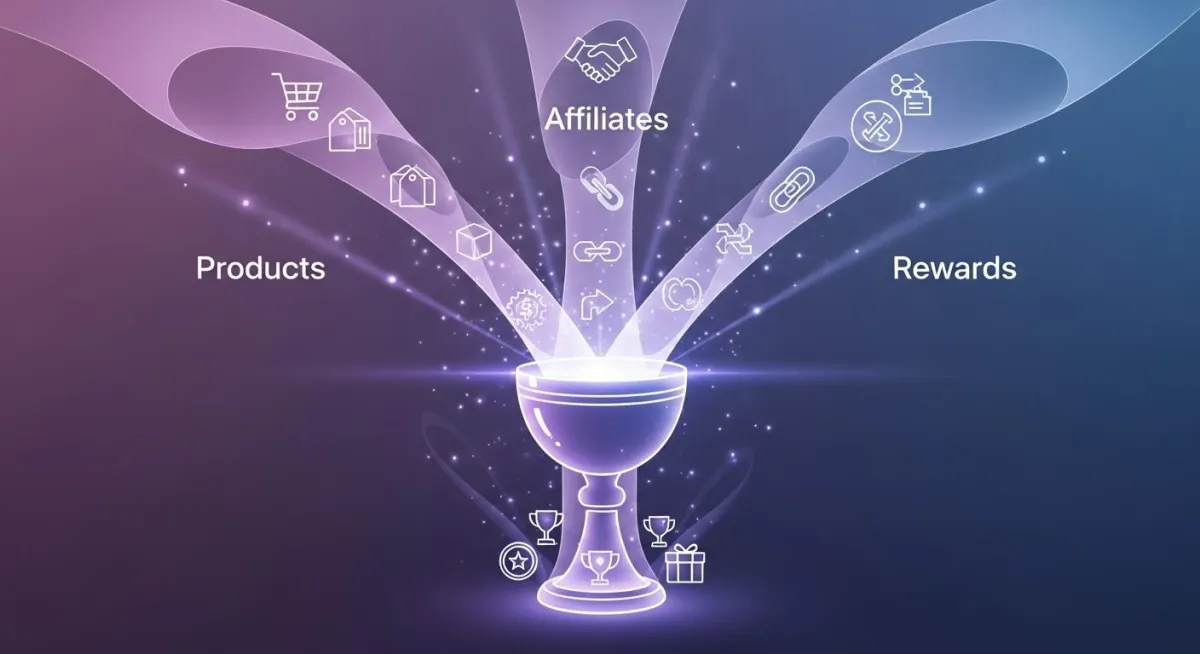
Products, Affiliates, Rewards — Why You Need a System That Connects Them All

Introduction
Most e-commerce brands don’t have a growth problem. They have a coordination problem.
Products live in one dashboard. Affiliates are managed in another. Rewards and loyalty sit somewhere else entirely.
Every system works, just not together.
So teams spend their days syncing data, fixing mismatches, chasing payouts, and explaining to customers why a reward didn’t apply or a referral didn’t track. Nothing is technically broken. It’s just exhausting. And expensive.
That chaos isn’t a rite of passage.
It’s a design flaw.
Why Fragmentation Is Quietly Killing Your ROI

On paper, multi-tool stacks look powerful.
In practice, they leak money.
Every extra platform adds:
another subscription
another learning curve
another integration that can fail
Worse, they fracture your data.
Your product system doesn’t know who your best referrers are. Your affiliate tool can’t see customer lifetime value. Your rewards engine has no context for why a customer converted.
So you end up making decisions in pieces instead of patterns. That’s not scalable growth. That’s digital juggling.
The Real Opportunity Everyone Misses

Products, affiliates, and rewards aren’t separate functions.
They’re three parts of the same growth loop.
Products give people something to believe in, Affiliates give your brand reach, Rewards give people a reason to stay involved. When these systems talk to each other, growth compounds. When they don’t, everything resets every month.
The brands winning today aren’t running better ads. They’re running better systems.
What Unification Actually Looks Like (Not the Buzzword Version)

Unification doesn’t mean everything in one login. It means one source of truth.
With a unified platform:
products update once and reflect everywhere, affiliates earn based on real contribution, not just clicks, rewards respond to actual behavior, not generic rules. Instead of duct-taping tools together, the system understands itself.
That’s the difference between automation and intelligence.
This Is Exactly What Uni-fy Was Built For

Uni-fy didn’t start as another e-commerce tool.
It started with a simple question:
Why are brands forced to manage growth in fragments?
So Uni-fy was built as a single growth engine, not a stack.
Inside Uni-fy:
products, affiliates, and rewards live in one system, contributors are tracked transparently, incentives align automatically, distribution becomes collaborative, not forced
A customer can buy, refer, earn, and return, all without leaving the ecosystem.
An affiliate can promote, track performance, and get rewarded without chasing links or reports.
A brand can see what’s actually driving revenue, in real time.
No exports.
No syncing nightmares.
No Frankenstein dashboards.
Why This Changes Everything for Brands
1. Better decisions, faster
When all data lives in one place, patterns emerge. You stop guessing and start optimizing.
2. Lower costs, higher leverage
Fewer tools. Fewer subscriptions. Less operational drag.
3. Real community-led growth
Rewards aren’t gimmicks. Affiliates aren’t outsiders. Everyone is aligned toward the same outcome.
4. Systems that scale without breaking
Adding new products, contributors, or reward structures doesn’t require rebuilding your stack.
You’re no longer managing growth. You’re designing it.
This Isn’t “Nice to Have” Anymore

Customer acquisition is getting more expensive. Attention is getting more fragmented. Trust is harder to earn.
Brands that rely purely on funnels will struggle. Brands that build ecosystems will compound.
That’s the shift Uni-fy is built for.
Not more tools.
Not more hacks.
One system that understands how growth actually works.
The Holy Grail Isn’t a Myth It’s Infrastructure

If your brand feels stretched across platforms… If growth feels harder every quarter… If your stack keeps growing but momentum doesn’t…
That’s not a marketing failure. That’s a systems problem.
Uni-fy solves it by design.
Explore how Uni-fy unifies products, affiliates, and rewards into one intelligent growth engine: here