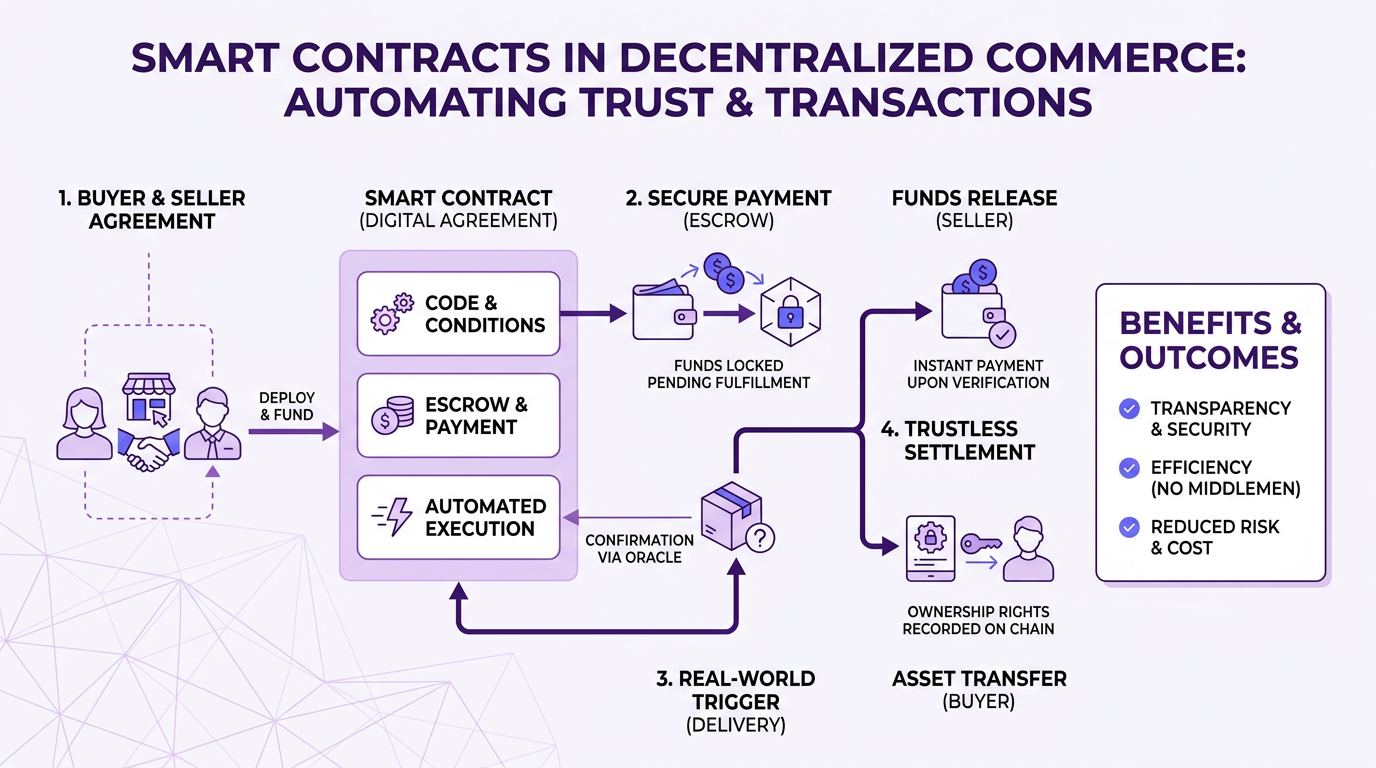
Smart Contracts in Decentralized Commerce: Automating Trust and Transactions
Smart contracts are self-executing agreements with the terms of the agreement directly written into code. They operate on a blockchain, enabling transparent, immutable, and tamper-proof transactions without the need for intermediaries. In the realm of
Decentralized Commerce, smart contracts are not just a technological enhancement; they are the foundational layer that automates trust, streamlines operations, and redefines how buyers and sellers interact. By removing the need for traditional escrow services, legal arbitration, and payment processors, smart contracts significantly reduce costs and increase efficiency, paving the way for truly peer-to-peer economic interactions. This shift is critical for building robust and resilient decentralized marketplaces.
Key Smart Contract Statistics
• The global smart contract market size was valued at USD 206.7 million in 2022 and is projected to reach USD 1.4 billion by 2030, growing at a CAGR of 27.6%.
• Over 70% of blockchain projects currently in development incorporate smart contract functionality.
• Ethereum, a leading smart contract platform, processes millions of transactions daily, many of which involve smart contract execution.
• Smart contracts have been instrumental in securing over $50 billion in DeFi protocols, demonstrating their financial utility and security.
The Core Mechanics of Smart Contracts in Commerce
At its heart, a smart contract is a piece of code that lives on a blockchain. It defines the rules and penalties around an agreement, much like a traditional contract. However, unlike traditional contracts, smart contracts automatically execute the terms when predefined conditions are met. For instance, in a purchase agreement, a smart contract could be programmed to release payment to a seller only after a tracking number confirms delivery of goods to the buyer. This automation eliminates human error, reduces fraud, and removes the need for trusted third parties.
How Smart Contracts Ensure Trustless Transactions
The trustless nature of smart contracts stems from their immutability and transparency on the blockchain. Once deployed, a smart contract cannot be altered, ensuring that the agreed-upon terms remain fixed. Every transaction and state change is recorded on the public ledger, visible to all participants, which fosters transparency. This inherent design makes them ideal for facilitating secure and verifiable transactions in a decentralized environment, from simple product purchases to complex supply chain agreements. The integration of
blockchain technology in retail is heavily reliant on these automated agreements.
| Smart Contract Type | Best For | Complexity | Security Level |
|---|
| Escrow Contracts | Secure payments, dispute resolution | Medium | High |
| Supply Chain Contracts | Tracking goods, automated payments | High | Very High |
| Royalty Distribution | Creator payouts, intellectual property | Medium | High |
| Insurance Policies | Automated claims processing | High | High |
Enhancing Efficiency and Reducing Costs
One of the most compelling advantages of smart contracts in decentralized commerce is their ability to significantly enhance operational efficiency and reduce costs. By automating processes that traditionally require manual oversight, legal intervention, or banking services, smart contracts cut down on processing times and associated fees. This efficiency gain is particularly impactful for cross-border transactions, where traditional methods can be slow and expensive.
The Role of Oracles in Smart Contract Execution
While smart contracts excel at executing logic on the blockchain, they cannot directly access real-world data. This is where oracles come into play. Oracles are third-party services that provide smart contracts with external information, such as price feeds, weather data, or shipping updates. For example, a smart contract for an insurance policy might rely on an oracle to confirm flight delays before automatically issuing a payout. Reliable oracles are crucial for the functionality and real-world applicability of smart contracts, bridging the gap between the blockchain and the physical world. This interconnectedness is vital for the broader adoption of
decentralized applications (dApps).
5-Step Smart Contract Implementation Framework for Commerce
Define Contract Logic — Clearly outline the terms, conditions, and triggers for the contract. What actions will initiate what outcomes? Who are the participants and what are their roles? This step requires a deep understanding of the business process being automated.
Choose a Blockchain Platform — Select a blockchain that supports smart contracts and aligns with your project's needs (e.g., Ethereum, Solana, Polygon). Consider factors like transaction fees, speed, security, and developer community.
Develop and Audit the Code — Write the smart contract code using a language like Solidity (for Ethereum). Rigorous auditing by security experts is crucial to identify vulnerabilities and ensure the contract behaves as intended, preventing costly exploits.
Deploy to Blockchain — Once audited and tested, deploy the smart contract to the chosen blockchain network. This makes the contract immutable and accessible to all participants.
Integrate with Oracles and User Interfaces — Connect the smart contract to necessary external data sources via oracles and build user-friendly interfaces (dApps) that allow users to interact with the contract easily. This ensures real-world utility and accessibility.
Security Considerations and Future Outlook
While smart contracts offer unparalleled security through their cryptographic nature and immutability, they are not entirely immune to risks. Bugs in the code, vulnerabilities in oracle integrations, or poorly designed contract logic can lead to significant financial losses. The infamous DAO hack is a stark reminder of the importance of thorough auditing and secure coding practices. As the technology matures, advancements in formal verification, bug bounty programs, and standardized contract templates are continuously improving their security posture.
The Evolution of Decentralized Autonomous Organizations (DAOs)
Smart contracts are also the backbone of Decentralized Autonomous Organizations (DAOs), which represent a new form of organizational structure governed by code rather than traditional hierarchies. In decentralized commerce, DAOs can manage marketplaces, resolve disputes, and even fund new projects, all through the collective decision-making of token holders, enforced by smart contracts. This evolution points towards a future where entire commercial ecosystems could be governed by transparent, automated rules, further solidifying the principles of
Decentralized Commerce.
Expert Insight: "The real power of smart contracts isn't just automation; it's the ability to codify complex business logic into an unchangeable, verifiable public record. This shifts the paradigm from 'trusting an entity' to 'trusting the code,' which is a far more robust foundation for global commerce. However, the initial design and auditing phases are paramount; a single line of flawed code can have catastrophic consequences, making expert development and security reviews non-negotiable."
Diagram: Smart Contract Lifecycle in Commerce
[Agreement Definition] → [Code Development & Audit] → [Deployment to Blockchain] → [Oracle Integration for External Data] → [Automated Execution upon Conditions Met] → [Immutable Record on Blockchain]
Challenges and Adoption Hurdles
Despite their transformative potential, smart contracts face several challenges to widespread adoption in commerce. Regulatory uncertainty remains a significant hurdle, as legal frameworks struggle to keep pace with technological innovation. The technical complexity of developing and deploying secure smart contracts also presents a barrier for many businesses. Furthermore, the scalability limitations of some blockchain networks can impact transaction speed and cost, although layer-2 solutions and newer blockchain architectures are actively addressing these issues. User experience also needs significant improvement for mainstream adoption, as interacting directly with blockchain addresses and gas fees can be daunting for non-technical users.
Interoperability and Cross-Chain Commerce
For decentralized commerce to truly flourish, smart contracts need to be able to interact seamlessly across different blockchain networks. This concept, known as interoperability, is crucial for creating a unified and efficient global decentralized economy. Projects focusing on cross-chain bridges and communication protocols are working to enable assets and data to flow freely between various blockchains, expanding the reach and utility of smart contracts beyond their native ecosystems. This will unlock new possibilities for
decentralized finance (DeFi) and commerce alike.
Frequently Asked Questions
What is the primary benefit of using smart contracts in commerce?
The primary benefit is the automation of trust and transactions, eliminating the need for intermediaries. This reduces costs, increases efficiency, and provides a transparent, immutable record of agreements and their execution, fostering greater security and reliability.
Can smart contracts be changed after they are deployed?
No, smart contracts are immutable once deployed to the blockchain. Their code cannot be altered. This immutability is a core security feature, but it also means that any bugs or vulnerabilities present at deployment cannot be easily fixed, highlighting the importance of thorough auditing.
How do smart contracts handle real-world information?
Smart contracts rely on oracles to access real-world information. Oracles are external data feeds that provide smart contracts with off-chain data, such as market prices, weather conditions, or shipping updates, enabling them to execute based on real-world events.
Are smart contracts legally binding?
The legal enforceability of smart contracts is still evolving and varies by jurisdiction. While the code itself is self-executing, legal systems are working to integrate these digital agreements into existing contractual law. Some jurisdictions are beginning to recognize them as legally binding.
What are the risks associated with smart contracts?
Key risks include coding errors leading to vulnerabilities, potential for exploits, regulatory uncertainty, and the challenge of integrating them with complex real-world legal and business processes. Thorough auditing and secure development practices are essential to mitigate these risks.
Key Takeaways
- Smart contracts are self-executing, tamper-proof agreements on a blockchain, foundational for automating trust in decentralized commerce.
- They significantly enhance efficiency and reduce costs by eliminating intermediaries and manual processes, especially for cross-border transactions.
- Oracles are crucial for smart contracts to interact with real-world data, bridging the gap between blockchain logic and external events.
- While offering high security, smart contracts require rigorous development and auditing to prevent vulnerabilities and ensure correct execution.
- The future of decentralized commerce heavily relies on the continued evolution of smart contracts, including improved interoperability and clearer regulatory frameworks.