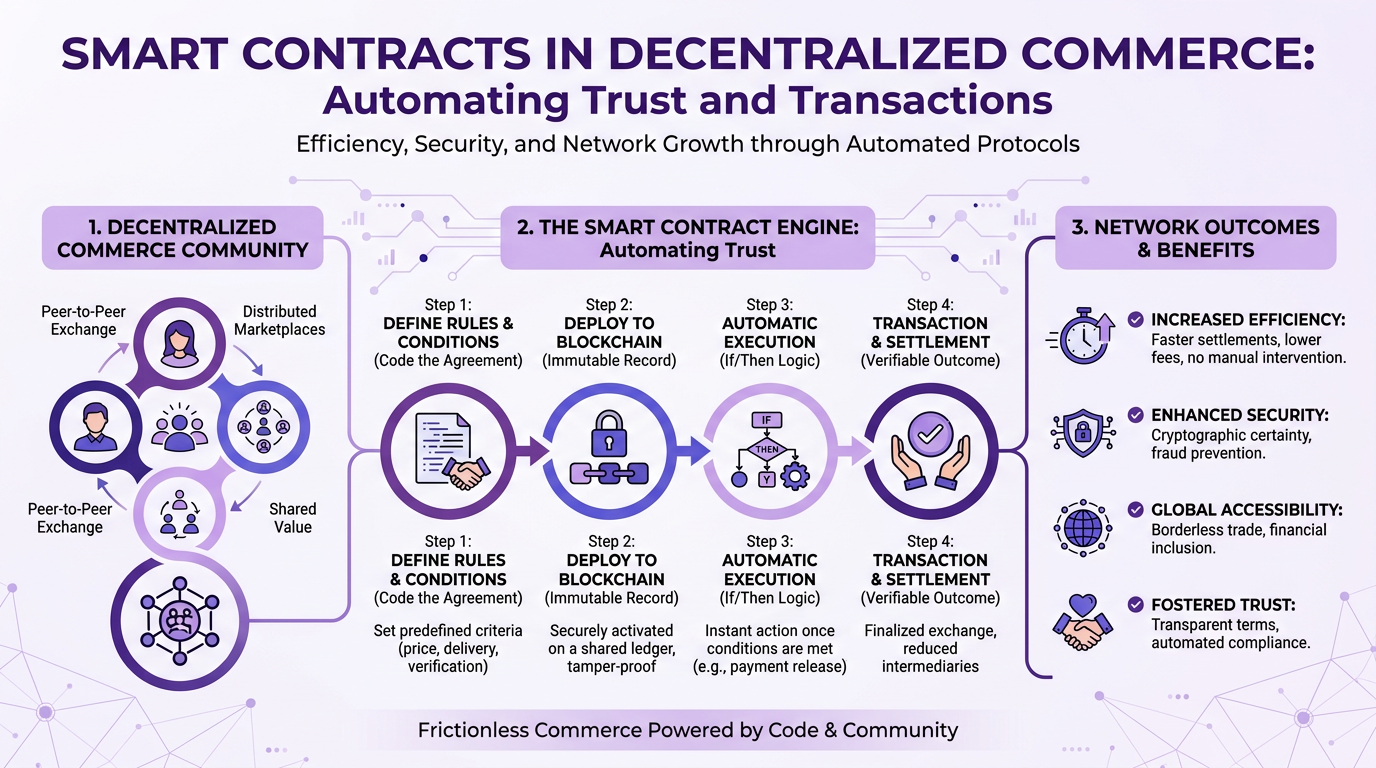
Smart Contracts in Decentralized Commerce: Automating Trust and Transactions
Smart contracts are the foundational technology enabling the automation and trustlessness inherent in
Decentralized Commerce. These self-executing agreements, with the terms of the agreement directly written into code, operate on a blockchain, removing the need for intermediaries. In the realm of decentralized commerce, smart contracts facilitate everything from secure payment processing to automated escrow services and transparent supply chain management. Their ability to execute predefined actions without human intervention or third-party oversight is revolutionizing how businesses and consumers interact, promising greater efficiency, reduced costs, and enhanced security across various transactional processes.
Key Smart Contract Statistics
• The global smart contracts market size was valued at USD 205.1 million in 2022 and is projected to grow at a compound annual growth rate (CAGR) of 83.5% from 2023 to 2030.
• Over 70% of blockchain projects currently in development incorporate smart contract functionality.
• Ethereum, the leading smart contract platform, processes millions of transactions daily, many of which involve complex smart contract interactions.
• Smart contracts have been instrumental in securing over $100 billion in DeFi (Decentralized Finance) protocols, a core component of decentralized commerce.
The Core Mechanics of Smart Contracts
At its heart, a smart contract is a piece of code stored on a blockchain that automatically executes when predetermined conditions are met. Unlike traditional contracts, which rely on legal systems and human enforcement, smart contracts are self-enforcing and immutable once deployed. This immutability means that once a contract is live, its terms cannot be altered, providing a high degree of security and predictability. The transparency of blockchain technology ensures that all participants can view the contract's code and its execution history, fostering an environment of trust without requiring parties to trust each other directly.
How Smart Contracts Function in Practice
When a smart contract is created, its rules and conditions are coded into the blockchain. For example, a contract might state: "IF product A is delivered to address B, THEN release payment C to seller D." Once product A's delivery is confirmed (often via an oracle, which feeds real-world data to the blockchain), the payment is automatically released. This eliminates the need for a bank or escrow service to hold funds, reducing fees and potential delays. This mechanism is crucial for enabling peer-to-peer transactions and fostering a truly decentralized marketplace.
| Smart Contract Type | Best For | Complexity | Security Level |
|---|
| Escrow Contracts | Secure P2P transactions, dispute resolution | Medium | High |
| Supply Chain Tracking | Verifying product authenticity, logistics | High | Very High |
| Digital Rights Management | Licensing digital assets, royalty distribution | Medium | High |
| Tokenization Contracts | Creating digital assets, fractional ownership | Medium | High |
Enhancing Trust and Efficiency in Decentralized Commerce
Smart contracts are pivotal in building trust within decentralized commerce ecosystems. By automating agreements, they remove the potential for human error, bias, or fraud that can plague traditional commerce. This automation extends to various aspects, from order fulfillment and payment processing to warranty claims and dispute resolution. The inherent transparency of blockchain ensures that all parties have an immutable record of transactions and contract states, significantly reducing the likelihood of disagreements.
Automating Payments and Escrow
One of the most immediate benefits of smart contracts in decentralized commerce is the automation of payments and the provision of secure escrow services. Instead of relying on centralized payment processors or banks, buyers and sellers can use smart contracts to hold funds in escrow until all conditions of a sale are met. This not only speeds up transaction times but also drastically reduces transaction fees. For instance, in a
decentralized marketplace, a buyer's funds could be locked in a smart contract and only released to the seller once the buyer confirms receipt of the goods, or a predefined delivery window expires. This mechanism is a cornerstone of building trust in a trustless environment.
5-Step Smart Contract Implementation Framework for Commerce
Define Contract Logic — Clearly outline all conditions, actions, and participants for the smart contract. This includes payment terms, delivery conditions, dispute resolution mechanisms, and any other relevant clauses. Precision here prevents future ambiguities.
Choose a Blockchain Platform — Select a blockchain that supports smart contracts and aligns with your project's needs (e.g., Ethereum, Solana, Polygon). Consider factors like transaction speed, cost, security, and developer community size.
Develop and Audit the Contract Code — Write the smart contract code using a language like Solidity (for Ethereum). Rigorous testing and independent security audits are crucial to identify and fix vulnerabilities before deployment, as bugs can be exploited.
Deploy to the Blockchain — Once thoroughly tested and audited, deploy the smart contract to the chosen blockchain network. This makes the contract immutable and accessible to all participants.
Integrate with DApps and Oracles — Connect the smart contract with decentralized applications (DApps) for user interaction and integrate with oracles to feed real-world data (e.g., delivery status, price feeds) into the contract, enabling it to react to external events.
Challenges and Future of Smart Contracts in Commerce
While smart contracts offer immense potential, they are not without challenges. The immutability that makes them secure also means that errors in code can be catastrophic and difficult to rectify. Furthermore, the legal enforceability of smart contracts in traditional jurisdictions is still evolving, creating a gap between technological capability and legal recognition. Scalability issues on some blockchain networks can also limit transaction throughput, impacting widespread adoption.
Overcoming Limitations with Advanced Solutions
Expert Insight: "The true power of smart contracts in commerce isn't just automation; it's the ability to create entirely new business models based on fractional ownership, dynamic pricing, and community governance. We're moving beyond simple transactions to complex, self-organizing economic entities. The legal frameworks will catch up, but the innovation won't wait."
Future developments, such as layer-2 scaling solutions, cross-chain interoperability, and more sophisticated oracle networks, are addressing these limitations. The integration of AI with smart contracts could also lead to more adaptive and intelligent agreements, capable of learning and adjusting to changing market conditions. As the technology matures and regulatory clarity improves, smart contracts will undoubtedly become an even more integral part of the evolving landscape of
Decentralized Commerce, fostering innovation in areas like
decentralized identity and automated logistics.
Diagram: Smart Contract Lifecycle in Commerce
[Contract Creation & Coding] → [Security Audit & Testing] → [Deployment to Blockchain] → [Event Trigger (e.g., Payment, Delivery Confirmation)] → [Automated Execution of Terms] → [Outcome (e.g., Fund Release, Asset Transfer)] → [Immutable Record on Blockchain]
Legal and Regulatory Landscape
The legal recognition and regulatory framework for smart contracts are still in their nascent stages. While some jurisdictions have begun to acknowledge smart contracts as legally binding, a universal standard is yet to emerge. This ambiguity can create complexities, especially in cross-border transactions. The challenge lies in translating the deterministic nature of code into the nuanced language of law, ensuring that dispute resolution mechanisms are effective and fair. As the adoption of decentralized commerce grows, so too will the pressure on legal systems to adapt and provide clear guidelines for smart contract enforceability and liability.
Frequently Asked Questions
What is the primary benefit of using smart contracts in commerce?
Smart contracts primarily benefit commerce by automating transactions and agreements, removing the need for intermediaries, and enhancing trust through immutability and transparency. This leads to reduced costs, faster execution, and minimized risk of fraud or human error.
How do smart contracts handle real-world data?
Smart contracts rely on "oracles" to feed real-world data, such as delivery confirmations, price feeds, or weather conditions, onto the blockchain. Oracles act as bridges between the off-chain world and the on-chain smart contract, enabling the contract to react to external events and execute its terms accordingly.
Are smart contracts legally binding?
The legal enforceability of smart contracts varies by jurisdiction and is an evolving area. While some legal systems are beginning to recognize them, a universal legal framework is still under development. It's crucial to consult legal professionals regarding the specific enforceability of smart contracts in your region.
Key Takeaways
- Smart contracts are self-executing, immutable agreements on a blockchain, central to the functionality of decentralized commerce.
- They automate transactions, payments, and escrow, significantly reducing costs, delays, and the need for intermediaries.
- Key benefits include enhanced trust, transparency, and efficiency in peer-to-peer and business-to-consumer interactions.
- Implementation requires careful definition of logic, platform selection, rigorous coding, security auditing, and integration with DApps and oracles.
- Challenges include code immutability, scalability, and evolving legal recognition, which are being addressed by ongoing technological and regulatory advancements.