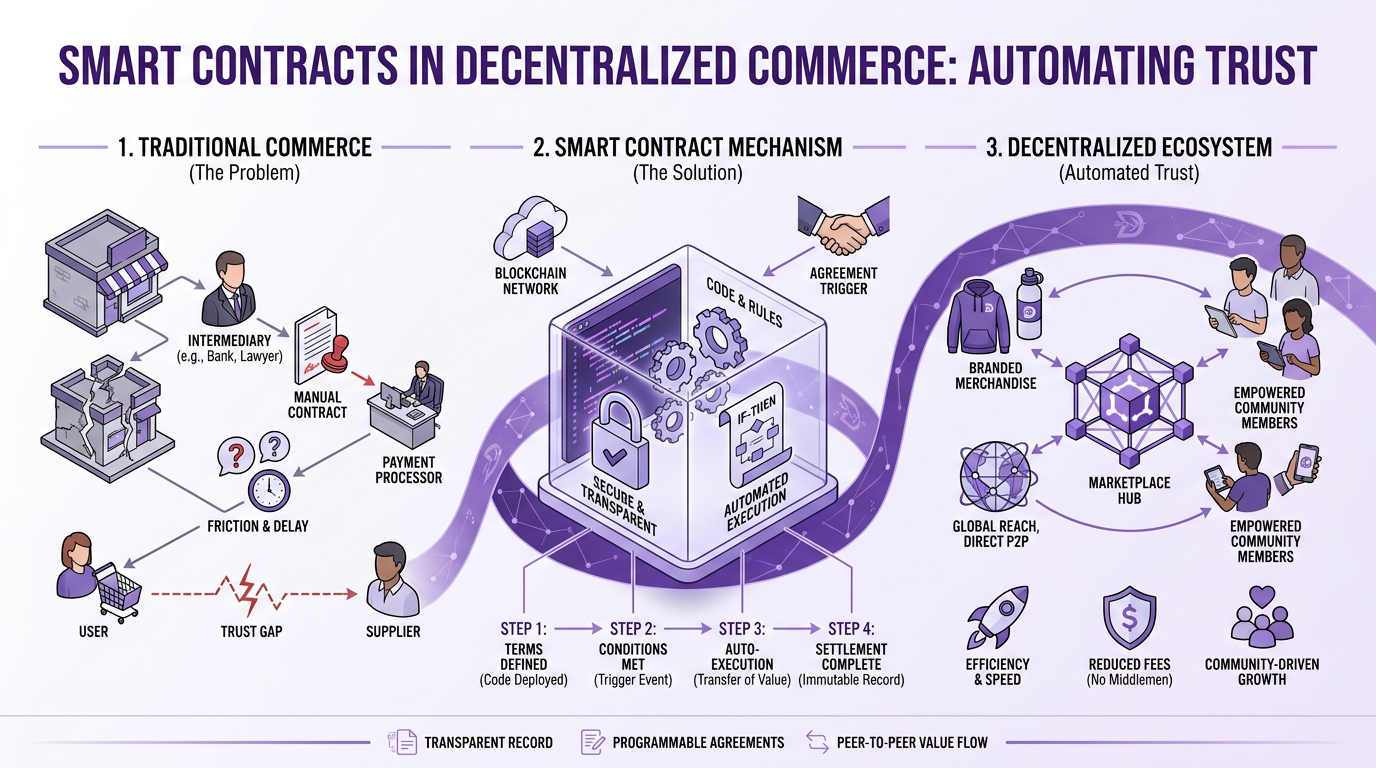
Smart Contracts in Decentralized Commerce: Automating Trust
Smart contracts are the digital backbone of
Decentralized Commerce, transforming how agreements are made and executed online. These self-executing contracts, with the terms of the agreement directly written into lines of code, run on a blockchain, automatically triggering actions when predefined conditions are met. By removing the need for intermediaries like banks, lawyers, or escrow services, smart contracts introduce an unprecedented level of automation, transparency, and trust into commercial transactions. They are not merely a technological enhancement; they represent a fundamental shift in how value is exchanged and agreements are enforced in a truly decentralized ecosystem, paving the way for more efficient, secure, and cost-effective interactions.
Key Smart Contract Adoption Statistics
• The global smart contract market size is projected to grow from USD 144.9 million in 2020 to USD 3.4 billion by 2026, at a CAGR of 70.3%.
• Over 75% of blockchain projects currently utilize smart contracts for various functionalities.
• Ethereum, a leading smart contract platform, processes millions of smart contract transactions daily.
• Smart contracts can reduce transaction costs by up to 30% by eliminating intermediaries and manual processes.
The Mechanics of Self-Executing Agreements
At its core, a smart contract is a piece of code stored on a blockchain that automatically executes when specific conditions are met. Imagine a vending machine: you put in money, select an item, and the machine dispenses it. A smart contract works similarly, but for digital agreements. The conditions and actions are cryptographically secured and transparently recorded on the distributed ledger. This eliminates the need for human intervention, reducing the potential for error, fraud, and delays. This automation is crucial for building efficient
decentralized payment systems and other commercial applications.
How Smart Contracts Ensure Trust
Because smart contracts are immutable once deployed on the blockchain, their terms cannot be altered. All parties can view the code and verify the conditions, ensuring transparency. When the conditions are met (e.g., payment received, delivery confirmed), the contract automatically executes its predefined actions (e.g., releasing funds, transferring ownership). This programmatic enforcement builds trust not on a third party's reputation, but on cryptographic certainty, a cornerstone of
blockchain technology.
| Feature | Smart Contracts | Traditional Contracts |
|---|
| Execution | Automated, Code-driven | Manual, Human-driven |
| Trust | Cryptographic, Trustless | Intermediary-based, Legal |
| Cost | Lower (no intermediaries) | Higher (legal fees, escrow) |
| Speed | Instantaneous | Slower, bureaucratic |
| Transparency | High (on blockchain) | Variable, often opaque |
Use Cases in Decentralized Commerce
Smart contracts have a myriad of applications within decentralized commerce, streamlining processes and creating new possibilities. From managing supply chains to facilitating peer-to-peer lending, their ability to automate complex agreements without central oversight is revolutionary. They are particularly vital for
decentralized marketplaces, where they handle escrow, payment release, and even dispute resolution.
Escrow and Payment Automation
One of the most impactful applications is automated escrow. In a traditional online purchase, a third-party service might hold funds until both buyer and seller confirm satisfaction. With smart contracts, the payment is locked in the contract until predefined conditions (e.g., delivery confirmation, quality inspection) are met. Once confirmed, the funds are automatically released to the seller. If conditions aren't met, the funds can be automatically returned to the buyer, all without a human intermediary. This significantly reduces transaction costs and speeds up the settlement process.
6-Step Smart Contract Development & Deployment Framework
Requirement Gathering — Define the exact commercial logic, conditions, and outcomes the smart contract needs to manage. Be precise about all possible scenarios.
Contract Design & Logic — Architect the contract's structure, functions, and data flow. Consider security best practices and potential attack vectors from the outset.
Coding (e.g., Solidity) — Write the smart contract code using a suitable language for the target blockchain (e.g., Solidity for Ethereum, Rust for Solana). Ensure code is clean, efficient, and well-commented.
Testing & Auditing — Rigorously test the contract with various inputs and edge cases. Engage independent security auditors to identify vulnerabilities and ensure correctness.
Deployment to Blockchain — Deploy the finalized and audited smart contract to the chosen blockchain network. This makes it immutable and publicly accessible.
Integration & Monitoring — Integrate the deployed contract with user interfaces (dApps) and monitor its execution. Provide clear instructions for users on how to interact with it.
Beyond Payments: Supply Chain and Identity
Smart contracts extend far beyond simple payment processing. In supply chain management, they can track goods from origin to destination, automatically triggering payments to suppliers upon delivery milestones or verifying product authenticity. For
decentralized identity, smart contracts can manage verifiable credentials, allowing users to prove attributes (e.g., age, qualifications) without revealing underlying personal data, enhancing privacy in commercial interactions. This integration of various blockchain components is what makes
web3 commerce so powerful.
Expert Insight: "Smart contracts are not just about automating existing processes; they enable entirely new business models. Imagine dynamic pricing based on real-time supply chain data, or micro-insurance policies that automatically pay out based on verifiable weather conditions. The true innovation lies in their ability to create programmable money and programmable trust, unlocking unprecedented flexibility and efficiency in commerce."
This level of automation and verifiable data flow is critical for complex commercial ecosystems, ensuring that all parties adhere to agreed-upon terms without the need for constant oversight or manual verification. The transparency offered by smart contracts also helps in reducing disputes and building stronger relationships between trading partners.
Diagram: Smart Contract-Enabled Supply Chain
[Raw Material Supplier] → [Smart Contract (Payment on Delivery)] → [Manufacturer] → [Smart Contract (Payment on Quality Check)] → [Distributor] → [Smart Contract (Payment on Retailer Acceptance)] → [Retailer]
Challenges and Future Developments
While powerful, smart contracts face challenges. The immutability that provides security also means that bugs or vulnerabilities in the code can be difficult or impossible to fix once deployed. This necessitates rigorous testing and auditing. Scalability of underlying blockchains can also limit transaction throughput. Furthermore, the legal enforceability of smart contracts in traditional jurisdictions is still evolving. However, advancements in formal verification, upgradeable contract patterns, and layer-2 scaling solutions are continually addressing these issues. As the legal framework catches up and developer tools mature, smart contracts will become an even more integral and seamless part of the global
Decentralized Commerce landscape.
Frequently Asked Questions
What is the main benefit of using smart contracts in commerce?
The main benefit is the automation of agreements without intermediaries, leading to increased efficiency, reduced costs, and enhanced trust. Smart contracts execute automatically when conditions are met, ensuring that terms are enforced precisely as coded and agreed upon by all parties.
Are smart contracts legally binding?
The legal enforceability of smart contracts is an evolving area. While the code itself is self-executing, its legal standing can vary by jurisdiction. Some countries are beginning to recognize smart contracts as legally binding, especially when they are tied to traditional legal frameworks, but it's not universally established.
What happens if there's a bug in a smart contract?
If a bug exists in a smart contract, it can be problematic because contracts are immutable once deployed. This can lead to funds being locked, incorrect execution, or security vulnerabilities. This highlights the critical importance of thorough testing, auditing, and formal verification before deployment.
Can smart contracts interact with real-world data?
Yes, smart contracts can interact with real-world data through oracles. Oracles are third-party services that provide external information (like price feeds, weather data, or delivery confirmations) to the blockchain, allowing smart contracts to react to events happening outside the blockchain network.
Key Takeaways
- Smart contracts automate commercial agreements on the blockchain, removing the need for intermediaries.
- They ensure trust through cryptographic security, transparency, and immutable, self-executing code.
- Key applications in decentralized commerce include automated escrow, payment processing, and supply chain management.
- Rigorous testing and auditing are crucial due to the immutability of deployed smart contracts.
- As blockchain technology evolves, smart contracts are set to become even more sophisticated and integrated into the future of Decentralized Commerce.