Tokenization of Assets: Unlocking New Economic Models in Decentralized Commerce
Tokenization of Assets: Unlocking New Economic Models in Decentralized Commerce
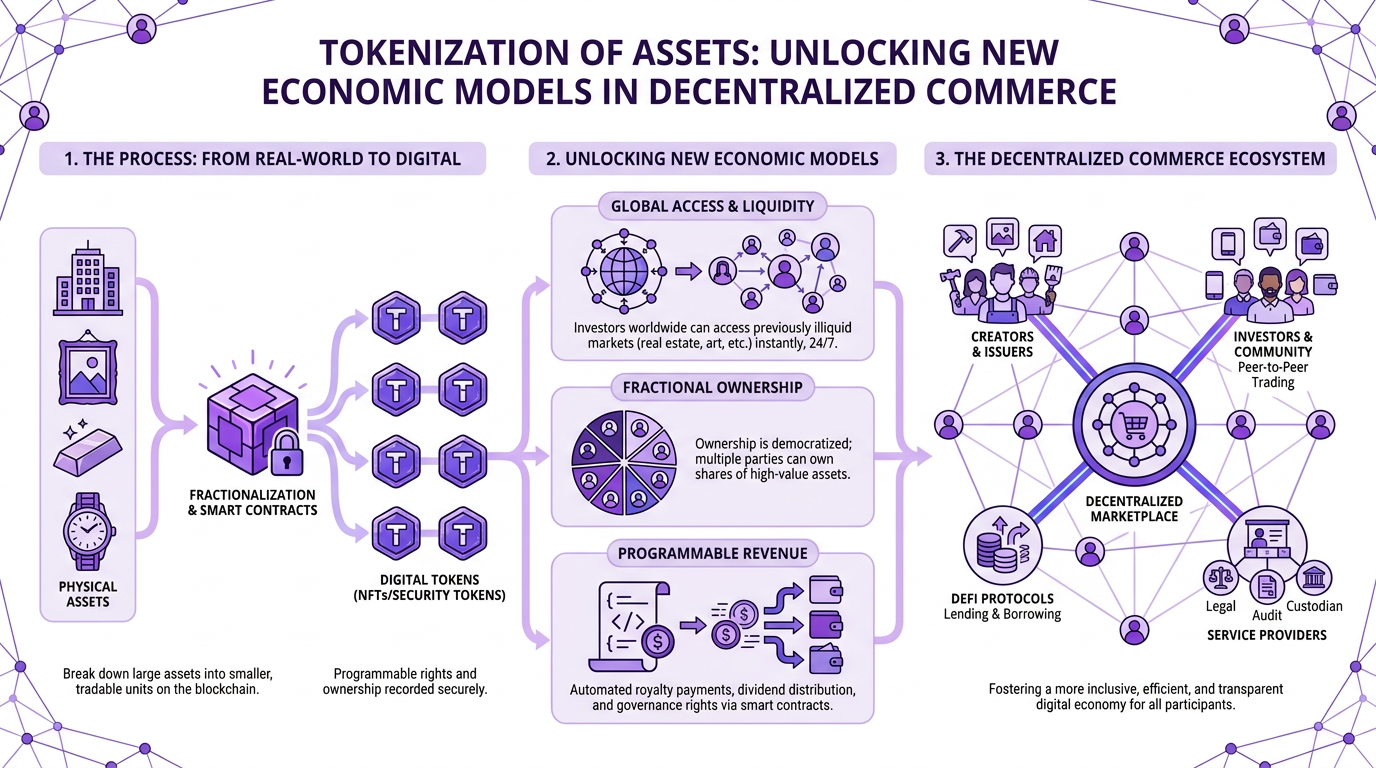
Tokenization of assets represents a revolutionary shift in how value is represented, transferred, and managed in the digital realm. By converting real-world or digital assets into blockchain-based tokens, we unlock unprecedented liquidity, fractional ownership, and transparency. This innovation is a cornerstone of Decentralized Commerce, enabling new economic models that were previously impossible or highly inefficient. From real estate and art to intellectual property and commodities, tokenization is democratizing access to investments and creating more efficient markets, fundamentally reshaping the future of trade and ownership.Key Asset Tokenization Statistics • The global market for tokenized assets is projected to reach $16 trillion by 2030, representing a significant portion of global GDP. • Real estate tokenization alone is expected to grow at a CAGR of over 60% in the coming years. • 75% of institutional investors believe tokenization will significantly impact capital markets within the next five years. • Fractional ownership enabled by tokenization can increase asset liquidity by up to 300% for traditionally illiquid assets.
Understanding the Mechanics of Asset Tokenization
Asset tokenization involves creating a digital representation of an asset on a blockchain. This digital token acts as a programmable, verifiable, and transferable record of ownership or rights associated with the underlying asset. Each token holds metadata about the asset, its ownership history, and any associated rights or obligations. The process typically involves a legal framework to link the digital token to the physical or intangible asset, ensuring enforceability in the real world.For example, a piece of real estate can be divided into thousands of tokens, each representing a fractional share of ownership. These tokens can then be bought, sold, or traded on a blockchain, much like traditional shares, but with the added benefits of blockchain's transparency, immutability, and efficiency. This process significantly lowers the barrier to entry for investors and increases the liquidity of traditionally illiquid assets.
Types of Tokens and Their Applications
Tokens can be broadly categorized into several types, each with specific applications in Decentralized Commerce:- Security Tokens: Represent ownership in an underlying asset, such as equity in a company, real estate, or a share of a fund. They are subject to securities regulations and offer investors rights like dividends or voting power.
- Utility Tokens: Provide access to a specific product or service within a blockchain ecosystem. They are not investments in the traditional sense but rather a means to interact with a decentralized application.
- Non-Fungible Tokens (NFTs): Unique, indivisible tokens representing ownership of a specific, distinct asset, such as digital art, collectibles, or unique physical items. NFTs are crucial for proving authenticity and ownership of rare goods.
- Stablecoins: Cryptocurrencies pegged to the value of a stable asset like fiat currency (e.g., USD) or commodities. They are essential for reducing volatility in decentralized transactions and facilitating payments.
| Token Type | Best For | Regulatory Status | Liquidity Potential |
|---|---|---|---|
| Security | Fractional ownership of real assets | Highly Regulated | Medium to High |
| Utility | Accessing platform services | Less Regulated | Medium |
| NFT | Unique digital/physical items | Emerging | Variable (High for rare) |
| Stablecoin | Payments, value preservation | Emerging | Very High |
Unlocking Liquidity and Fractional Ownership
One of the most significant advantages of asset tokenization is its ability to unlock liquidity for traditionally illiquid assets. Assets like real estate, fine art, or private equity are often difficult and time-consuming to buy and sell due to high transaction costs, legal complexities, and limited buyer pools. Tokenization allows these assets to be divided into smaller, more affordable units, making them accessible to a broader range of investors.This fractional ownership model democratizes investment opportunities, allowing individuals to own a small share of a high-value asset without needing to purchase the entire item. For sellers, it means faster sales cycles and access to a global pool of investors. This increased liquidity and accessibility are vital for fostering a more inclusive and dynamic decentralized economy.
5-Step Asset Tokenization Framework
Enhancing Transparency and Efficiency
Blockchain's inherent transparency ensures that all token transactions are recorded on an immutable ledger, accessible to all authorized participants. This eliminates the need for intermediaries like brokers or custodians to verify ownership, reducing costs and speeding up transactions. The audit trail provided by the blockchain enhances trust and reduces the potential for fraud or manipulation.Furthermore, smart contracts automate many of the processes associated with asset management, such as dividend payouts, royalty distributions, or voting rights. This automation reduces administrative overhead, minimizes human error, and ensures that agreements are executed precisely as programmed, leading to significant efficiencies across the asset's lifecycle.
Expert Insight: "Tokenization isn't just about putting assets on a blockchain; it's about embedding programmable logic into ownership itself. This allows for dynamic, real-time management of rights, revenue streams, and governance that traditional legal and financial systems simply can't match. The true power lies in the ability to create entirely new financial instruments and business models that are inherently more transparent and efficient, fundamentally altering how value is created and exchanged in a decentralized world."
Impact on Traditional Finance and Commerce
Tokenization is poised to disrupt traditional finance by offering a more efficient and accessible alternative for capital formation and asset management. It can reduce the time and cost associated with issuing and trading securities, making markets more efficient. In commerce, it enables new forms of ownership and value exchange, from fractional ownership of luxury goods to royalty distribution for digital content creators. This integration of real-world assets into the blockchain ecosystem is vital for the widespread adoption and utility of Decentralized Commerce.Diagram: Asset Tokenization Lifecycle Real-World Asset → Legal Structuring → Smart Contract Creation → Token Issuance → Secondary Market Trading → Automated Rights/Revenue Distribution → Governance by Token Holders
Regulatory Landscape and Future Outlook
The regulatory landscape for tokenized assets is still evolving, with different jurisdictions adopting varying approaches. Security tokens, in particular, are subject to existing securities laws, requiring careful compliance. However, regulators worldwide are increasingly recognizing the potential of tokenization and are working towards establishing clearer guidelines. This regulatory clarity will be crucial for mainstream adoption and institutional participation.As the technology matures and regulatory frameworks become more defined, tokenization is expected to become a standard practice for a wide array of assets. The future will likely see a seamless integration of tokenized assets into both traditional and decentralized financial systems, creating a more interconnected, liquid, and efficient global economy. This will further solidify the foundation for robust and scalable Decentralized Commerce platforms.
Frequently Asked Questions
What is the primary benefit of tokenizing assets?
The primary benefit is increased liquidity and fractional ownership for traditionally illiquid assets like real estate or art. Tokenization allows these assets to be divided into smaller, more affordable units, making them accessible to a broader range of investors and facilitating easier trading.Are tokenized assets regulated?
Yes, especially security tokens, which represent ownership in an underlying asset, are typically subject to existing securities regulations. The regulatory landscape is still evolving, but compliance with relevant laws is crucial for the legal and safe operation of tokenized assets.How does tokenization impact the average investor?
Tokenization democratizes investment by lowering the entry barrier for high-value assets. Average investors can now own a fraction of an asset like a commercial building or a piece of fine art, which was previously only accessible to wealthy individuals or institutions, fostering greater financial inclusion.Key Takeaways
- Tokenization converts real-world or digital assets into blockchain-based tokens, enabling fractional ownership, increased liquidity, and enhanced transparency.
- It supports various token types, including security tokens, utility tokens, NFTs, and stablecoins, each serving distinct purposes in the decentralized economy.
- Tokenization significantly boosts liquidity for traditionally illiquid assets and democratizes investment opportunities by allowing fractional ownership.
- Blockchain's transparency and smart contracts enhance efficiency, reduce costs, and automate asset management processes, building trust among participants.
- While regulatory clarity is still developing, tokenization is poised to revolutionize traditional finance and commerce, creating new economic models and driving the growth of Decentralized Commerce.