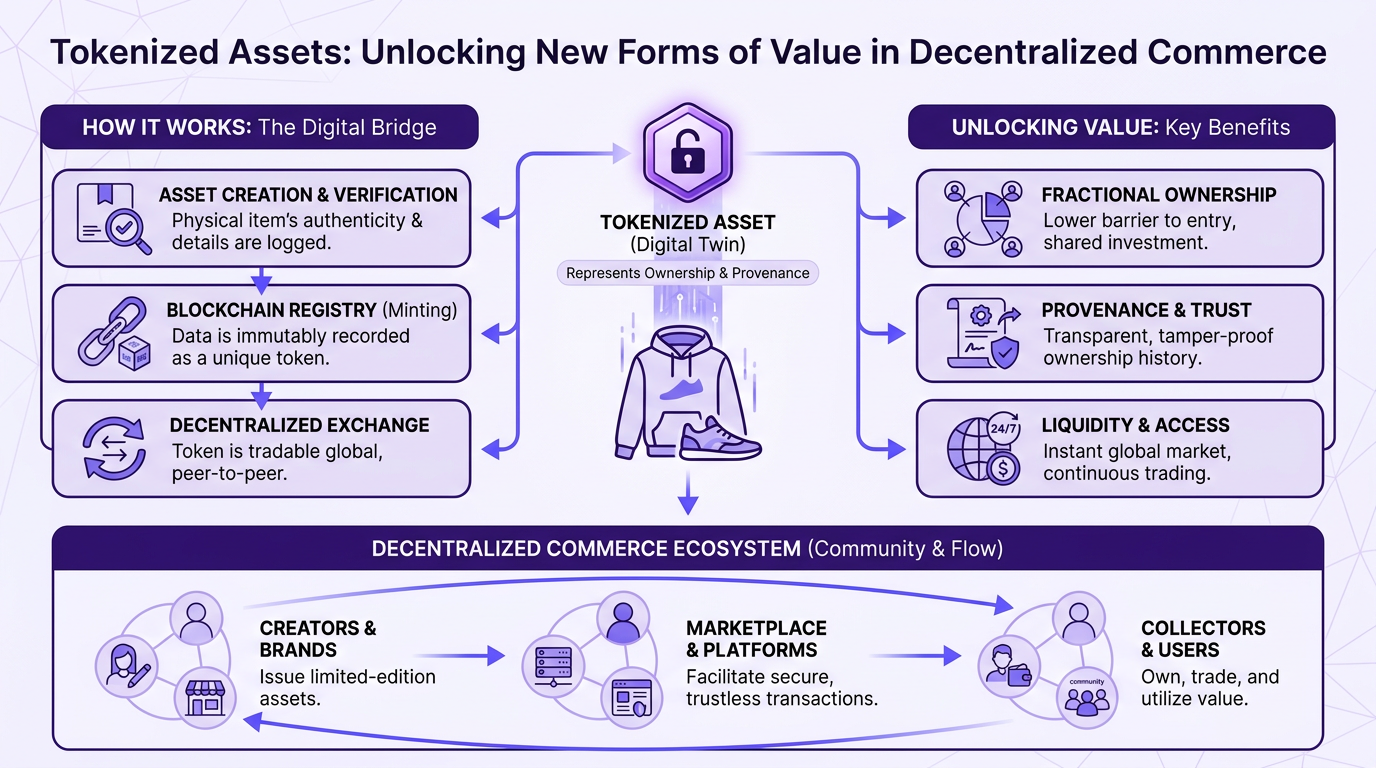
Tokenized Assets: Unlocking New Forms of Value in Decentralized Commerce
Tokenized Assets: Unlocking New Forms of Value in Decentralized Commerce
The digital revolution has consistently sought to transform physical and intangible assets into more liquid, accessible, and programmable forms. Tokenized Assets represent the pinnacle of this evolution, leveraging blockchain technology to create digital representations of real-world or digital assets. This innovation is not merely about digitizing ownership; it's about fractionalizing, democratizing access, and enabling entirely new forms of commerce that are inherently more efficient, transparent, and global. For the burgeoning field of Decentralized Commerce, tokenized assets are a foundational pillar, enabling the exchange of value in ways previously unimaginable.From real estate and art to intellectual property and even carbon credits, almost any asset can be tokenized, transforming illiquid holdings into tradable digital units. This process unlocks significant capital, reduces transaction costs, and opens up new investment opportunities for a broader range of participants, fundamentally reshaping how value is created, owned, and exchanged within decentralized ecosystems.
Key Tokenization Market Statistics • The market for tokenized real-world assets is projected to reach $16 trillion by 2030, representing a significant portion of global wealth. • Tokenization can reduce asset transfer costs by up to 70% compared to traditional methods. • Over 60% of institutional investors believe tokenization will significantly impact financial markets within the next five years. • The average settlement time for tokenized securities can be reduced from days to minutes or even seconds.
The Mechanics of Tokenization: Bridging Real and Digital Worlds
Tokenization involves creating a digital token on a blockchain that represents ownership or a share of an underlying asset. This token carries all the relevant information about the asset, including its ownership history, characteristics, and any associated rights or obligations. The blockchain's immutable ledger ensures that the ownership record is secure, transparent, and cannot be tampered with.This process effectively transforms traditional, often illiquid assets into programmable digital units that can be easily transferred, traded, and managed without the need for intermediaries. The underlying asset can be anything from a physical object like a piece of art or a building, to intangible assets like patents, royalties, or even future revenue streams. This flexibility is crucial for expanding the scope and utility of decentralized marketplaces.
Types of Tokenized Assets
Tokenized assets generally fall into a few categories:- Security Tokens: Represent ownership in traditional assets like stocks, bonds, real estate, or funds. They are subject to securities regulations.
- Non-Fungible Tokens (NFTs): Unique, indivisible tokens representing ownership of a specific, one-of-a-kind asset, often digital art, collectibles, or unique digital items.
- Utility Tokens: Provide access to a specific product or service within a blockchain ecosystem, rather than representing ownership of an external asset.
- Stablecoins: Cryptocurrencies pegged to a stable asset like fiat currency or commodities, used to maintain value stability.
| Aspect | Traditional Asset Ownership | Tokenized Asset Ownership |
|---|---|---|
| Liquidity | Often illiquid, high barriers to entry | High, fractional ownership possible |
| Transferability | Complex, slow, intermediary-heavy | Fast, peer-to-peer, blockchain-based |
| Cost | High transaction fees, legal costs | Lower transaction fees, reduced intermediaries |
| Accessibility | Limited to accredited investors/large capital | Democratized, fractional ownership |
| Transparency | Opaque, centralized records | High, immutable blockchain record |
| Programmability | Limited | High, via smart contracts |
Democratizing Access and Fractional Ownership
One of the most transformative aspects of tokenized assets is their ability to enable fractional ownership. Historically, investing in high-value assets like commercial real estate or fine art was reserved for wealthy individuals or institutions due to the prohibitive capital requirements. Tokenization breaks down these barriers by allowing assets to be divided into thousands or even millions of digital tokens, each representing a small share of the underlying asset.This means that an individual can own a fraction of a skyscraper, a famous painting, or a music royalty stream for a relatively small investment. This democratization of access opens up new investment avenues for everyday investors and significantly increases the liquidity of previously illiquid assets. Such an inclusive approach is vital for the ethos of Decentralized Commerce, promoting broader participation and wealth distribution.
5-Step Asset Tokenization Framework
Enhancing Liquidity and Reducing Transaction Costs
Traditional asset markets are often characterized by high transaction costs, lengthy settlement periods, and limited trading hours. Tokenized assets, by contrast, can be traded 24/7 on global blockchain networks, significantly enhancing liquidity. The peer-to-peer nature of blockchain transactions, facilitated by smart contracts, drastically reduces the need for costly intermediaries like brokers, custodians, and clearinghouses.Expert Insight: "Tokenization isn't just about putting assets on a blockchain; it's about embedding intelligence and programmability directly into the asset itself. This allows for automated compliance, instant settlements, and the creation of complex financial instruments that were previously too cumbersome or expensive to manage. For Decentralized Commerce, this means a future where every product, every service, every piece of intellectual property can be a liquid, tradable asset, opening up entirely new revenue streams and business models."This reduction in friction translates to lower costs for both buyers and sellers, making markets more efficient and accessible. The ability to instantly verify ownership and transfer assets globally without geographical or time zone restrictions is a powerful driver for the expansion of decentralized economic activity.
Diagram: Asset Tokenization Process [Real-World Asset (e.g., Property)] → [Legal Due Diligence & Valuation] → [Smart Contract Creation (Rules & Rights)] → [Tokens Minted on Blockchain] → [Tokens Distributed to Investors] → [Secondary Market Trading (Decentralized Exchange)] → [Value Unlocked]
The Impact on Decentralized Commerce and Beyond
Tokenized assets are poised to revolutionize Decentralized Commerce by expanding the range of goods and services that can be exchanged. Imagine buying fractional ownership in a luxury yacht, trading intellectual property rights for a new software feature, or investing in a basket of tokenized carbon credits directly within a decentralized application. This flexibility fosters innovation in business models and creates new avenues for value creation.Beyond commerce, tokenization has profound implications for financial markets, supply chain finance, and even governance. It enables more transparent and efficient capital formation, facilitates micro-investments, and allows for the creation of sophisticated financial products that are programmable and self-executing. As the infrastructure for tokenized assets matures, we will see a seamless integration of real-world value into the digital economy, driving unprecedented growth and opportunity.
Frequently Asked Questions
What is a tokenized asset?
A tokenized asset is a digital representation of a real-world or digital asset recorded on a blockchain. It allows for fractional ownership, increased liquidity, and transparent transfer of value, leveraging the security and immutability of blockchain technology.How do tokenized assets increase liquidity?
Tokenized assets increase liquidity by enabling fractional ownership, allowing more investors to participate with smaller capital. They can also be traded 24/7 on global blockchain networks, reducing settlement times and removing the need for traditional intermediaries.What types of assets can be tokenized?
Almost any asset can be tokenized, including physical assets like real estate, art, and commodities, as well as intangible assets such as intellectual property, royalties, and even future revenue streams. Digital assets like in-game items can also be tokenized as NFTs.Key Takeaways
- Tokenized assets are digital representations of real-world or digital assets on a blockchain, unlocking new forms of value exchange.
- They enable fractional ownership, democratizing access to high-value assets and increasing their liquidity.
- Tokenization significantly reduces transaction costs and settlement times by eliminating intermediaries and leveraging smart contracts.
- This technology is a cornerstone for the expansion and innovation within Decentralized Commerce, allowing for the trading of a wider array of goods and services.
- Understanding the legal and technical frameworks for tokenization is crucial for successful implementation and adoption.