Unlocking the Future of E-commerce: A Deep Dive into uni-fy DCommerce
Unlocking the Future of E-commerce: A Deep Dive into uni-fy DCommerce
The digital commerce landscape is undergoing a profound transformation, driven by the principles of Web3. At the forefront of this evolution is uni-fy dcommerce, a revolutionary approach that redefines how businesses and consumers interact in the online marketplace. Unlike traditional e-commerce, which often centralizes control and data, uni-fy dcommerce leverages decentralized technologies to empower users, enhance transparency, and foster a more equitable digital economy. This shift is not merely incremental; it represents a fundamental rethinking of ownership, value exchange, and trust in online transactions. Understanding the core tenets of uni-fy dcommerce is crucial for any business looking to thrive in the next generation of digital retail.uni-fy dcommerce is more than just a platform; it's a paradigm shift towards a more open, secure, and user-centric online shopping experience. It addresses many of the limitations inherent in current e-commerce models, offering solutions for data privacy, transaction costs, and marketplace control. For a comprehensive understanding of this innovative ecosystem, exploring the full capabilities of uni-fy dcommerce is essential.
Key DCommerce Adoption Statistics • The global blockchain in retail market size is projected to reach over $11 billion by 2028, growing at a CAGR of 29.7%. • 68% of consumers are concerned about their data privacy when shopping online, driving demand for decentralized solutions. • Transaction fees on traditional e-commerce platforms can range from 1.5% to 3.5% per sale, a significant overhead for merchants. • Over 50% of online shoppers are willing to pay more for products from brands that demonstrate transparency and ethical practices.
The Core Principles of uni-fy DCommerce
At its heart, uni-fy dcommerce is built upon several foundational principles that distinguish it from conventional e-commerce. These include decentralization, transparency, security, and user empowerment. Decentralization means that no single entity controls the entire marketplace; instead, power is distributed across a network of participants. This eliminates single points of failure and reduces the risk of censorship or manipulation. Transparency is achieved through blockchain technology, where all transactions are recorded on an immutable ledger, visible to all participants. This fosters trust and accountability, crucial elements often lacking in centralized systems.Security is inherently enhanced in a decentralized model. Cryptographic protocols protect data and transactions, making them far more resilient to cyberattacks and fraud. User empowerment is perhaps the most significant benefit, giving consumers greater control over their data, privacy, and even the governance of the marketplace itself. Merchants also benefit from lower transaction fees, direct access to their customers, and new avenues for loyalty and engagement through tokenization. This holistic approach to digital commerce is what makes dcommerce explained such a compelling topic for businesses and consumers alike.
Decentralization vs. Centralization in E-commerce
Understanding the fundamental difference between centralized and decentralized e-commerce is key to appreciating the value of uni-fy dcommerce. Traditional platforms like Amazon or Shopify operate on a centralized model, where they own and control all aspects of the marketplace, from data storage to payment processing. While convenient, this model comes with inherent trade-offs in terms of data privacy, censorship risk, and high fees. Decentralized commerce, conversely, distributes these functions across a network, often utilizing blockchain technology.| Feature | Centralized E-commerce | Decentralized E-commerce (uni-fy DCommerce) |
|---|---|---|
| Control | Single entity (platform owner) | Distributed across network participants |
| Data Ownership | Platform owns user data | Users own their data |
| Transaction Fees | High (platform commission) | Lower (network fees) |
| Transparency | Opaque (platform's discretion) | High (blockchain ledger) |
| Censorship Risk | High (platform can delist/ban) | Low (network consensus) |
| Security | Centralized vulnerability | Distributed, cryptographic security |
| Innovation | Platform-driven | Community-driven, open-source |
The Technology Powering uni-fy DCommerce
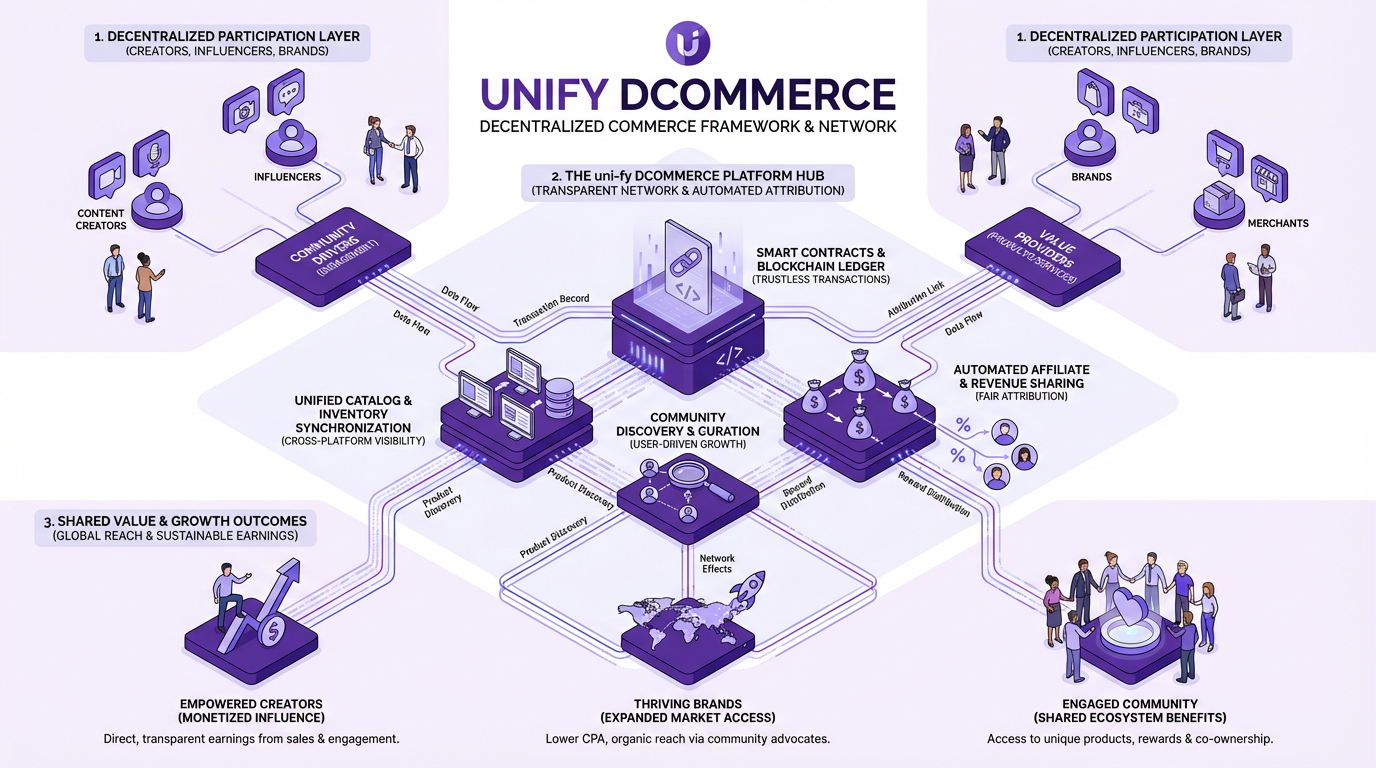
The technological backbone of uni-fy dcommerce is Web3, encompassing blockchain, smart contracts, and decentralized applications (dApps). Blockchain provides the immutable ledger for recording transactions and ownership, ensuring transparency and security. Smart contracts are self-executing agreements coded directly onto the blockchain, automating processes like payments, refunds, and escrow services without the need for intermediaries. DApps are applications that run on a decentralized network, offering user interfaces for interacting with the underlying blockchain protocols.These technologies collectively enable a new generation of e-commerce platforms that are more resilient, fair, and efficient. They facilitate direct peer-to-peer transactions, reduce reliance on third-party payment processors, and open up possibilities for new business models, such as tokenized loyalty programs and fractional ownership of digital assets. The integration of these elements is what defines a robust dcommerce platform capable of handling the complexities of modern retail.
5-Step DCommerce Implementation Framework
Implementing a uni-fy dcommerce strategy requires careful planning and execution. Here’s a framework to guide businesses through the process:Benefits and Challenges of Adopting uni-fy DCommerce
The benefits of uni-fy dcommerce are compelling, offering enhanced security, reduced costs, greater transparency, and direct customer relationships. Merchants can bypass hefty platform fees, gain full ownership of their customer data, and build more resilient supply chains. Consumers benefit from increased privacy, verifiable product authenticity, and potentially lower prices due to reduced intermediary costs. This shift is integral to the future of e-commerce web3.However, adopting uni-fy dcommerce also presents challenges. The nascent nature of Web3 technology means there's a learning curve for both businesses and users. Scalability issues, regulatory uncertainties, and the need for robust security audits are all considerations. User experience can sometimes be more complex than traditional platforms, requiring users to manage crypto wallets and understand blockchain concepts. Overcoming these hurdles will be key to widespread adoption and the success of any uni-fy dcommerce initiative.
Expert Insight: "Many businesses are hesitant to dive into dcommerce due to perceived technical complexity. The real challenge isn't the technology itself, but rather rethinking established business models and user journeys. The platforms that succeed will be those that abstract away the blockchain for the end-user, making the decentralized experience feel as seamless, if not more so, than traditional e-commerce."
The Role of NFTs and Metaverse in uni-fy DCommerce
Non-fungible tokens (NFTs) and the metaverse are poised to play a significant role in the evolution of uni-fy dcommerce. NFTs can represent unique digital or physical products, providing verifiable ownership and authenticity. This opens up new possibilities for digital collectibles, luxury goods, and even fractional ownership of high-value items. The metaverse, as an immersive virtual environment, offers new avenues for shopping experiences, allowing consumers to interact with products and brands in novel ways. Imagine trying on virtual clothes or exploring a digital showroom before making a purchase. These integrations will further enhance the value proposition of a uni-fy dcommerce ecosystem.Diagram: uni-fy DCommerce Ecosystem Flow User Wallet → Decentralized Marketplace (Smart Contracts) → Product Listing (NFT/Token) → Payment (Crypto) → Order Fulfillment (Decentralized Logistics) → Immutable Transaction Record (Blockchain) → User Feedback/Reputation (On-chain)
Building Your Own uni-fy DCommerce Presence
For businesses ready to embrace this new frontier, building a uni-fy dcommerce presence involves strategic planning and execution. It starts with understanding your target audience's readiness for Web3 technologies and identifying specific pain points that decentralization can address. Whether it's setting up a decentralized storefront or integrating blockchain for supply chain transparency, the opportunities are vast. Resources on how to build a dcommerce store are becoming increasingly available, guiding businesses through the technical and strategic considerations.Choosing the right dcommerce platform is also critical. Some platforms offer ready-made solutions, while others provide more flexibility for custom development. The decision will depend on your technical capabilities, budget, and desired level of decentralization. Regardless of the approach, focusing on user experience and education will be paramount to driving adoption and ensuring the success of your decentralized commerce venture.
Frequently Asked Questions
What is the primary difference between uni-fy dcommerce and traditional e-commerce?
uni-fy dcommerce primarily differs by leveraging decentralized technologies like blockchain, giving users more control over their data and transactions, and reducing reliance on central intermediaries. Traditional e-commerce platforms are centralized, controlling data, payments, and marketplace rules.How does uni-fy dcommerce enhance security for online transactions?
uni-fy dcommerce enhances security through cryptographic encryption, immutable blockchain ledgers, and smart contracts that automate agreements without human intervention. This significantly reduces the risk of fraud, data breaches, and censorship compared to centralized systems.Can small businesses benefit from uni-fy dcommerce?
Yes, small businesses can significantly benefit from uni-fy dcommerce by reducing transaction fees, gaining direct access to customers, and building transparent, trust-based relationships. It also opens up new avenues for funding and loyalty programs through tokenization.What are the main challenges in adopting uni-fy dcommerce?
The main challenges include the technical learning curve for businesses and users, regulatory uncertainties, ensuring scalability of blockchain networks, and developing user-friendly interfaces that abstract away Web3 complexities. Overcoming these requires strategic planning and investment.How do NFTs fit into the uni-fy dcommerce ecosystem?
NFTs in uni-fy dcommerce can represent unique digital or physical products, providing verifiable proof of ownership and authenticity. They enable new business models for digital collectibles, luxury goods, and fractional ownership, enhancing product value and consumer trust.Key Takeaways
- Decentralization is Key: uni-fy dcommerce shifts power from centralized platforms to users and a distributed network, enhancing transparency and security.
- Web3 Technologies Drive Innovation: Blockchain, smart contracts, and dApps are the foundational technologies enabling this new era of e-commerce.
- Significant Benefits, Manageable Challenges: While offering reduced costs, enhanced privacy, and direct relationships, adoption requires navigating technical complexities and regulatory landscapes.
- New Business Models Emerge: NFTs and the metaverse are creating novel opportunities for product ownership, loyalty, and immersive shopping experiences.
- Strategic Implementation is Crucial: Businesses must carefully plan their Web3 stack, tokenomics, and user experience to successfully transition to a uni-fy dcommerce model.