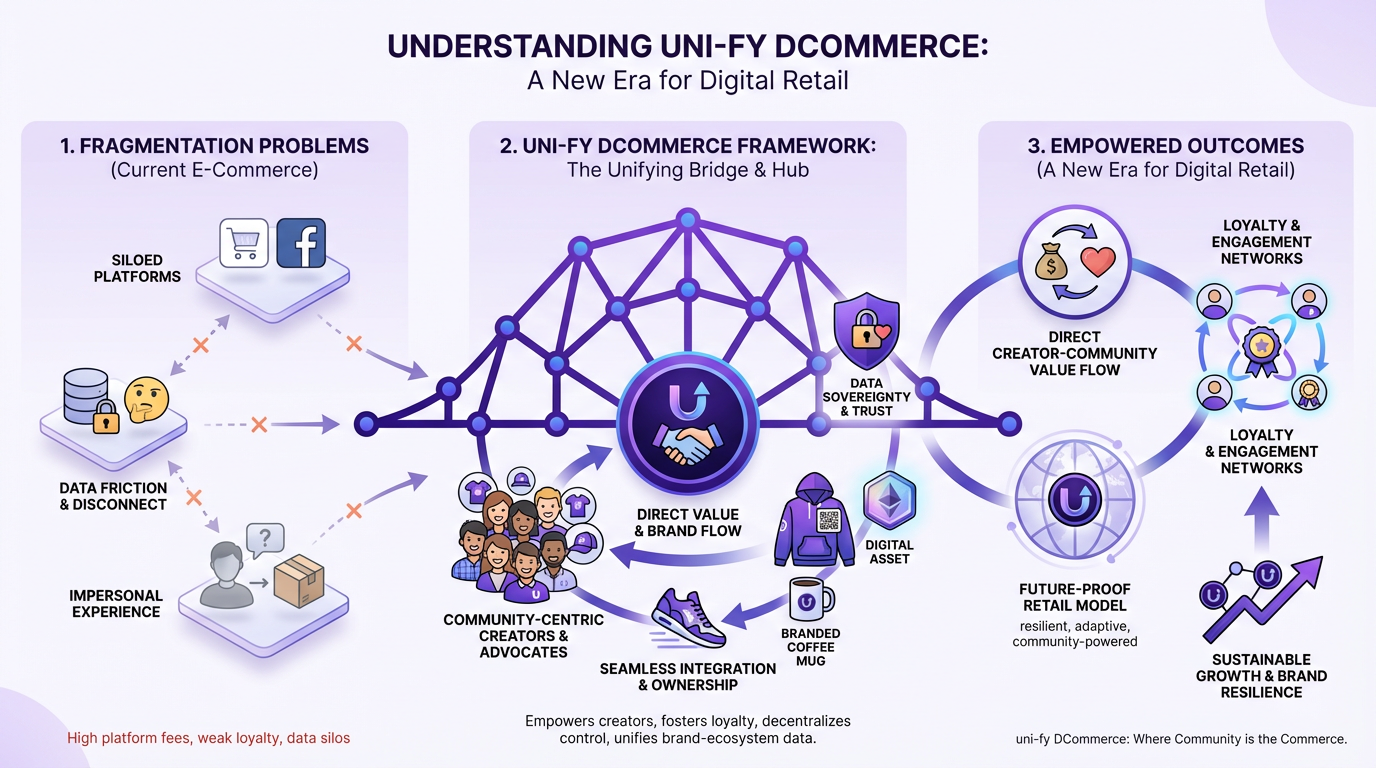
Understanding uni-fy DCommerce: A New Era for Digital Retail
Understanding uni-fy DCommerce: A New Era for Digital Retail
The landscape of online commerce is undergoing a significant transformation, moving towards more decentralized and user-centric models. At the forefront of this evolution is uni-fy dcommerce, a groundbreaking approach that redefines how transactions occur, data is managed, and trust is established in the absence of central authorities. This shift is not merely an upgrade to existing systems but a fundamental reimagining of digital retail, driven by the principles of Web3 and blockchain technology.uni-fy dcommerce offers a compelling alternative to traditional e-commerce, addressing critical issues such as data privacy, high intermediary fees, and the concentration of power in a few large platforms. For businesses and consumers alike, understanding the nuances of uni-fy dcommerce is becoming increasingly vital to navigate the future of online shopping. To delve deeper into its capabilities and vision, exploring the core of uni-fy dcommerce provides invaluable insights.
Key Decentralized Economy Growth Statistics • The total value locked (TVL) in DeFi protocols, a precursor to dcommerce, exceeded $100 billion in 2021. • 45% of Gen Z consumers are interested in purchasing goods directly from creators using blockchain technology. • Data breaches cost businesses an average of $4.24 million per incident, highlighting the need for decentralized security. • The global market for decentralized applications (dApps) is projected to grow substantially, with e-commerce being a key sector.
The Foundational Pillars of uni-fy DCommerce
uni-fy dcommerce is built upon several core pillars that collectively create a robust and equitable online marketplace. These include decentralization, transparency, immutability, and user ownership. Decentralization means that the marketplace operates without a single point of control, distributing power across its participants. This reduces the risk of censorship, single points of failure, and monopolistic practices often seen in traditional e-commerce giants. Transparency is achieved through blockchain technology, where every transaction and interaction is recorded on a public, verifiable ledger.Immutability ensures that once a transaction or data entry is recorded on the blockchain, it cannot be altered or deleted, providing an unprecedented level of trust and accountability. User ownership empowers individuals with complete control over their data and digital assets, moving away from models where platforms own user information. These pillars are what make dcommerce explained so revolutionary, offering a stark contrast to the status quo.
Centralized vs. Decentralized Control: A Paradigm Shift
The distinction between centralized and decentralized control is perhaps the most defining characteristic of uni-fy dcommerce. In a centralized model, a single entity dictates terms, manages data, and processes payments. This can lead to issues like arbitrary policy changes, data exploitation, and high fees. uni-fy dcommerce, conversely, distributes these functions, leveraging smart contracts and blockchain networks to automate processes and enforce rules agreed upon by the community.| Aspect | Centralized E-commerce | uni-fy DCommerce |
|---|---|---|
| Data Control | Platform-owned | User-owned (self-sovereign) |
| Marketplace Rules | Platform-set | Community-governed (DAO) |
| Transaction Costs | High platform fees | Lower network/gas fees |
| Dispute Resolution | Platform mediation | Smart contract arbitration/community vote |
| Innovation Pace | Top-down, proprietary | Open-source, community-driven |
| Trust Mechanism | Intermediary trust | Cryptographic trust |
How uni-fy DCommerce Enhances Security and Privacy
Security and privacy are paramount concerns in the digital age, and uni-fy dcommerce offers significant advancements in these areas. By utilizing blockchain's cryptographic security, transactions are inherently more secure and resistant to fraud. Each transaction is encrypted and linked to the previous one, forming an unbreakable chain. This makes it incredibly difficult for malicious actors to tamper with records or steal funds.Privacy is enhanced by giving users control over their personal data. Instead of platforms collecting and monetizing user information, individuals can choose what data they share and with whom, often through decentralized identity solutions. This shift empowers consumers and reduces the risk of large-scale data breaches that plague centralized systems. The development of a secure dcommerce platform is a key focus for Web3 innovators.
5-Step Secure DCommerce Transaction Flow
Understanding the flow of a secure uni-fy dcommerce transaction highlights its advantages:The Impact of Web3 on uni-fy DCommerce
Web3 is the driving force behind uni-fy dcommerce, providing the technological infrastructure for a decentralized internet. This includes blockchain networks, which serve as the backbone for transparent and secure transactions; smart contracts, which automate agreements without intermediaries; and decentralized applications (dApps), which provide user interfaces for interacting with these underlying technologies. The synergy of these elements creates an environment where online commerce is more efficient, fair, and resistant to manipulation.As Web3 continues to mature, we can expect uni-fy dcommerce to become even more sophisticated, integrating features like decentralized autonomous organizations (DAOs) for community governance, and advanced tokenomics for loyalty and incentive programs. This evolution is central to the future of e-commerce web3, promising a truly transformative impact on how we buy and sell online.
Expert Insight: "The real game-changer for uni-fy dcommerce isn't just lower fees or better privacy, it's the ability to foster true community ownership. When users and merchants have a direct stake in the platform's success, innovation accelerates, and the marketplace becomes inherently more resilient and aligned with its participants' interests."
New Business Models Enabled by uni-fy DCommerce
uni-fy dcommerce opens the door to entirely new business models that were previously impossible or impractical in traditional e-commerce. These include fractional ownership of high-value assets (both digital and physical) through NFTs, community-governed marketplaces where users vote on platform policies, and direct-to-consumer models that eliminate multiple layers of intermediaries. Businesses can also leverage token-gated access for exclusive content or products, creating unique loyalty programs that reward active participation. For those looking to innovate, learning how to build a dcommerce store is a crucial first step.Diagram: uni-fy DCommerce Value Chain Creator/Manufacturer → Decentralized Supply Chain (Traceability) → uni-fy DCommerce Platform (Smart Contracts) → Consumer (Self-Sovereign Identity) → Payment (Crypto/Token) → Community Governance (DAO)
Embracing the uni-fy DCommerce Revolution
For businesses contemplating the transition to uni-fy dcommerce, the journey involves strategic planning and a willingness to embrace new technologies. It's not just about adopting a new platform; it's about rethinking your entire approach to customer engagement, data management, and value creation. Choosing the right dcommerce platform that aligns with your business goals and technical capabilities is a critical decision.uni-fy dcommerce represents more than just a technological upgrade; it's a movement towards a more equitable and efficient digital economy. By understanding its core principles and actively engaging with its development, businesses can position themselves at the forefront of this exciting new era of digital retail. The opportunity to build trust, reduce costs, and empower users is immense, making uni-fy dcommerce a compelling path forward for the future of online commerce.
Frequently Asked Questions
What is the primary goal of uni-fy dcommerce?
The primary goal of uni-fy dcommerce is to create a more decentralized, transparent, and user-centric online marketplace. It aims to empower both merchants and consumers by reducing reliance on central intermediaries, enhancing security, and fostering greater data privacy.How does uni-fy dcommerce differ in terms of fees?
uni-fy dcommerce typically features significantly lower transaction fees compared to traditional e-commerce platforms. Instead of high platform commissions, it often involves only network or 'gas' fees required to process transactions on the underlying blockchain, which are generally much lower.Is uni-fy dcommerce ready for mainstream adoption?
While uni-fy dcommerce is still evolving, it is rapidly progressing towards mainstream adoption. Key challenges like user experience, scalability, and regulatory clarity are being actively addressed by developers and platforms, making it increasingly accessible for a broader audience.What role do smart contracts play in uni-fy dcommerce?
Smart contracts are crucial in uni-fy dcommerce as they automate agreements and transactions without the need for intermediaries. They handle everything from product listings and payment processing to escrow services and dispute resolution, ensuring trust and efficiency.Can uni-fy dcommerce integrate with existing business systems?
Yes, uni-fy dcommerce can be integrated with existing business systems, though it may require custom development or the use of specific APIs and middleware. The goal is often to create a hybrid model where certain aspects of commerce are decentralized while others remain integrated with legacy systems.Key Takeaways
- Decentralized Control: uni-fy dcommerce eliminates central authorities, distributing power and data across a network.
- Enhanced Trust & Security: Blockchain's immutability and cryptography provide unparalleled transparency and fraud resistance.
- User Empowerment: Consumers gain control over their data and digital assets, fostering a more equitable marketplace.
- Web3 Foundation: Built on Web3 principles, uni-fy dcommerce is a key component of the internet's next generation.
- New Opportunities: It enables innovative business models, lower costs, and direct merchant-consumer relationships, reshaping digital retail.