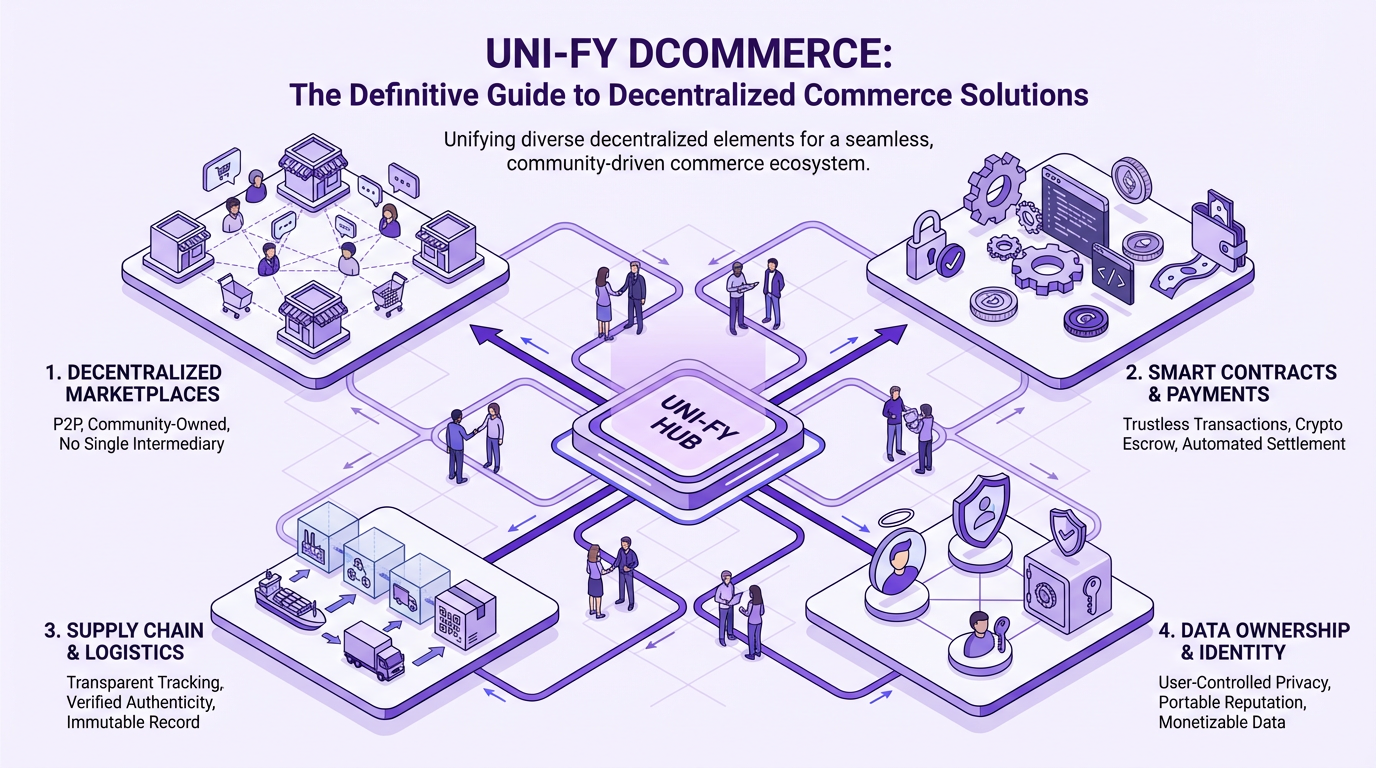
Uni-fy DCommerce: The Definitive Guide to Decentralized Commerce Solutions
Uni-fy DCommerce: The Definitive Guide to Decentralized Commerce Solutions
Table of Contents
- The Dawn of Decentralized Commerce: Understanding Uni-fy DCommerce
- Architecting the Future: Core Components of Uni-fy DCommerce Solutions
- Launching into the Decentralized Economy: A Strategic Framework for Uni-fy DCommerce Adoption
- Advanced Strategies for Maximizing Uni-fy DCommerce Impact
- The DCommerce Landscape: Market Trends and Competitive Edge
- Frequently Asked Questions
- Related Guides
The Dawn of Decentralized Commerce: Understanding Uni-fy DCommerce
Uni-fy dCommerce represents a fundamental re-imagining of how goods and services are exchanged online. Moving beyond the limitations of centralized platforms, it leverages blockchain technology to create trustless, peer-to-peer interactions. This means transactions occur directly between buyers and sellers, without the need for intermediaries that often extract significant fees, control data, and dictate terms. The essence of uni-fy dcommerce lies in empowering participants, ensuring transparency, and fostering true digital ownership.At its core, uni-fy dcommerce is about establishing a new economic primitive. It's not just about accepting cryptocurrency; it's about building entire commerce ecosystems on decentralized protocols. This includes everything from product listing and discovery to payment processing, supply chain management, and dispute resolution, all governed by smart contracts and community consensus rather than corporate policy. The result is a more robust, censorship-resistant, and globally accessible marketplace.
The Pillars of Decentralization in Commerce
Uni-fy dCommerce stands on several foundational pillars, each contributing to its transformative potential:- Blockchain Immutability: All transactions and ownership records are permanently stored on a distributed ledger, providing an unalterable audit trail and eliminating fraud.
- Smart Contract Automation: Self-executing agreements automate complex processes like payments, escrow, and royalty distribution, reducing operational overhead and human error.
- Tokenization of Assets: Digital and physical goods can be represented as non-fungible tokens (NFTs) or fungible tokens, enabling fractional ownership, verifiable provenance, and new forms of digital scarcity.
- Community Governance: Decentralized Autonomous Organizations (DAOs) can empower users and stakeholders to participate in the evolution and decision-making of the dCommerce platform, fostering a truly democratic marketplace.
Key DCommerce Statistics • The global blockchain market size is projected to reach over $163.83 billion by 2029, growing at a CAGR of 56.3% from 2022 to 2029 (Fortune Business Insights). • NFT sales volume reached approximately $25 billion in 2021, indicating significant consumer interest in tokenized digital assets (DappRadar). • Over 300 million people globally owned cryptocurrency in 2021, a foundational user base for dCommerce platforms (Crypto.com). • Transaction fees on traditional e-commerce platforms can range from 1.5% to 3.5% per transaction, a significant cost burden dCommerce aims to reduce (various payment processors).
Architecting the Future: Core Components of Uni-fy DCommerce Solutions
Building a successful uni-fy dcommerce platform requires a sophisticated integration of various Web3 technologies. Uni-fy provides comprehensive solutions that abstract away much of this complexity, allowing businesses to focus on their core offerings. These solutions are designed to be modular, scalable, and interoperable, ensuring they can adapt to diverse business models and evolving market demands.Central to uni-fy's offering is its robust infrastructure for a web3 product launch platform. This includes tools for creating and managing tokenized products, establishing secure payment gateways using cryptocurrencies, and integrating with decentralized identity solutions. The goal is to provide a seamless experience for both merchants and consumers, mirroring the ease of use of traditional e-commerce while delivering the benefits of decentralization.
Essential Modules for Uni-fy DCommerce Implementation
| Module | Best For | Difficulty | ROI Potential |
|---|---|---|---|
| Tokenized Product Creation | Digital art, collectibles, fractionalized assets, event tickets | Medium | Very High |
| Decentralized Payment Gateway | Global transactions, reduced fees, censorship resistance | Medium | High |
| NFT Marketplace Integration | Unique digital goods, verifiable ownership, secondary markets | Hard | Very High |
| DAO Governance Framework | Community-driven platforms, shared ownership, long-term sustainability | Hard | High |
| Decentralized Identity (DID) | Enhanced privacy, secure authentication, reputation systems | Medium | Medium |
Expert Insight: "Many businesses mistakenly believe dCommerce is just about accepting Bitcoin. The real power of uni-fy dcommerce lies in redesigning the entire value chain. It's about leveraging smart contracts for automated royalties, using NFTs for verifiable product authenticity, and building community-owned platforms. This shift isn't incremental; it's foundational, demanding a strategic re-evaluation of how value is created and exchanged."
Launching into the Decentralized Economy: A Strategic Framework for Uni-fy DCommerce Adoption
Adopting uni-fy dcommerce requires a structured approach, moving beyond conceptual understanding to practical implementation. Uni-fy offers a clear pathway for businesses to transition or launch into the decentralized space, ensuring a smooth and effective deployment of their dCommerce initiatives.5-Step Uni-fy DCommerce Launch Framework
Advanced Strategies for Maximizing Uni-fy DCommerce Impact
Beyond the foundational implementation, advanced strategies can significantly amplify the impact of uni-fy dcommerce solutions. These approaches focus on leveraging the unique properties of Web3 to create novel business models, enhance user engagement, and build defensible market positions.One such strategy involves integrating cross-chain compatibility. While many dCommerce solutions initially launch on a single blockchain, enabling interoperability with other chains can dramatically expand market reach and liquidity. This allows users from different blockchain ecosystems to interact with your platform, fostering a more inclusive and expansive decentralized economy. Another powerful tactic is the implementation of dynamic NFTs, where the characteristics or value of a tokenized product can change based on external data or user interaction, opening up new possibilities for gamification and evolving digital assets.
Harnessing the Power of Decentralized Identity and Reputation
Decentralized Identity (DID) systems, when integrated with uni-fy dcommerce, can revolutionize customer relationships and trust. Instead of relying on centralized platforms to verify identity or manage reputation, users can own and control their digital credentials. This allows for:- Self-Sovereign Data: Users decide what information to share, enhancing privacy and control.
- Portable Reputation: A user's transaction history or positive reviews on one dCommerce platform could be verifiable and transferable to another, building trust across the decentralized web.
- Sybil Resistance: Making it harder for malicious actors to create multiple fake identities, improving the integrity of reviews and community governance.
The DCommerce Landscape: Market Trends and Competitive Edge
The dCommerce landscape is rapidly evolving, driven by technological innovation and increasing user demand for ownership and transparency. Uni-fy dcommerce solutions are positioned to capitalize on these trends, offering a distinct competitive advantage over traditional e-commerce giants.One significant trend is the rise of creator economies built on Web3. Artists, musicians, and content creators are increasingly turning to platforms that allow them to directly monetize their work through NFTs and tokenized experiences, bypassing intermediaries that often take substantial cuts. Uni-fy's web3 product launch platform is perfectly suited to empower these creators, providing the infrastructure for direct-to-fan engagement and revenue generation.
Diagram: Uni-fy DCommerce Value Flow
[Creator/Merchant] → [Tokenized Product (NFT/FT) on Uni-fy Platform] → [Decentralized Marketplace] → [Buyer with Crypto Wallet] → [Smart Contract Execution (Payment & Ownership Transfer)] → [Royalty Distribution/Community Treasury] → [Feedback Loop to Creator/Merchant & Platform Governance]
Another critical trend is the growing demand for supply chain transparency. By leveraging blockchain, uni-fy dcommerce can provide immutable records of a product's journey from origin to consumer, combating counterfeiting and ensuring ethical sourcing. This level of verifiable provenance builds profound trust with consumers, a competitive differentiator in an increasingly discerning market.
Frequently Asked Questions
What is uni-fy dcommerce and how does it differ from traditional e-commerce?
Uni-fy dcommerce refers to decentralized commerce solutions built on blockchain technology, enabling peer-to-peer transactions without intermediaries. It differs from traditional e-commerce by offering enhanced transparency, reduced fees, true digital ownership via tokenization, and community governance, moving control from centralized entities to users.How can uni-fy dcommerce reduce transaction costs for businesses?
Uni-fy dcommerce reduces transaction costs by minimizing or eliminating intermediary fees associated with traditional payment processors and marketplaces. Smart contracts automate many processes, further reducing operational overhead, and direct crypto payments often incur lower network fees compared to credit card processing.What role do NFTs play in uni-fy dcommerce solutions?
NFTs (Non-Fungible Tokens) are crucial in uni-fy dcommerce as they represent unique digital or physical assets, enabling verifiable ownership, provenance, and scarcity. They facilitate new business models like digital collectibles, fractionalized real estate, and event ticketing, and can automate royalty payments to creators on secondary sales.Is uni-fy dcommerce only for cryptocurrency users?
While uni-fy dcommerce inherently uses blockchain and often involves cryptocurrencies for transactions, solutions are evolving to be more user-friendly. Uni-fy aims to abstract away much of the crypto complexity, potentially integrating fiat on-ramps and intuitive interfaces to make dCommerce accessible to a broader audience, including those new to Web3.What are the security benefits of using uni-fy dcommerce platforms?
Uni-fy dcommerce platforms offer significant security benefits due to the inherent properties of blockchain technology. Transactions are cryptographically secured and immutable, making them highly resistant to fraud and censorship. Smart contracts execute transparently and automatically, reducing the risk of human error or malicious manipulation, and decentralized identity solutions enhance user privacy and control over personal data.Related Guides
- Web3 Product Launch Platform - Comprehensive guide to web3 product launch platform