Uni-fy DCommerce: The Definitive Guide to Decentralized Commerce with Uni-fy
Uni-fy DCommerce: The Definitive Guide to Decentralized Commerce with Uni-fy
Table of Contents
- The Dawn of Decentralized Commerce with Uni-fy
- Understanding the Core Principles of Uni-fy DCommerce
- Strategic Advantages of Adopting Uni-fy DCommerce
- Implementing Your DCommerce Strategy with Uni-fy
- Advanced Strategies for Maximizing Uni-fy DCommerce Potential
- The Future Landscape: Uni-fy DCommerce and the Web3 Economy
- Frequently Asked Questions
- Related Guides
The Dawn of Decentralized Commerce with Uni-fy
Decentralized commerce, or DCommerce, represents a fundamental shift from traditional e-commerce models. Instead of relying on central authorities like Amazon or eBay, DCommerce leverages blockchain technology to create peer-to-peer marketplaces. This eliminates intermediaries, reduces transaction costs, enhances security through cryptographic verification, and returns ownership of data and control over transactions to the participants themselves. Uni-fy is pioneering this movement, building a comprehensive ecosystem designed to facilitate seamless and trustless exchanges of goods and services.The core promise of uni-fy dcommerce lies in its ability to foster true economic sovereignty. Sellers gain greater control over their products, pricing, and customer relationships, free from the arbitrary rules and fees of centralized platforms. Buyers benefit from enhanced transparency, verifiable product origins, and often, more competitive pricing due to reduced overheads. The underlying architecture of the uni-fy platform ensures that every transaction is recorded on an immutable ledger, providing an unprecedented level of accountability and trust.
The Pillars of Uni-fy's DCommerce Vision
Uni-fy's approach to decentralized commerce is built upon several key technological and philosophical pillars:- Blockchain Agnosticism — While leveraging the power of various blockchains, uni-fy aims for interoperability, ensuring a broad reach and future-proofing its infrastructure.
- User-Centric Design — The uni-fy platform features are meticulously crafted to provide an intuitive and accessible experience, abstracting away the complexities of blockchain for everyday users.
- Community Governance — Future iterations of uni-fy dcommerce will increasingly incorporate decentralized autonomous organization (DAO) principles, allowing the community to shape the platform's evolution.
- Enhanced Security & Privacy — By design, blockchain transactions offer superior security and privacy compared to traditional methods, with uni-fy further enhancing these aspects through robust protocols.
Key DCommerce Statistics • The global blockchain market size is projected to reach over $163.8 billion by 2029, growing at a CAGR of 56.3% (Source: MarketsandMarkets). • Over 70% of consumers are concerned about their data privacy online, driving demand for decentralized solutions (Source: PwC). • Blockchain-based supply chain solutions could reduce global trade costs by 15% (Source: World Economic Forum). • The total value locked (TVL) in DeFi protocols, a precursor to DCommerce, surpassed $100 billion in 2021, demonstrating significant user adoption of decentralized finance (Source: DeFi Llama).
Understanding the Core Principles of Uni-fy DCommerce
At its heart, uni-fy dcommerce operates on principles that challenge the status quo of traditional e-commerce. It's not merely about moving existing online stores onto a blockchain; it's about reimagining the entire transactional framework. The fundamental shift lies in decentralization, where control is distributed across a network rather than concentrated in a single entity. This distribution fosters resilience, censorship resistance, and a more equitable distribution of value.Smart contracts are the backbone of uni-fy dcommerce. These self-executing agreements, with the terms directly written into code, automate transactions and enforce agreements without the need for intermediaries. This reduces the risk of fraud, speeds up processes, and significantly lowers operational costs. For instance, a smart contract can automatically release payment to a seller once a buyer confirms receipt of a product, or trigger a refund if predefined conditions are not met. This programmatic trust is a cornerstone of the uni-fy web3 vision, ensuring that interactions are governed by code, not by corporate policy.
How Uni-fy Leverages Web3 Technologies
Uni-fy's commitment to Web3 technologies is evident in every aspect of its dcommerce ecosystem. Beyond smart contracts, uni-fy integrates decentralized identifiers (DIDs) for self-sovereign identity, decentralized storage solutions (like IPFS) for secure and resilient data hosting, and tokenization for representing ownership, loyalty points, or even fractionalized assets. These technologies collectively create a robust, transparent, and user-controlled environment for commerce.- Self-Sovereign Identity (SSI): Users control their digital identities, deciding what information to share and with whom, eliminating the need for centralized identity providers.
- Decentralized Storage: Product listings, images, and transaction records are stored on distributed networks, making them resistant to censorship and single points of failure.
- Tokenomics: Uni-fy utilizes carefully designed tokenomics to incentivize participation, reward contributors, and facilitate governance within its dcommerce ecosystem.
Strategic Advantages of Adopting Uni-fy DCommerce
For businesses and consumers alike, the transition to uni-fy dcommerce offers a compelling array of strategic advantages that address many of the pain points inherent in centralized systems. These benefits extend beyond mere cost savings, encompassing enhanced security, greater transparency, and a renewed sense of ownership and control.One of the most significant advantages is the drastic reduction in transaction fees. Traditional payment processors and marketplace operators often levy substantial percentages on every sale. Uni-fy dcommerce, by cutting out these intermediaries, allows sellers to retain a much larger portion of their revenue, leading to more competitive pricing for consumers or higher profit margins for businesses. Furthermore, the immutability of blockchain records provides an unparalleled level of transparency, allowing all parties to verify transaction details, product provenance, and payment flows, fostering a trustless environment where trust is built into the system itself.
Comparing DCommerce with Traditional E-commerce
Understanding the distinct benefits of uni-fy dcommerce is best achieved through a direct comparison with its traditional counterpart:| Feature | Traditional E-commerce | Uni-fy DCommerce |
|---|---|---|
| Intermediaries | Centralized platforms (Amazon, Shopify, PayPal) | Peer-to-peer, smart contracts |
| Fees | High transaction fees, listing fees, subscription fees | Minimal blockchain gas fees, potentially platform fees |
| Data Ownership | Platform owns user/transaction data | User owns their data, self-sovereign identity |
| Security | Centralized databases, vulnerable to hacks | Cryptographic security, distributed ledger |
| Transparency | Opaque, terms dictated by platform | Transparent, auditable blockchain records |
| Censorship | Platform can delist, ban, or freeze accounts | Censorship-resistant, open access |
| Payment Speed | Can involve bank delays, chargebacks | Near-instantaneous, irreversible (via smart contracts) |
Expert Insight: "The real power of uni-fy dcommerce isn't just about lower fees; it's about re-establishing the direct relationship between creator and consumer. When you remove the gatekeepers, you unlock innovation, foster genuine community, and create a more resilient, equitable economy. Businesses that embrace this early will gain a significant competitive edge, not just in cost, but in customer loyalty and brand integrity."
Implementing Your DCommerce Strategy with Uni-fy
Transitioning to a decentralized commerce model with uni-fy requires a thoughtful and strategic approach. It's not a simple copy-paste of existing e-commerce operations but rather a re-evaluation of how value is exchanged and relationships are built. The uni-fy platform provides the foundational tools, but successful implementation hinges on understanding the nuances of blockchain interactions and user behavior in a Web3 context.Businesses should begin by identifying which aspects of their current operations would benefit most from decentralization. Is it payment processing, supply chain transparency, customer loyalty programs, or direct-to-consumer sales? Uni-fy's modular design allows for phased adoption, enabling businesses to integrate dcommerce functionalities incrementally, minimizing disruption while maximizing learning. This iterative approach is crucial for adapting to the rapidly evolving Web3 landscape and leveraging the full suite of uni-fy platform features.
5-Step Uni-fy DCommerce Implementation Framework
Advanced Strategies for Maximizing Uni-fy DCommerce Potential
Beyond basic implementation, unlocking the full potential of uni-fy dcommerce requires a sophisticated understanding of Web3 economics and community dynamics. This involves moving beyond simple transactions to building entire decentralized ecosystems around your products or services. Advanced strategies leverage the inherent programmability and transparency of blockchain to create novel business models and deepen customer relationships.Consider the power of tokenization. With uni-fy dcommerce, businesses can issue their own utility tokens to represent loyalty points, access rights, or even fractional ownership of high-value assets. These tokens can be traded, staked, or used to participate in governance, creating a vibrant, self-sustaining economy around your brand. This not only incentivizes customer engagement but also transforms passive consumers into active stakeholders. Another advanced approach involves integrating decentralized finance (DeFi) primitives, such as lending or borrowing protocols, directly into your dcommerce platform, offering innovative financing options or yield generation opportunities for your community.
Leveraging NFTs and Supply Chain Transparency
Non-fungible tokens (NFTs) offer a powerful tool within uni-fy dcommerce for proving authenticity, tracking provenance, and creating unique digital assets. For physical goods, an NFT can serve as a digital certificate of authenticity, permanently linked to a product's journey from creation to consumer. This is particularly valuable for luxury goods, art, or collectibles, where counterfeiting is a significant concern. The uni-fy platform features are designed to support such integrations, enabling businesses to mint and manage NFTs with relative ease.- Digital Twins for Physical Goods: Create an NFT for each physical product, recording its manufacturing details, ownership history, and even environmental impact on the blockchain.
- Fractional Ownership: Tokenize high-value assets (e.g., real estate, art) into smaller, tradable units, making them accessible to a broader investor base within a dcommerce framework.
- Royalty Streams: Program NFTs to automatically pay royalties to creators on secondary sales, ensuring fair compensation for intellectual property.
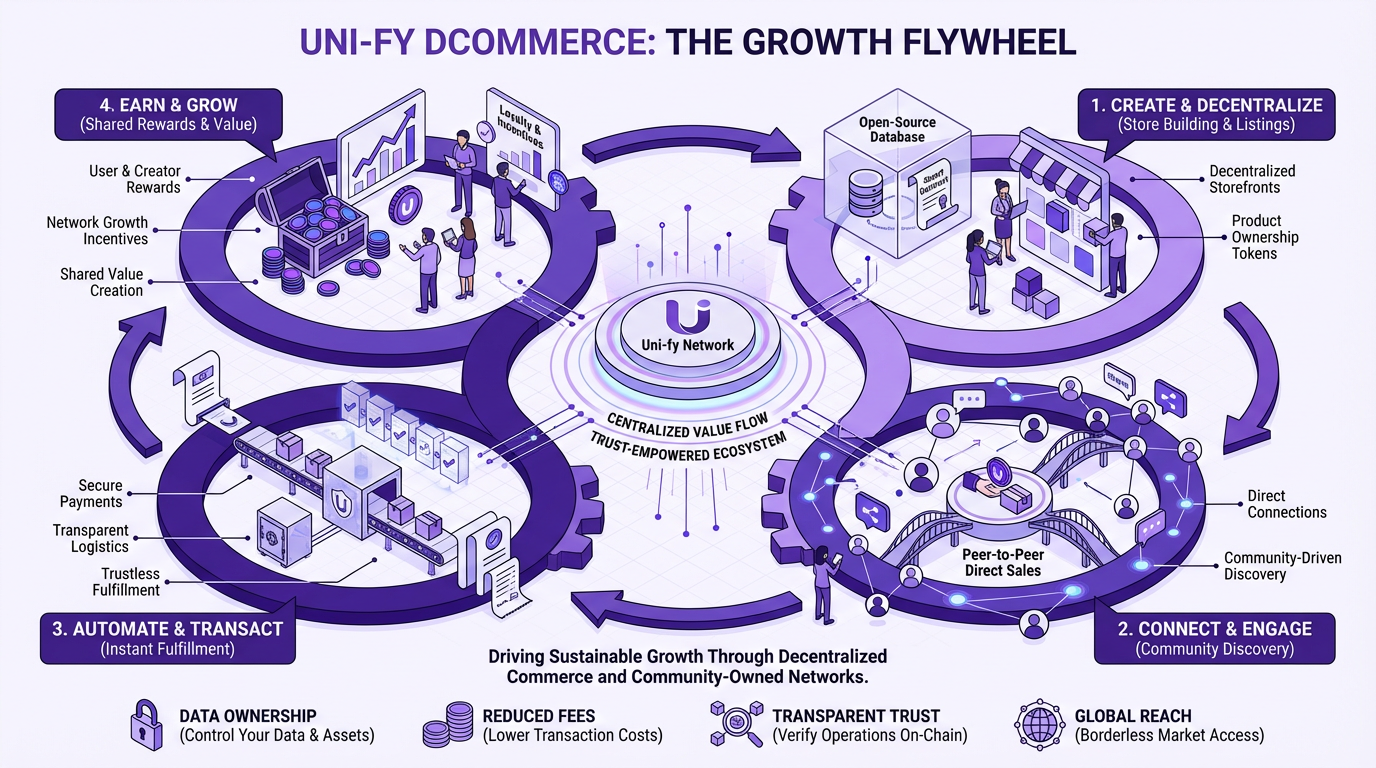
Diagram: Uni-fy DCommerce Ecosystem Flow [Seller Onboards to Uni-fy Platform] → [Product/Service Tokenized (NFT/FT)] → [Smart Contract for Sale Deployed] → [Buyer Discovers & Initiates Purchase] → [Payment via Crypto/Fiat Gateway] → [Smart Contract Executes & Transfers Ownership] → [Decentralized Reputation System Updates] → [Feedback Loop to Seller for Product Improvement]
The Future Landscape: Uni-fy DCommerce and the Web3 Economy
The trajectory of uni-fy dcommerce is inextricably linked to the broader evolution of the Web3 economy. As blockchain technology matures and user adoption grows, decentralized commerce is poised to become a dominant force, reshaping how we interact with brands, consume goods, and participate in economic activity. Uni-fy is not just building a platform; it's contributing to the foundational layers of this new internet, where ownership, privacy, and decentralization are paramount.The future will see increasingly sophisticated integrations between dcommerce, DeFi, and the metaverse. Imagine purchasing a digital asset in a virtual world, with its authenticity and ownership instantly verifiable on the blockchain via uni-fy's infrastructure, and then having that asset grant you exclusive access to a physical product or experience. The possibilities are vast, extending beyond simple retail to encompass decentralized services, intellectual property management, and entirely new forms of value exchange. The uni-fy web3 vision is about enabling this interconnected, permissionless future.
This shift will also empower a new generation of entrepreneurs and creators. With lower barriers to entry, global reach, and direct access to their audience, individuals and small businesses can compete more effectively with established giants. Uni-fy dcommerce fosters an environment where innovation thrives, and value is distributed more equitably across the network, rather than being concentrated in the hands of a few centralized entities. The long-term impact will be a more resilient, transparent, and user-centric global economy.
Frequently Asked Questions
What is uni-fy dcommerce?
Uni-fy dcommerce refers to decentralized commerce facilitated by the Uni-fy platform, leveraging blockchain technology to enable direct, secure, and transparent peer-to-peer transactions without the need for traditional intermediaries. It aims to reduce fees, enhance data privacy, and give greater control to buyers and sellers.How does uni-fy dcommerce differ from traditional e-commerce?
Uni-fy dcommerce fundamentally differs by operating on a decentralized blockchain network, using smart contracts for automated transactions, and eliminating central authorities. This results in lower fees, enhanced security, greater transparency, and user ownership of data, contrasting with the centralized, intermediary-heavy model of traditional e-commerce.What are the key benefits of using the uni-fy platform for dcommerce?
The uni-fy platform offers benefits such as significantly reduced transaction costs, enhanced security through cryptographic verification, immutable and transparent transaction records, greater data privacy for users, and increased control for sellers over their products and customer relationships. It also supports advanced Web3 features like tokenization and NFTs.Is uni-fy dcommerce secure?
Yes, uni-fy dcommerce is designed with enhanced security in mind. It leverages the inherent cryptographic security of blockchain technology, smart contracts to automate and enforce agreements, and decentralized storage to protect data from single points of failure, making transactions more secure and resistant to fraud than many traditional systems.How can businesses get started with uni-fy dcommerce?
Businesses can get started with uni-fy dcommerce by assessing their current e-commerce needs, onboarding to the uni-fy platform, setting up their decentralized identity, and piloting a small-scale dcommerce program. They should then engage with their community, gather feedback, and gradually scale their operations while integrating more advanced Web3 elements.Related Guides
- Uni-fy Web3 - Comprehensive guide to uni-fy web3
- Uni-fy Platform Features - Comprehensive guide to uni-fy platform features
- Uni-fy Platform - Comprehensive guide to uni-fy platform