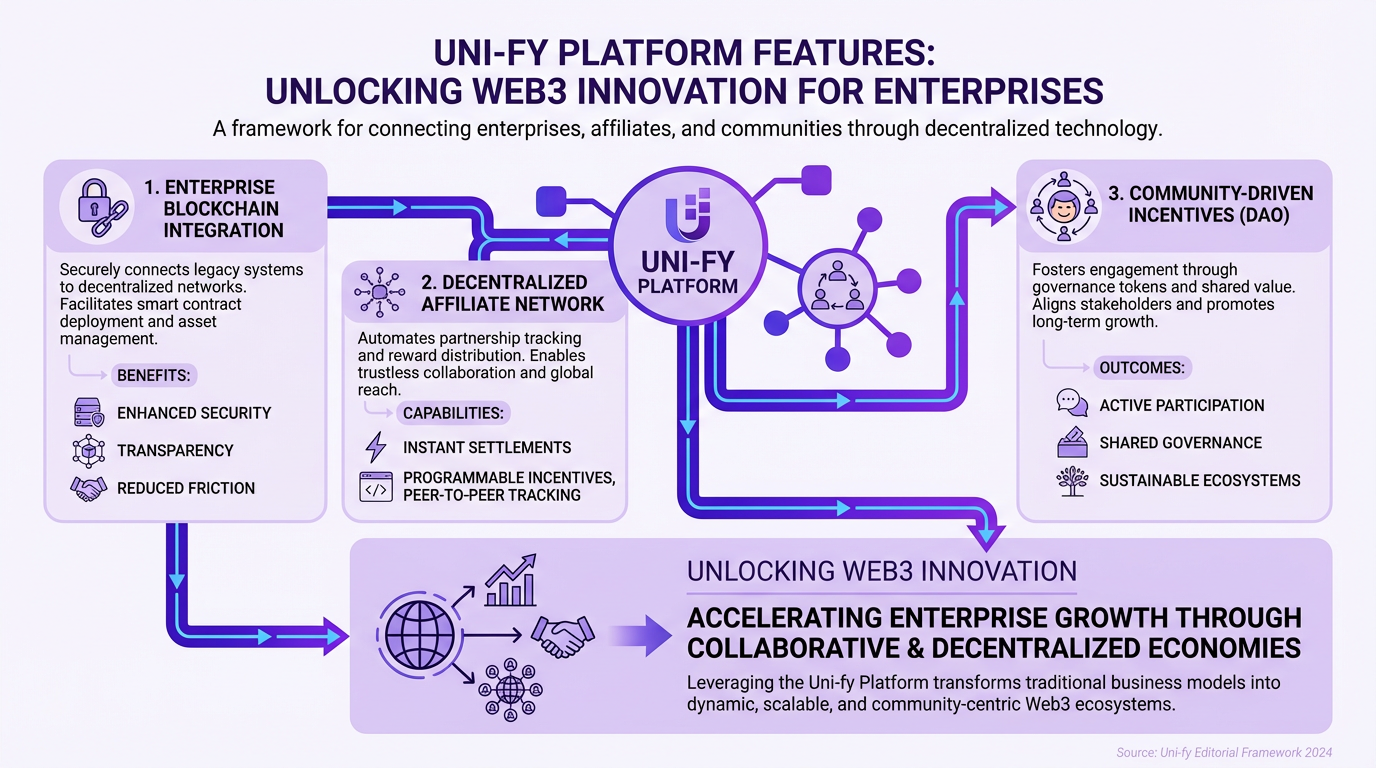
Uni-fy Platform Features: Unlocking Web3 Innovation for Enterprises
The uni-fy platform is engineered to bridge the gap between traditional enterprise systems and the burgeoning world of Web3. As businesses increasingly recognize the transformative potential of blockchain, decentralized applications (dApps), and tokenization, the need for a robust, secure, and scalable infrastructure becomes paramount. The core
uni-fy platform features are designed to empower enterprises to seamlessly integrate these advanced technologies, offering a comprehensive suite of tools for everything from secure asset management to complex smart contract deployment. This article delves into the specific functionalities that make the uni-fy platform a leading choice for organizations looking to innovate within the decentralized ecosystem, providing a clear pathway to leveraging Web3 without the inherent complexities.
Key Web3 Adoption Statistics
• 81% of enterprises believe blockchain technology will be critical to their future success within the next three years (IBM).
• The global blockchain market size is projected to grow from $4.9 billion in 2021 to $67.4 billion by 2026, at a Compound Annual Growth Rate (CAGR) of 68.4% (MarketsandMarkets).
• 75% of large corporations are exploring or actively engaged in blockchain initiatives (Deloitte).
• Over $25 billion was invested in blockchain and crypto startups in 2021, a significant increase from previous years (CB Insights).
Core Infrastructure & Security Features
At the heart of the uni-fy platform lies a meticulously designed infrastructure focused on enterprise-grade security and reliability. This includes multi-layered encryption, robust access controls, and a modular architecture that allows for flexible deployment across various cloud environments or on-premise setups. The platform prioritizes data integrity and operational continuity, understanding that any disruption can have significant financial and reputational consequences for large organizations. Its underlying design ensures that all transactions and data interactions within the Web3 ecosystem are both verifiable and immutable, adhering to the highest standards of cryptographic security.
Secure Digital Asset Management
One of the most critical
uni-fy platform features is its advanced digital asset management system. This goes beyond simple wallet functionality, offering institutional-grade custody solutions, multi-signature approvals, and granular permissioning. Enterprises can manage a diverse portfolio of digital assets, from cryptocurrencies to tokenized real-world assets, with complete oversight and auditability. The system integrates with existing financial reporting tools, streamlining compliance and accounting processes.
| Feature Category | Best For | Difficulty | ROI Potential |
|---|
| Secure Wallets | Managing diverse digital assets | Medium | High |
| Multi-Sig Approvals | Enhanced transaction security | Medium | High |
| Granular Permissions | Role-based access control | Easy | Medium |
| Audit Trails | Compliance & transparency | Easy | High |
Smart Contract Development & Deployment Tools
The uni-fy platform provides a comprehensive environment for developing, testing, and deploying smart contracts. Recognizing the complexity and potential vulnerabilities associated with smart contract code, the platform offers integrated development environments (IDEs), robust testing frameworks, and automated security auditing tools. This significantly reduces the time and risk associated with bringing new decentralized applications to market, allowing enterprises to focus on business logic rather than infrastructure concerns.
5-Step Smart Contract Lifecycle Framework
Design & Specification — Clearly define the contract's purpose, logic, and state transitions. This step involves detailed business analysis and technical specification to prevent costly errors later.
Development & Coding — Write the smart contract code using supported languages (e.g., Solidity). Leverage the platform's IDEs and libraries for efficient and secure coding practices.
Testing & Auditing — Rigorously test the contract for functionality, edge cases, and security vulnerabilities. Utilize automated tools and engage third-party auditors to identify and mitigate risks before deployment.
Deployment & Integration — Deploy the audited smart contract to the chosen blockchain network. Integrate it with existing enterprise systems and front-end applications using the platform's APIs and SDKs.
Monitoring & Management — Continuously monitor contract performance, gas usage, and security post-deployment. Implement upgradeability patterns where necessary to adapt to evolving business needs or address unforeseen issues.
Interoperability & Integration Capabilities
A key differentiator for the uni-fy platform is its commitment to interoperability. Enterprises rarely operate in isolation, and their Web3 initiatives must seamlessly integrate with existing legacy systems, cloud services, and other blockchain networks. The platform offers a rich set of APIs, SDKs, and connectors that facilitate data exchange and process orchestration across disparate environments. This ensures that Web3 solutions built on uni-fy can become an integral part of an enterprise's broader digital transformation strategy, rather than isolated silos.
Expert Insight: "Many enterprises get bogged down trying to force-fit Web3 into their existing monolithic architectures. The real power of a platform like uni-fy lies in its ability to abstract away blockchain complexities while providing flexible integration points. This allows businesses to innovate at the application layer without having to re-engineer their entire IT stack, making the transition to a decentralized future far more pragmatic and less disruptive."
Bridging Traditional and Decentralized Systems
The platform's robust integration capabilities extend to various enterprise resource planning (ERP) systems, customer relationship management (CRM) platforms, and supply chain management (SCM) solutions. This allows for the tokenization of real-world assets, automated supply chain tracking, and decentralized identity management, all while maintaining a unified view of operations. The ability to connect to multiple blockchain networks, including public and private chains, further enhances its utility, positioning the uni-fy platform as a versatile hub for enterprise Web3 initiatives.
Diagram: Enterprise Web3 Integration Flow
[Legacy ERP/CRM] → [Uni-fy Integration Layer (APIs/SDKs)] → [Uni-fy Core Platform] → [Blockchain Network (Public/Private)] → [Decentralized Applications (dApps)] → [Feedback Loop to Legacy Systems]
Analytics & Reporting Tools
Understanding the performance and impact of Web3 operations is crucial for any enterprise. The uni-fy platform includes sophisticated analytics and reporting tools that provide real-time insights into blockchain transactions, smart contract execution, and digital asset movements. These tools offer customizable dashboards, historical data analysis, and predictive modeling capabilities, enabling businesses to make data-driven decisions and optimize their Web3 strategies. This transparency is vital for compliance, risk management, and demonstrating the return on investment (ROI) of decentralized initiatives.
Community & Support Ecosystem
Beyond the technical features, the uni-fy platform fosters a vibrant community and provides extensive support resources. This includes comprehensive documentation, developer forums, and dedicated enterprise support channels. For businesses venturing into the often-complex world of Web3, having access to expert guidance and a collaborative community can significantly accelerate adoption and problem-solving. This holistic approach ensures that enterprises not only have the tools but also the knowledge and support required to succeed.
Frequently Asked Questions
What makes uni-fy platform features suitable for large enterprises?
Uni-fy platform features are designed with enterprise-grade security, scalability, and integration capabilities in mind, offering robust digital asset management, advanced smart contract tools, and extensive interoperability to connect with existing systems, making it ideal for large organizations.
Can the uni-fy platform integrate with existing ERP systems?
Yes, the uni-fy platform offers a rich set of APIs and SDKs specifically designed to facilitate seamless integration with various enterprise resource planning (ERP) systems, CRM platforms, and other legacy software, enabling unified data flow and process orchestration.
What kind of security measures are built into the uni-fy platform?
The uni-fy platform incorporates multi-layered security measures including advanced encryption, granular access controls, multi-signature transaction approvals, and regular security audits to protect digital assets and data integrity for enterprise users.
Does the uni-fy platform support multiple blockchain networks?
Yes, a core strength of the uni-fy platform is its ability to connect and interact with multiple blockchain networks, both public and private, providing enterprises with the flexibility to choose the most suitable chain for their specific Web3 applications and use cases.
How does uni-fy help with smart contract development and deployment?
The uni-fy platform provides an integrated environment for smart contract development, including IDEs, testing frameworks, and automated security auditing tools, significantly streamlining the process from coding to secure deployment and ongoing management.
Key Takeaways
- The uni-fy platform offers enterprise-grade features for secure digital asset management, smart contract development, and seamless integration with existing systems.
- Its robust infrastructure prioritizes security, scalability, and compliance, essential for large organizations adopting Web3 technologies.
- Comprehensive tools for smart contract lifecycle management, from design to monitoring, reduce complexity and risk.
- Extensive interoperability capabilities ensure that Web3 solutions built on uni-fy can become an integral part of an enterprise's broader digital strategy.
- The platform's analytics and reporting tools provide crucial insights for optimizing Web3 operations and demonstrating ROI.