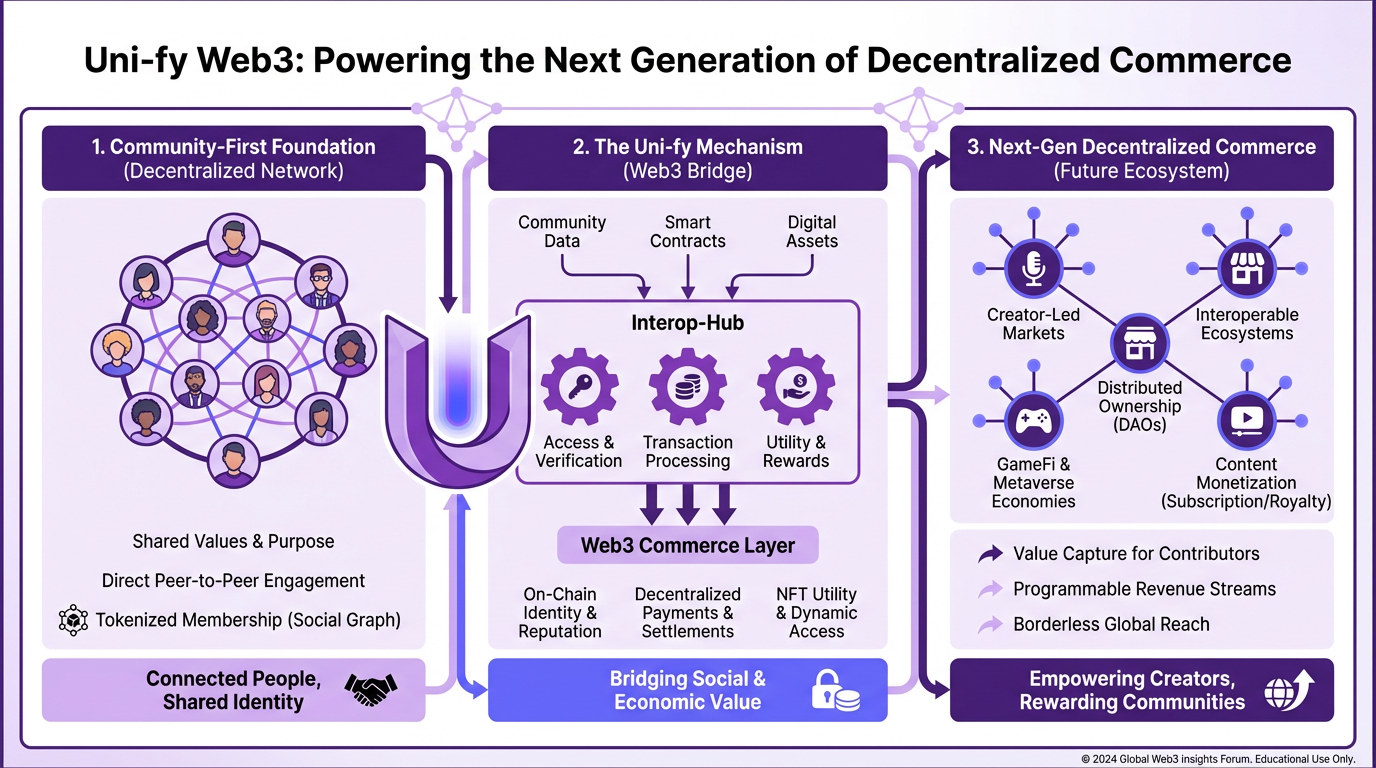
Uni-fy Web3: Powering the Next Generation of Decentralized Commerce
Uni-fy Web3: Powering the Next Generation of Decentralized Commerce
The internet is undergoing a fundamental transformation, shifting from centralized platforms to a decentralized, user-owned paradigm known as Web3. This evolution is particularly impactful for commerce, where traditional models often grapple with data privacy concerns, high transaction fees, and limited transparency. Uni-fy Web3 represents the cutting edge of this shift, leveraging blockchain technology to create a more equitable, efficient, and secure ecosystem for digital transactions. By integrating decentralized identifiers, smart contracts, and tokenized economies, Uni-fy Web3 solutions are redefining how businesses and consumers interact, offering unprecedented levels of control and trust. This foundational shift is integral to the broader vision of a robust and innovative uni-fy dcommerce landscape, where every interaction is transparent and user-centric.At its core, Uni-fy Web3 is about empowering participants. It moves beyond the limitations of Web2's platform-centric approach, where intermediaries often dictate terms and extract significant value. Instead, it fosters direct peer-to-peer interactions, enabling new business models and enhancing existing ones with cryptographic security and immutable records. This paradigm shift is not merely technological; it's a philosophical reorientation towards a more open and fair digital economy, a cornerstone of what makes a leading uni-fy dcommerce platform so compelling.
Key Web3 Adoption Statistics • The global Web3 market size was valued at USD 3.2 billion in 2022 and is projected to reach USD 81.9 billion by 2030, growing at a CAGR of 48.7% (Source: Grand View Research). • Over 50 million unique active wallets interacted with decentralized applications (dApps) in Q3 2023 (Source: DappRadar). • 75% of enterprises are exploring or implementing blockchain technology, a core component of Web3 (Source: Deloitte). • The number of blockchain developers globally exceeded 100,000 in 2023, indicating rapid ecosystem growth (Source: Electric Capital).
The Decentralized Infrastructure of Uni-fy Web3
Uni-fy Web3 solutions are built upon a robust decentralized infrastructure, moving away from single points of failure and centralized control. This architecture relies on distributed ledger technologies (DLTs) like blockchain, which provide an immutable and transparent record of all transactions. Unlike traditional databases, where a single entity controls the data, DLTs distribute data across a network of nodes, making it highly resilient to censorship and manipulation. This fundamental shift ensures that all participants in the Uni-fy Web3 ecosystem have verifiable ownership and control over their digital assets and data.This infrastructure enables a new generation of applications, often referred to as dApps (decentralized applications), which operate without a central authority. These dApps leverage smart contracts—self-executing agreements with the terms directly written into code—to automate processes and enforce agreements without the need for intermediaries. For commerce, this translates to reduced operational costs, faster settlement times, and enhanced trust between buyers and sellers. The ability to automate complex transactions securely is a game-changer for businesses looking to optimize their operations and build stronger customer relationships within a uni-fy dcommerce framework.
Core Components of Uni-fy Web3 Infrastructure
Uni-fy Web3's infrastructure is a mosaic of interconnected technologies, each playing a crucial role in enabling decentralized commerce. Understanding these components is key to appreciating the power and potential of this new paradigm.| Component | Best For | Difficulty | ROI Potential |
|---|---|---|---|
| Blockchain Networks | Immutable transaction records, decentralized consensus | Hard | Very High |
| Smart Contracts | Automated agreements, trustless execution | Medium | High |
| Decentralized Identifiers (DIDs) | Self-sovereign identity, enhanced privacy | Medium | High |
| Tokenization | Digital asset representation, fractional ownership | Easy | Medium |
| Interoperability Protocols | Cross-chain communication, seamless user experience | Hard | Very High |
Empowering Users with Self-Sovereign Identity (SSI)
One of the most transformative aspects of Uni-fy Web3 is its emphasis on Self-Sovereign Identity (SSI). In the traditional Web2 model, users often surrender control of their personal data to large corporations, leading to privacy breaches and data exploitation. SSI, powered by decentralized identifiers (DIDs) and verifiable credentials (VCs), flips this model on its head. Users own and control their digital identities, choosing precisely what information to share, with whom, and for how long. This dramatically enhances privacy and security, fostering greater trust in online interactions.For commerce, SSI means a more streamlined and secure customer experience. Imagine a scenario where a customer can prove their age or residency without revealing their full date of birth or home address to every vendor. This not only protects their privacy but also reduces the burden on businesses to store sensitive data, mitigating risks of data breaches. Uni-fy Web3 integrates SSI to create a truly user-centric commerce experience, where identity is a tool for empowerment, not exploitation. This focus on user control is a hallmark of advanced uni-fy dcommerce platforms.
5-Step SSI Integration Framework for Uni-fy Web3
Implementing Self-Sovereign Identity within a Uni-fy Web3 ecosystem requires a structured approach to ensure security, usability, and compliance.The Role of Tokenization in Uni-fy Web3 Commerce
Tokenization is a cornerstone of Uni-fy Web3, transforming traditional assets and rights into digital tokens on a blockchain. These tokens can represent anything from physical goods and real estate to loyalty points, intellectual property, or even fractional ownership in a company. This process unlocks new levels of liquidity, transparency, and programmability for assets that were previously illiquid or difficult to transfer. For Uni-fy Web3 commerce, tokenization opens up a vast array of possibilities, from creating unique digital collectibles (NFTs) to enabling fractional ownership of high-value items, making them accessible to a broader market.Consider the impact on supply chains: products can be tokenized at their origin, with each transfer of ownership recorded on the blockchain, providing an immutable audit trail. This enhances transparency, reduces fraud, and allows consumers to verify the authenticity and provenance of their purchases. Furthermore, tokenized loyalty programs can offer greater flexibility and value to customers, as points can be traded, exchanged, or even used across different platforms. The strategic use of tokenization is a key differentiator for innovative uni-fy dcommerce platforms, driving engagement and creating new revenue streams.
Expert Insight: "Many businesses are still grappling with the concept of tokenization as merely a 'digital asset.' The real power lies in its programmability. When you tokenize an asset, you're not just creating a digital representation; you're embedding rules, rights, and automated actions directly into its code. This shifts the focus from static ownership to dynamic utility, enabling entirely new business models and customer experiences that were impossible in Web2."
Enhancing Customer Experiences with Uni-fy Web3
Uni-fy Web3 isn't just about backend infrastructure; it's about fundamentally improving the customer experience. By leveraging decentralized technologies, businesses can offer greater transparency, security, and personalization. Imagine a customer journey where their data is protected by default, where they earn verifiable rewards for their loyalty, and where they can participate directly in the governance of the platforms they use. This level of engagement and trust is unprecedented in traditional commerce.Decentralized autonomous organizations (DAOs) can even allow customers to have a say in product development or service offerings, fostering a sense of community and ownership. This participatory model builds stronger brand loyalty and creates a more resilient ecosystem. The future of commerce, powered by Uni-fy Web3, is one where the customer is truly at the center, with tools and technologies that empower them at every step. This is a core tenet of the advanced solutions offered by Uni-fy, including those for uni-fy launchpad.
Diagram: Uni-fy Web3 Customer Journey [User Onboarding (DID Creation)] → [Verifiable Credential Issuance] → [Secure Transaction (Smart Contract)] → [Tokenized Rewards/Loyalty] → [Community Governance (DAO Participation)] → [Feedback Loop to User Onboarding]
The Future of Commerce with Uni-fy Web3
The integration of Uni-fy Web3 technologies is not a distant future; it's happening now. Businesses that embrace this paradigm shift will be better positioned to meet the evolving demands of consumers who increasingly value privacy, transparency, and ownership. From decentralized marketplaces to tokenized supply chains and self-sovereign identity solutions, Uni-fy Web3 offers a comprehensive toolkit for building the next generation of commerce platforms. The transition will require careful planning and execution, but the rewards—in terms of efficiency, security, and customer loyalty—are substantial.Uni-fy is at the forefront of this revolution, providing the tools and expertise necessary to navigate the complexities of Web3 implementation. By focusing on practical, scalable solutions, Uni-fy helps businesses unlock the full potential of decentralized commerce, ensuring they remain competitive and innovative in a rapidly changing digital landscape. This commitment to pioneering solutions is what defines the Uni-fy approach to uni-fy dcommerce.
Frequently Asked Questions
What is Uni-fy Web3 and how does it differ from traditional Web2 commerce?
Uni-fy Web3 refers to the application of decentralized technologies like blockchain, smart contracts, and tokenization to commerce. It differs from Web2 by shifting control from centralized platforms to users, offering enhanced privacy, transparency, and security through self-sovereign identity and immutable transaction records, reducing reliance on intermediaries.How does Self-Sovereign Identity (SSI) benefit Uni-fy Web3 users?
SSI empowers Uni-fy Web3 users by giving them full control over their digital identities and personal data. Users can selectively disclose verifiable credentials, enhancing privacy, reducing the risk of data breaches, and streamlining authentication processes without relying on centralized identity providers.What role do smart contracts play in Uni-fy Web3 commerce?
Smart contracts are self-executing agreements stored on a blockchain, automatically enforcing the terms of a transaction without intermediaries. In Uni-fy Web3 commerce, they automate processes like payments, escrow, and fulfillment, ensuring trustless execution, reducing costs, and increasing efficiency and transparency.Can Uni-fy Web3 solutions integrate with existing business systems?
Yes, Uni-fy Web3 solutions are designed with interoperability in mind. While they introduce new decentralized paradigms, they can be integrated with existing enterprise resource planning (ERP) systems, customer relationship management (CRM) platforms, and other legacy systems through APIs and specialized connectors, facilitating a smooth transition.What are the main security advantages of Uni-fy Web3 for businesses?
Uni-fy Web3 offers significant security advantages through cryptographic encryption, immutable blockchain records, and decentralized architecture. This reduces the risk of single points of failure, enhances data integrity, and provides transparent audit trails, making transactions and data more secure against tampering and fraud.Key Takeaways
- Uni-fy Web3 is revolutionizing commerce by leveraging decentralized technologies for greater transparency, security, and user control.
- Self-Sovereign Identity (SSI) is a core component, empowering users with ownership over their digital data and enhancing privacy.
- Tokenization unlocks new business models and liquidity by representing assets and rights as digital tokens on the blockchain.
- Smart contracts automate transactions and agreements, reducing the need for intermediaries and increasing efficiency.
- The shift to Uni-fy Web3 promises a more equitable and resilient digital economy, with significant benefits for both businesses and consumers.