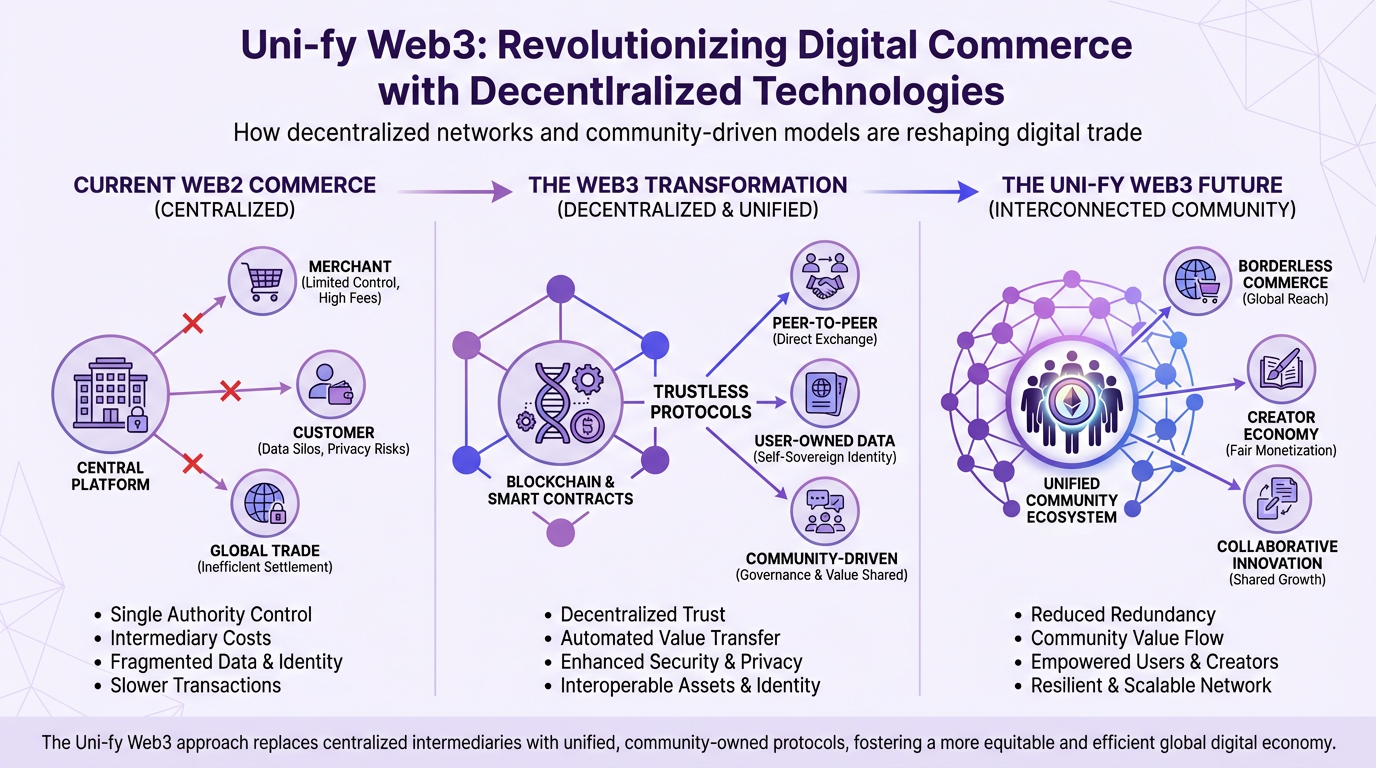
Uni-fy Web3: Revolutionizing Digital Commerce with Decentralized Technologies
Uni-fy Web3: Revolutionizing Digital Commerce with Decentralized Technologies
Web3 represents a fundamental shift in how we interact with the internet, moving from centralized platforms to decentralized, user-owned ecosystems. For businesses, this paradigm shift offers unprecedented opportunities to redefine customer relationships, enhance data security, and unlock new revenue streams. Uni-fy Web3 solutions are at the forefront of integrating these transformative technologies into digital commerce, enabling businesses to build more resilient, transparent, and engaging online experiences. By leveraging blockchain, smart contracts, and decentralized identifiers, uni-fy Web3 empowers merchants to reclaim control over their data and foster true ownership for their customers, a core tenet of effective uni-fy dcommerce strategies.This evolution is not merely about adopting new technologies; it's about reimagining the very foundations of digital transactions and customer loyalty. Uni-fy Web3 provides the infrastructure for businesses to navigate this complex landscape, offering tools and platforms that simplify the integration of decentralized principles into existing commerce operations. From tokenized loyalty programs to verifiable digital assets, the potential for innovation is immense, promising a future where commerce is more equitable and secure for all participants.
Key Web3 Adoption Statistics • The global Web3 market size was valued at USD 3.2 billion in 2023 and is projected to grow at a CAGR of 44.9% from 2024 to 2030 (Grand View Research). • Over 50% of consumers globally are interested in owning digital assets or participating in tokenized loyalty programs (Accenture). • Blockchain technology is expected to add $1.76 trillion to global GDP by 2030 (PwC). • Approximately 30% of internet users have interacted with Web3 applications, indicating a growing mainstream adoption (Statista).
Understanding the Core Components of Uni-fy Web3 Commerce
Uni-fy Web3 commerce is built upon a stack of decentralized technologies that collectively enable a new generation of online transactions. At its heart lies blockchain, a distributed ledger technology that ensures transparency, immutability, and security without the need for central intermediaries. This foundational layer supports smart contracts, self-executing agreements whose terms are directly written into code, automating processes like payments, escrow, and royalty distribution.Beyond these, decentralized identifiers (DIDs) and verifiable credentials (VCs) are crucial for establishing self-sovereign identity, allowing users to control their personal data and grant access selectively. Non-fungible tokens (NFTs) introduce digital ownership for unique assets, opening doors for new product categories, loyalty rewards, and community building. Integrating these components effectively is what sets leading uni-fy dcommerce platforms apart, offering a robust framework for future-proof digital business.
Centralized vs. Decentralized Commerce: A Comparison
The shift to Web3 fundamentally alters the power dynamics in digital commerce. Understanding these differences is crucial for businesses considering the transition.| Strategy | Best For | Difficulty | ROI Potential |
|---|---|---|---|
| Centralized Commerce | Established businesses, quick setup, broad audience | Easy | Medium |
| Decentralized Commerce (Web3) | Niche markets, high-value goods, community building, data privacy | Hard | Very High |
| Hybrid Approach | Gradual transition, leveraging existing infrastructure with Web3 elements | Medium | High |
Implementing Decentralized Identity with Uni-fy Web3
One of the most profound impacts of Web3 on commerce is the concept of decentralized identity. Traditional e-commerce relies on centralized identity providers, often leading to data silos and privacy concerns. Uni-fy Web3 solutions empower users with self-sovereign identity, where individuals own and control their digital credentials. This not only enhances privacy but also streamlines authentication processes and reduces the risk of data breaches.For businesses, adopting decentralized identity means building trust through transparency and giving customers more control over their data. This can lead to stronger customer relationships and a more loyal user base. It also opens up possibilities for personalized experiences without intrusive data collection, as users can selectively share verified attributes rather than full profiles. This is a critical component for any business looking to enhance its digital presence and customer trust, especially when considering advanced uni-fy dcommerce strategies.
5-Step Decentralized Identity Integration Framework
The Role of NFTs and Tokenization in Uni-fy Web3 Commerce
Non-fungible tokens (NFTs) and broader tokenization strategies are transforming how businesses create value, engage customers, and manage digital assets. Uni-fy Web3 leverages NFTs to represent unique digital items, from collectibles and art to loyalty points and access passes. This enables true digital ownership, a concept previously elusive in the digital realm. For commerce, this means new product lines, enhanced customer loyalty programs, and innovative marketing opportunities.Tokenization extends beyond NFTs to fungible tokens, which can represent fractional ownership of assets, in-game currencies, or even shares in a company. These tokens can be used for crowdfunding, governance, or as a medium of exchange within a decentralized ecosystem. The ability to create and manage these digital assets securely and transparently is a cornerstone of modern uni-fy dcommerce platforms, offering unprecedented flexibility and control.
Expert Insight: "The real power of NFTs in commerce isn't just about selling digital art; it's about creating persistent, verifiable digital relationships with your customers. Imagine a loyalty program where your points are NFTs that can be traded, sold, or even used to unlock exclusive experiences across different brands. That's where the true innovation lies – shifting from ephemeral discounts to enduring digital assets that build lasting value for both the brand and the consumer."
Building Token-Gated Experiences
Token-gated commerce allows businesses to offer exclusive access to products, content, or communities based on the ownership of specific NFTs or tokens. This creates a powerful sense of exclusivity and community, rewarding loyal customers and fostering deeper engagement. Uni-fy Web3 provides the tools to implement such experiences seamlessly, from verifying token ownership to managing access permissions.Diagram: Token-Gated Access Flow [User with Wallet] → [Connects Wallet to DApp] → [DApp Verifies Token Ownership] → [Access Granted to Exclusive Content/Product] → [User Engages with Exclusive Content]
Challenges and Opportunities in Uni-fy Web3 Adoption
While the promise of Uni-fy Web3 is immense, its adoption is not without challenges. Scalability, regulatory uncertainty, and user experience complexities are significant hurdles. Blockchain networks can sometimes struggle with transaction throughput, leading to higher fees and slower processing times. The evolving regulatory landscape for digital assets and decentralized finance (DeFi) also presents compliance challenges for businesses operating globally. Furthermore, the technical learning curve for new users can be steep, hindering mass adoption.However, these challenges are being actively addressed by the Web3 community and platforms like Uni-fy. Layer 2 scaling solutions, advancements in user-friendly wallet interfaces, and clearer regulatory frameworks are emerging. For businesses, the opportunity lies in being early adopters, shaping the future of digital commerce, and building a competitive advantage. By focusing on intuitive design and robust security, businesses can overcome adoption barriers and unlock the full potential of uni-fy web3 to create truly innovative customer experiences.
Frequently Asked Questions
What is the primary benefit of Uni-fy Web3 for businesses?
Uni-fy Web3 primarily benefits businesses by enabling decentralized, user-centric commerce. This leads to enhanced data security, greater transparency, new revenue models through digital asset ownership, and stronger customer loyalty by empowering users with control over their data and digital assets.How does Uni-fy Web3 address data privacy concerns?
Uni-fy Web3 addresses data privacy by leveraging decentralized identity (DIDs) and verifiable credentials (VCs). This allows users to own and control their personal data, selectively sharing only necessary information with businesses, rather than relying on centralized entities that aggregate and manage user data.Can existing e-commerce platforms integrate Uni-fy Web3 features?
Yes, existing e-commerce platforms can integrate Uni-fy Web3 features through various APIs and SDKs. Uni-fy solutions are designed to be modular, allowing businesses to gradually adopt decentralized components like NFT marketplaces, token-gated access, or blockchain-based loyalty programs without a complete overhaul of their current infrastructure.What are some examples of Uni-fy Web3 applications in commerce?
Examples include NFT-based loyalty programs where customers earn unique digital collectibles, token-gated access to exclusive products or communities, verifiable digital ownership of luxury goods, and decentralized marketplaces that cut out intermediaries, offering better terms for creators and consumers.Key Takeaways
- Uni-fy Web3 is transforming digital commerce by shifting power from centralized platforms to users and decentralized networks.
- Core technologies like blockchain, smart contracts, DIDs, and NFTs enable new models for ownership, identity, and value creation.
- Decentralized identity empowers users with data control, fostering trust and streamlining secure interactions.
- NFTs and tokenization unlock innovative loyalty programs, product offerings, and community-building strategies.
- While challenges exist, Uni-fy Web3 offers significant opportunities for businesses to build more resilient, transparent, and engaging commerce experiences, fundamentally enhancing their uni-fy dcommerce capabilities.