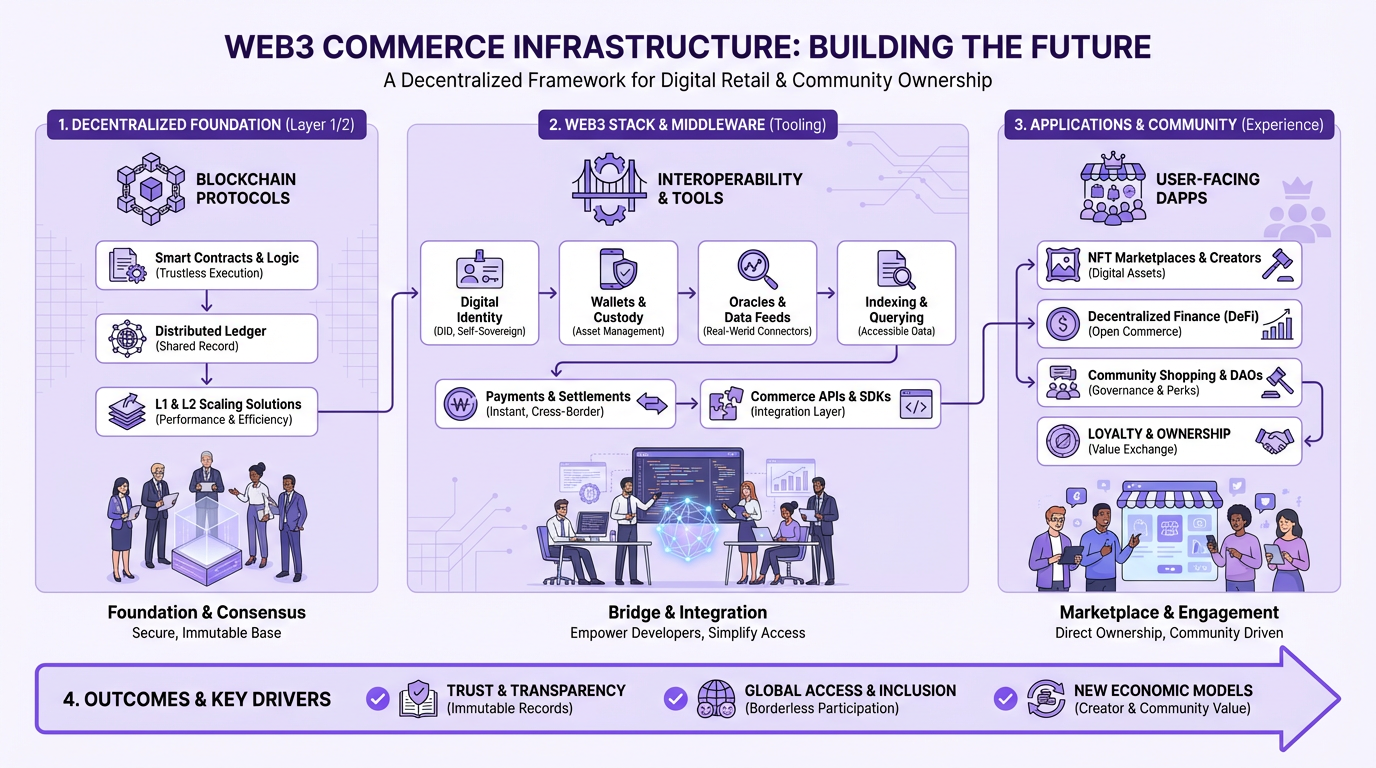
The Definitive Guide to Web3 Commerce Infrastructure: Building the Future of Digital Retail
The Definitive Guide to Web3 Commerce Infrastructure: Building the Future of Digital Retail
Table of Contents
- The Dawn of Decentralized Commerce: Understanding Web3 Commerce Infrastructure
- Core Components of Web3 Commerce Infrastructure
- Strategic Adoption: Integrating Web3 into Your E-commerce Ecosystem
- Building Your Web3 E-commerce Solution: A Step-by-Step Framework
- Advanced Strategies for Web3 E-commerce Success
- Industry Analysis: The Evolving Landscape of Web3 Retail
- Frequently Asked Questions
- Related Guides
The Dawn of Decentralized Commerce: Understanding Web3 Commerce Infrastructure
Web3 commerce infrastructure represents the underlying technological stack that enables decentralized, blockchain-powered e-commerce. Unlike traditional Web2 platforms, which are centralized and controlled by single entities, Web3 commerce leverages distributed ledger technologies (DLTs) to create trustless, transparent, and user-owned ecosystems. This fundamental shift empowers both merchants and consumers, offering unprecedented levels of security, privacy, and direct interaction. It moves beyond simply selling products online without a website to creating entirely new economic models.At its core, Web3 commerce infrastructure is built upon principles of decentralization, immutability, and tokenization. This means that transactions are recorded on public blockchains, smart contracts automate agreements, and digital assets (tokens, NFTs) represent ownership or utility. The implications for e-commerce are vast, ranging from enhanced supply chain transparency to novel customer engagement models. Businesses looking to future-proof their operations and tap into new markets must grasp these foundational concepts.
Key Web3 E-commerce Statistics • The global blockchain market size is projected to reach over $163.83 billion by 2029, growing at a CAGR of 56.3% from 2022 to 2029, indicating massive underlying infrastructure growth. (Source: Fortune Business Insights) • Over 50% of consumers globally are interested in purchasing digital assets like NFTs, suggesting a growing market for tokenized goods and services. (Source: Statista) • The market for decentralized applications (dApps) is expected to grow significantly, with e-commerce being a primary beneficiary of this expansion. (Source: various industry reports) • Approximately 30% of internet users worldwide own cryptocurrency, providing a substantial user base ready for Web3 payment solutions. (Source: TripleA)
The Shift from Centralized Control to User Ownership
Traditional e-commerce platforms operate as intermediaries, controlling data, transactions, and often dictating terms for merchants. This centralized model, while efficient in many ways, introduces points of failure, data privacy concerns, and limits innovation. Web3 commerce infrastructure dismantles this model by distributing control across a network of participants. This shift empowers users with true ownership of their data and digital assets, fostering a more equitable and resilient digital economy. It also opens up new avenues for decentralized finance e-commerce, allowing for peer-to-peer transactions and novel financial instruments.Core Components of Web3 Commerce Infrastructure
Building a robust Web3 e-commerce solution requires understanding its key architectural components. These elements work in concert to create a seamless, decentralized shopping experience.Blockchain Networks and Smart Contracts
At the heart of Web3 commerce are blockchain networks like Ethereum, Polygon, Solana, and others. These distributed ledgers provide the immutable, transparent record-keeping necessary for all transactions and asset ownership. Smart contracts, self-executing agreements coded onto the blockchain, automate processes such as payment processing, order fulfillment, and royalty distribution. They eliminate the need for intermediaries, reducing costs and increasing trust. For instance, a smart contract can automatically release payment to a seller once a buyer confirms receipt of goods, without any third-party escrow service.Web3 Wallet Integration and Digital Identity
Web3 wallet integration is crucial for user interaction within decentralized commerce. Wallets like MetaMask, WalletConnect, or Phantom serve as a user's digital identity and secure portal to the Web3 ecosystem. They store cryptocurrencies, NFTs, and other digital assets, enabling users to sign transactions, prove ownership, and interact with dApps. For merchants, integrating these wallets means facilitating direct, secure payments and enabling customers to manage their digital assets seamlessly. This is a significant departure from traditional payment gateways, offering enhanced security and privacy.Decentralized Storage and Data Management
Unlike Web2 where data is stored on centralized servers, Web3 commerce leverages decentralized storage solutions like IPFS (InterPlanetary File System) or Arweave. This ensures that product listings, images, and user data are not controlled by a single entity, making them censorship-resistant and more resilient. This approach enhances data integrity and privacy, giving users more control over their personal information. It's a critical piece of the puzzle for building a truly decentralized online store.Tokenization and NFTs for Products and Loyalty
Tokenization is a cornerstone of Web3 commerce. Fungible tokens (cryptocurrencies) are used for payments, while non-fungible tokens (NFTs) represent unique digital or physical assets. NFTs can be used to represent product ownership, digital collectibles, loyalty rewards, or even fractional ownership of high-value items. For example, a luxury brand could issue an NFT with each physical product, serving as a verifiable certificate of authenticity and ownership. This opens up new models for customer engagement and verifiable provenance.| Component | Best For | Difficulty | ROI Potential |
|---|---|---|---|
| Blockchain & Smart Contracts | Automating transactions, ensuring transparency | Hard | Very High |
| Web3 Wallet Integration | Secure payments, user identity | Medium | High |
| Decentralized Storage | Data integrity, censorship resistance | Medium | Medium |
| Tokenization (NFTs/FTs) | Unique product representation, loyalty programs | Medium | High |
Strategic Adoption: Integrating Web3 into Your E-commerce Ecosystem
Integrating Web3 into an existing or new e-commerce ecosystem requires a strategic approach. It's not merely about adding a crypto payment option; it's about rethinking the entire customer journey and business model. Whether you're looking for the best online store builder or exploring best e-commerce platforms for dropshipping-commerce_platforms_for_dropshipping), understanding Web3's potential is key.Enhancing Customer Relationship Management with Blockchain
Traditional customer relationship management e-commerce often relies on centralized databases, leading to data silos and privacy concerns. Web3 offers a new paradigm where customer data, with explicit user consent, can be managed on a blockchain. This allows for verifiable loyalty programs, transparent reward distribution, and a more secure way for customers to control their personal information. Brands can build deeper trust by demonstrating a commitment to data sovereignty.Multi-Channel Selling and Decentralized Marketplaces
Web3 infrastructure facilitates truly decentralized multi-channel selling e-commerce. Instead of relying on a few dominant platforms, merchants can list their products on various decentralized marketplaces, reaching a broader audience without incurring high platform fees. This also includes specialized platforms like a blockchain gaming marketplace, where in-game assets can be traded as NFTs, creating entirely new economies. The ability to sell products online without a website becomes more robust through these decentralized avenues.Expert Insight: "Many businesses mistakenly view Web3 as a niche add-on. The reality is that it's a foundational shift. The real value isn't just in accepting crypto, but in leveraging smart contracts for automated supply chains, using NFTs for verifiable product authenticity, and building community-owned loyalty programs. It's about moving from a transactional relationship to a truly participatory ecosystem with your customers."
Building Your Web3 E-commerce Solution: A Step-by-Step Framework
Implementing Web3 commerce infrastructure requires a structured approach. This framework outlines the essential steps for businesses looking to transition or launch into decentralized retail.6-Step Web3 E-commerce Implementation Framework
Advanced Strategies for Web3 E-commerce Success
Beyond the foundational elements, several advanced strategies can significantly enhance a Web3 e-commerce venture.Leveraging Decentralized Finance (DeFi) for E-commerce
Integrating decentralized finance e-commerce solutions can unlock new financial models. This includes offering crypto-backed loans for purchases, enabling fractional ownership of high-value goods through tokenization, or even creating yield-generating opportunities for customer loyalty programs. Imagine a loyalty program where customer points are actually tokens that can be staked for additional rewards or traded on open markets.Building Community-Owned Marketplaces
Instead of proprietary platforms, Web3 enables the creation of community-owned marketplaces. These platforms can be governed by their users (token holders) through DAOs, allowing for collective decision-making on fees, features, and moderation. This fosters a strong sense of ownership and alignment among participants, potentially leading to more vibrant and resilient ecosystems, particularly relevant for a blockchain gaming marketplace where players often have a strong desire for ownership.The Role of AI and Machine Learning in Web3 Commerce
While Web3 emphasizes decentralization, AI and machine learning can play a crucial role in optimizing the user experience without compromising core Web3 principles. AI can be used for personalized recommendations on decentralized marketplaces, fraud detection in crypto transactions, or even to optimize smart contract gas fees. The key is to ensure these AI models operate transparently and respect user data sovereignty, perhaps even running on decentralized compute networks.Diagram: Web3 E-commerce Ecosystem Flow [Customer Web3 Wallet] → [Decentralized E-commerce DApp (Front-end)] → [Smart Contract (Order/Payment)] → [Blockchain Network (Transaction Record)] → [Decentralized Storage (Product Data)] → [Merchant Web3 Wallet (Receive Payment)] → [Feedback Loop to Customer Web3 Wallet (NFT Receipt/Loyalty)]
Industry Analysis: The Evolving Landscape of Web3 Retail
The Web3 commerce landscape is dynamic and rapidly expanding, attracting significant investment and innovation. Traditional retailers are exploring Web3 integrations, while new, crypto-native brands are emerging. The adoption curve is steep, driven by a desire for greater transparency, efficiency, and direct consumer engagement.Major players are investing in metaverse commerce, NFT marketplaces, and decentralized identity solutions. The challenge lies in bridging the gap between existing Web2 infrastructure and the nascent Web3 ecosystem, ensuring scalability, user-friendliness, and regulatory compliance. As the technology matures, we can expect more seamless integrations and broader mainstream adoption. The ability to [sell products online without a website] is evolving into selling products within interconnected decentralized metaverses and marketplaces.
The competitive landscape is characterized by both established tech giants experimenting with Web3 and agile startups building entirely new decentralized commerce protocols. Success will hinge on creating compelling user experiences, fostering strong communities, and demonstrating tangible value propositions that surpass traditional e-commerce models. The evolution of web3 marketing tools will be critical in driving this adoption, moving beyond traditional advertising to community-driven growth and incentivized participation.
Frequently Asked Questions
What is web3 commerce infrastructure?
Web3 commerce infrastructure refers to the underlying technological stack that enables decentralized, blockchain-powered e-commerce. It leverages distributed ledger technologies, smart contracts, and tokenization to create trustless, transparent, and user-owned online retail experiences, fundamentally shifting control from centralized entities to users.How does web3 wallet integration benefit e-commerce?
Web3 wallet integration allows customers to securely manage their digital assets, make direct cryptocurrency payments, and verify their digital identity without relying on traditional financial intermediaries. This enhances security, privacy, and streamlines the checkout process for Web3-native users, fostering a more direct merchant-customer relationship.Can I use web3 commerce infrastructure to sell products online without a website?
Yes, Web3 commerce infrastructure enables selling products online without a traditional website by leveraging decentralized marketplaces and platforms. These platforms allow merchants to list tokenized goods (NFTs or fungible tokens) and conduct transactions directly on the blockchain, often with lower fees and greater reach than traditional centralized platforms.What role do NFTs play in web3 commerce?
NFTs (Non-Fungible Tokens) play a crucial role in Web3 commerce by representing unique digital or physical assets, verifiable ownership, and authenticity. They can be used for digital collectibles, loyalty programs, exclusive access, or as proof of ownership for physical goods, opening up new avenues for product differentiation and customer engagement.How does web3 improve customer relationship management in e-commerce?
Web3 enhances customer relationship management (CRM) by enabling verifiable, transparent, and user-controlled data management on the blockchain. This allows for more secure and equitable loyalty programs, direct communication channels through token-gated communities, and empowers customers with greater control over their personal data, fostering deeper trust and engagement.Related Guides
- Decentralized Finance E-commerce - Comprehensive guide to decentralized finance e-commerce
- Web3 Wallet Integration - Comprehensive guide to web3 wallet integration
- Web3 Marketing Tools - Comprehensive guide to web3 marketing tools
- Blockchain Gaming Marketplace - Comprehensive guide to blockchain gaming marketplace
- Customer Relationship Management E-commerce - Comprehensive guide to customer relationship management e-commerce
- Multi-channel Selling E-commerce - Comprehensive guide to multi-channel selling e-commerce
- Sell Products Online Without A Website - Comprehensive guide to sell products online without a website
- Best Online Store Builder - Comprehensive guide to best online store builder
- Best E-commerce Platforms For Dropshipping - Comprehensive guide to best e-commerce platforms for dropshipping