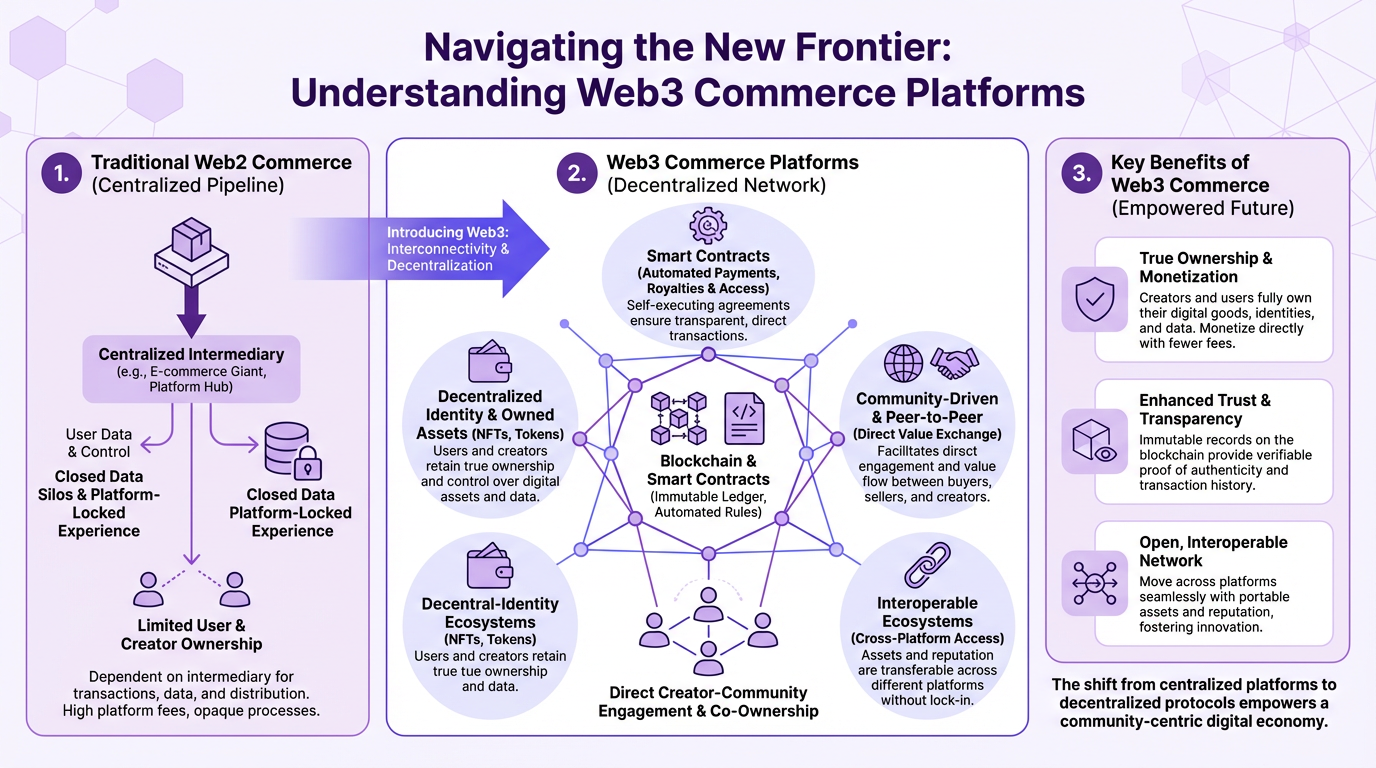
Navigating the New Frontier: Understanding Web3 Commerce Platforms
Navigating the New Frontier: Understanding Web3 Commerce Platforms
Web3 commerce platforms represent the next evolutionary stage of online retail, moving beyond the centralized models of Web2 to embrace decentralization, user ownership, and blockchain technology. These platforms are not just about accepting cryptocurrency payments; they fundamentally redefine the relationship between merchants, consumers, and the underlying infrastructure of digital trade. By integrating concepts like NFTs, decentralized identity, and token-gated access, Web3 commerce platforms offer a richer, more equitable, and more secure online shopping experience. For businesses looking to future-proof their operations and engage with a new generation of digital natives, understanding and adopting these platforms is becoming increasingly critical within the broader ecosystem of Decentralized Commerce Platforms.This shift promises to unlock new business models, foster stronger community engagement, and return data ownership to individuals. As we delve into the mechanics and implications of Web3 commerce, it becomes clear that this isn't just an incremental update but a foundational change in how digital value is created and exchanged.
Key Web3 Commerce Statistics • The total value locked (TVL) in DeFi protocols, a precursor to Web3 commerce, exceeded $200 billion in 2021. • Over 300 million people globally own cryptocurrency, a key enabler for Web3 commerce transactions. • The market for digital collectibles (NFTs), a core component of Web3 commerce, reached over $25 billion in sales volume in 2021. • A recent survey indicated that 60% of Gen Z and Millennials are interested in purchasing products or services using cryptocurrencies or NFTs.
The Pillars of Web3 Commerce Platforms
Web3 commerce platforms are built upon several interconnected technological and philosophical pillars that differentiate them from their Web2 predecessors. These include decentralization, blockchain technology, digital asset ownership (NFTs), and self-sovereign identity. Together, these elements create an environment where users have more control and ownership.Decentralization and Blockchain Integration
At the heart of Web3 commerce is decentralization. Instead of relying on central servers and intermediaries, transactions and data are distributed across a blockchain network. This provides transparency, immutability, and censorship resistance. Blockchain technology enables secure, peer-to-peer transactions using cryptocurrencies and facilitates the creation of smart contracts that automate commerce logic, from payment processing to loyalty programs. This is a core differentiator from traditional Decentralized Commerce Platforms that might not fully embrace the Web3 stack.| Feature | Web3 Commerce | Web2 Commerce |
|---|---|---|
| Data Ownership | User-owned | Platform-owned |
| Identity | Self-sovereign, decentralized | Centralized, platform-managed |
| Payments | Crypto, stablecoins, NFTs | Fiat, credit cards |
| Monetization | Tokenomics, royalties, community | Advertising, data sales, commissions |
| Governance | Community-driven (DAOs) | Centralized (company) |
Unlocking New Business Models with Web3
Web3 commerce platforms enable entirely new business models and customer engagement strategies. The concept of digital ownership, facilitated by NFTs, allows for unique product offerings, verifiable authenticity, and secondary market royalties for creators. Token-gated commerce experiences allow merchants to offer exclusive access to products, content, or communities based on ownership of specific tokens, fostering deeper loyalty and engagement.5-Step Web3 Commerce Strategy Framework
Challenges and the Road Ahead for Web3 Commerce
Despite its immense potential, Web3 commerce faces challenges, including user experience complexities, regulatory uncertainty, and scalability issues on some blockchains. Educating consumers about digital wallets, gas fees, and private keys remains a significant hurdle. However, continuous innovation in layer-2 solutions, user-friendly interfaces, and standardized protocols are rapidly addressing these concerns.Expert Insight: "The biggest barrier to mainstream Web3 commerce adoption isn't the technology itself, but the user experience. We need to abstract away the crypto jargon and make interacting with decentralized applications as intuitive as using a credit card. Until then, Web3 commerce will remain largely for early adopters. Simplicity is the ultimate sophistication here."Furthermore, the development of decentralized storefront builders is making it easier for non-technical users to launch their own Web3-enabled shops, democratizing access to this new frontier of commerce.
Diagram: Web3 Commerce Ecosystem User (Self-Sovereign Identity) → Web3 Wallet → Decentralized Storefront (Smart Contracts) → Blockchain (Transactions/NFTs) → Decentralized Storage (Product Data) → Community Governance (DAO)
Frequently Asked Questions
What is the fundamental difference between Web2 and Web3 commerce platforms?
Web2 commerce platforms are centralized, with data and control residing with the platform provider. Web3 commerce platforms are decentralized, leveraging blockchain for user ownership of data and assets, self-sovereign identity, and community-driven governance.How do Web3 commerce platforms handle payments?
Web3 commerce platforms primarily handle payments using cryptocurrencies, stablecoins, and sometimes NFTs as a form of payment or access. Transactions are processed via smart contracts on a blockchain, offering transparency and immutability.What are NFTs and how do they relate to Web3 commerce?
NFTs (Non-Fungible Tokens) are unique digital assets stored on a blockchain, representing ownership of a specific item or piece of content. In Web3 commerce, NFTs can be products themselves, loyalty rewards, access passes to exclusive experiences, or verifiable digital receipts.Is Web3 commerce only for digital goods?
No, while Web3 commerce is prominent for digital goods like NFTs, it can also be applied to physical goods. NFTs can represent ownership of physical items, enabling verifiable authenticity, tracking, and secondary market royalties, bridging the digital and physical worlds.What are the security implications of using Web3 commerce platforms?
Security in Web3 commerce relies heavily on the security of the underlying blockchain and smart contracts. Users are responsible for securing their private keys. While blockchain offers inherent security advantages like immutability, vulnerabilities in smart contract code or user negligence can pose risks, making audits and user education crucial.Key Takeaways
- Web3 commerce platforms represent the next generation of online retail, built on decentralization, user ownership, and blockchain technology.
- Key pillars include blockchain integration, digital asset ownership (NFTs), and self-sovereign identity, enabling new levels of transparency and control.
- These platforms unlock innovative business models, such as token-gated access and creator royalties, fostering deeper community engagement.
- Challenges include user experience complexities, regulatory uncertainty, and scalability, though continuous innovation is addressing these hurdles.
- Adopting a Web3 commerce strategy involves defining value, choosing the right blockchain, designing tokenomics, integrating decentralized identity, and fostering community governance.
Scale Your Business with Advanced Dcommerce Strategy and Tools
Stay ahead of the competition by leveraging blockchain-backed commerce solutions and affiliate tools.