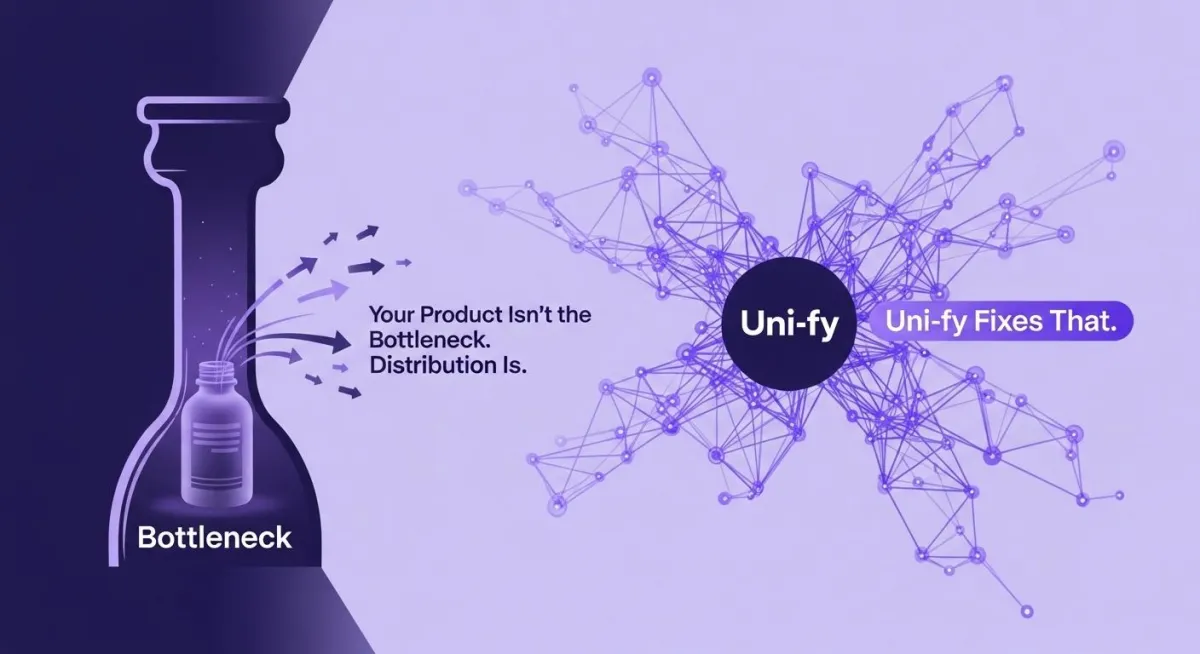
Your Product Isn’t the Bottleneck. Distribution Is (Web3)

Introduction
For a long time in Web3, we lied to ourselves. We said the problem was adoption. We said users “didn’t understand the tech.” We said the product needed one more feature, one more update, one more redesign but after watching dozens of genuinely good Web3 products fade quietly while mediocre ones exploded, the pattern became uncomfortable to ignore.
The difference was never quality.
It was distribution.
Web3 Has a Visibility Problem, Not an Innovation Problem

If you’ve spent any real time in Web3, you already know this, there is no shortage of builders, wallets, protocols, tools, merch brands, creator platforms, communities, everyone is shipping. Constantly.
What’s missing is reliable, compounding visibility.
Most Web3 products launch into silence.
A tweet. A Discord announcement.Maybe a short campaign if there’s budget.
Then the team waits.
And when nothing happens, the instinct is predictable:
“Let’s push harder.”
“Let’s run ads.”
“Let’s partner with an influencer.”
That approach works sometimes. Briefly. But it doesn’t stack. It doesn’t compound. And the moment attention shifts, which it always does in Web3, momentum dies.
That’s not a product failure.
That’s a distribution failure.
The Hidden Cost of One-Person Distribution

Here’s something builders don’t like admitting:
Doing distribution alone is exhausting.
When you’re the only one pushing your product, every post feels heavy. Every launch feels lonely. Every quiet day feels like a verdict on your work.
Most Web3 teams underestimate how much energy this drains over time. Not just capital, belief.
And the irony is brutal:
You can decentralize your protocol, but still centralize your growth entirely on yourself.
That’s the contradiction Uni-fy exists to solve.
Shopify Isn’t Broken. And Uni-fy Isn’t Here to Replace It.
Let’s be clear about positioning, because lazy comparisons kill credibility.
Shopify gives you infrastructure.
Checkout. Inventory. Payments.
It does that well.
But Shopify was never designed to solve distribution that compounds. It assumes traffic comes from ads, influencers, or luck.
Web3 shouldn’t work like that. In Web3, networks outperform funnels. Aligned incentives outperform impressions. Participation beats persuasion. Uni-fy doesn’t replace Shopify.
Uni-fy gives you what don't.
What Uni-fy Actually Changes

Uni-fy turns products into network-driven assets.
Instead of hoping people support your launch, Uni-fy gives them a reason to participate in it.
Affiliates aren’t an afterthought. Ambassadors aren’t manual. Community members aren’t just spectators, they become distributors, transparently, accountably, and measurably.
This matters because distribution only compounds when:
Incentives are clear
Attribution is fair
Participation feels worth it
Without that structure, community is just a word teams hide behind.
Why This Matters in Web3 Specifically
Web3 is moving away from isolated conversations.
The next wave isn’t about louder marketing. It’s about connected ecosystems. Projects that win will not be the ones shouting the most, but the ones enabling others to grow with them.
That’s why Uni-fy isn’t positioned as a growth hack.
It’s infrastructure for collaboration.
When a product lives inside a Uni-fy network:
Distribution doesn’t reset every launch
Momentum doesn’t depend on one account
Growth isn’t fragile
You stop asking, How do we get more attention?
You start asking, How do we align more people?
That’s a better question.
The Difference Between Hype and Systems

Hype looks impressive from the outside. Systems look boring until they win repeatedly.
Web3 has been addicted to hype cycles for years. Fast pumps. Loud launches. Short memories.
Uni-fy is built for the opposite type of builder:
The one who wants repeatable growth. The one who values accountability over noise. The one who understands that real distribution is designed, not hoped for.
When distribution compounds, products stop feeling fragile.
And when products stop feeling fragile, teams build better.
Final Thought

If your product isn’t moving, don’t panic and rebuild it.
Ask a harder question instead:
Who is incentivized to distribute this with you?
If the answer is no one, that’s the real bottleneck.
Uni-fy exists for builders who are done pushing aloneband ready to turn their products into network-powered growth engines.
Explore how Uni-fy enables decentralized distribution that actually compounds: here