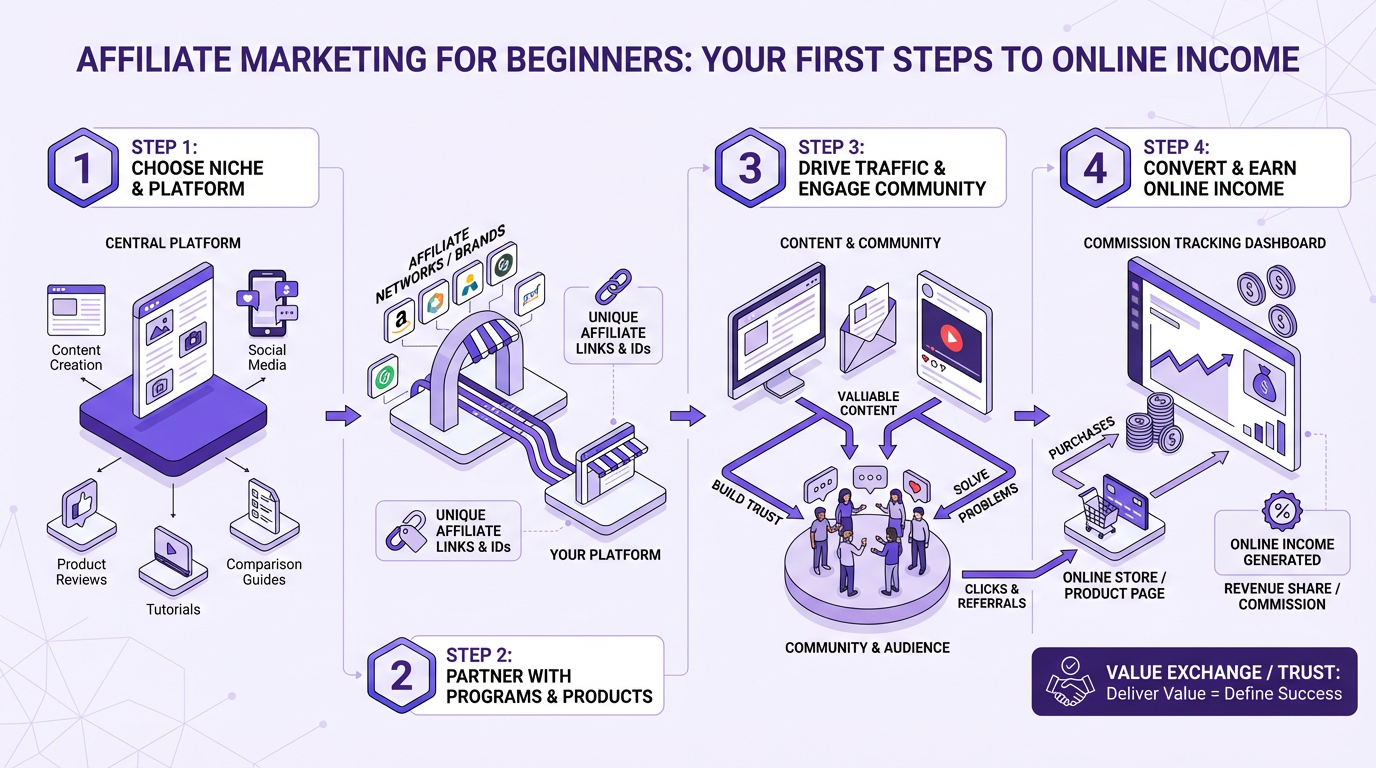
Affiliate Marketing for Beginners: Your First Steps to Online Income
Affiliate Marketing for Beginners: Your First Steps to Online Income
Affiliate marketing offers an enticing entry point into the world of online entrepreneurship, particularly for beginners. It's a business model where you promote other companies' products or services and earn a commission for every sale or lead generated through your unique referral link. The beauty of it lies in its simplicity: you don't need to create your own products, manage inventory, or handle customer service. Your primary role is to connect potential customers with valuable offerings, making it an attractive option for those looking to start an online business with minimal upfront investment.However, while the concept is simple, success in affiliate marketing requires strategic planning, consistent effort, and a genuine desire to provide value to an audience. It's not a get-rich-quick scheme, but a legitimate business model that, when executed correctly, can generate significant passive income. Understanding the fundamentals of various Affiliate Marketing Programs is the first step toward building a sustainable online income stream.
Key Beginner Affiliate Marketing Statistics • Over 90% of affiliate marketers start with little to no prior experience. • The average time to see first significant earnings (>$1000/month) is 6-12 months for consistent beginners. • Content marketing (blogs, videos) is the most common starting point for new affiliates. • Roughly 60% of beginners choose Amazon Associates as their first affiliate program.
What Exactly is Affiliate Marketing and How Does It Work?
At its core, affiliate marketing involves three main parties: the merchant (the company that sells the product), the affiliate (you, the marketer), and the customer. The process typically unfolds as follows:This performance-based model means you only get paid when you drive results, making it a low-risk advertising strategy for merchants and a potentially high-reward opportunity for affiliates.
Common Affiliate Marketing Models for Beginners
| Model | Best For | Difficulty | ROI Potential |
|---|---|---|---|
| Content Marketing (Blog/Reviews) | Building authority, long-term SEO | Medium | High |
| Social Media Marketing | Engaging existing audience, quick reach | Easy/Medium | Medium |
| Email Marketing | Nurturing leads, direct promotions | Medium | High |
| YouTube Reviews/Tutorials | Visual learners, product demonstrations | Medium/Hard | High |
The 5-Step Blueprint for Beginner Affiliate Marketers
Starting your affiliate marketing journey can feel overwhelming with so much information available. This simplified blueprint provides a clear, actionable path for beginners to follow.5-Step Beginner Affiliate Marketing Blueprint
Finding and Joining Affiliate Programs
Once you have a niche and a platform, the next step is to find affiliate programs. There are several ways to do this:- Affiliate Networks: These are marketplaces that connect merchants with affiliates. Popular networks include Amazon Associates, ShareASale, CJ Affiliate (Commission Junction), ClickBank, and Rakuten Marketing. Each has its own strengths and product categories. A thorough Affiliate marketing platforms comparison can help you choose.
- Direct Merchant Programs: Many companies run their own in-house affiliate programs. You can often find these by visiting a company's website and looking for a link like "Affiliates," "Partners," or "Referral Program" in the footer.
- Product Research: If you love a particular product, search for "[Product Name] affiliate program" on Google.
Expert Insight: "For beginners, focus on mastering one traffic source and one content format before trying to do everything. Trying to juggle SEO, social media, email, and YouTube all at once will lead to burnout and mediocre results. Pick one, get good at it, then expand."
Essential Tools for Beginner Affiliates
While you can start with minimal tools, some can significantly enhance your efficiency and effectiveness:- Website Builder: (e.g., WordPress with a good theme) for creating your blog or review site.
- Keyword Research Tool: (e.g., Google Keyword Planner, Ubersuggest, Ahrefs/SEMrush for advanced users) to find profitable keywords and understand search demand.
- Email Marketing Software: (e.g., Mailchimp, ConvertKit) for building an email list and direct communication.
- Analytics Tools: (e.g., Google Analytics) to track website traffic and user behavior.
- Graphic Design Tool: (e.g., Canva) for creating engaging visuals for your content and social media.
Diagram: Beginner Affiliate Journey [Niche Selection] → [Product Research] → [Platform Setup] → [Content Creation] → [Traffic Generation] → [Affiliate Link Clicks] → [Sales/Leads] → [Commission Earned]
Building Trust and Driving Conversions
For beginners, building trust with your audience is paramount. People are more likely to buy from someone they trust. Be transparent about your affiliate relationships (it's legally required in many places). Provide honest reviews, highlighting both pros and cons. Focus on solving your audience's problems rather than just pushing products.To drive conversions, ensure your calls to action are clear and compelling. Use strong headlines, engaging visuals, and persuasive copy. Test different approaches to see what resonates best with your audience. Remember, your goal is to guide your audience to a solution, and the affiliate product is that solution.
Related: Creator Economy Dcommerce: Empowering Artists and Innovators
Related: Community Ownership in Commerce: Empowering the Decentralized Economy
Frequently Asked Questions
How long does it take to make money with affiliate marketing?
It varies greatly, but most beginners who are consistent and strategic can start seeing their first commissions within 3-6 months. Significant income (e.g., $1,000+/month) often takes 6-12 months or more of dedicated effort.Do I need to buy the products I promote?
While not strictly necessary, personally using and experiencing the products you promote can significantly enhance your reviews and recommendations, building trust with your audience. It allows you to provide authentic insights and answer questions more effectively.Is affiliate marketing saturated?
While popular niches can be competitive, affiliate marketing as a whole is not saturated. There are always new products, new niches, and new ways to reach audiences. The key is to find your unique angle, provide value, and build a loyal audience.What are the legal requirements for affiliate marketing?
Key legal requirements include disclosing your affiliate relationship (e.g., using disclaimers like "affiliate link" or "sponsored post"), adhering to FTC guidelines, and complying with data privacy regulations like GDPR or CCPA. Understanding Legal aspects of affiliate marketing is crucial.Key Takeaways
- Affiliate marketing is an accessible way for beginners to earn online income by promoting others' products.
- Success hinges on choosing a niche, selecting quality products, and building a platform to provide value.
- Focus on creating high-quality, problem-solving content and driving targeted traffic to it.
- Building trust and transparency with your audience is crucial for long-term success.
- Patience and consistent effort are more important than quick gains in the early stages.