Community Ownership in Commerce: Empowering the Decentralized Economy
Community Ownership in Commerce: Empowering the Decentralized Economy
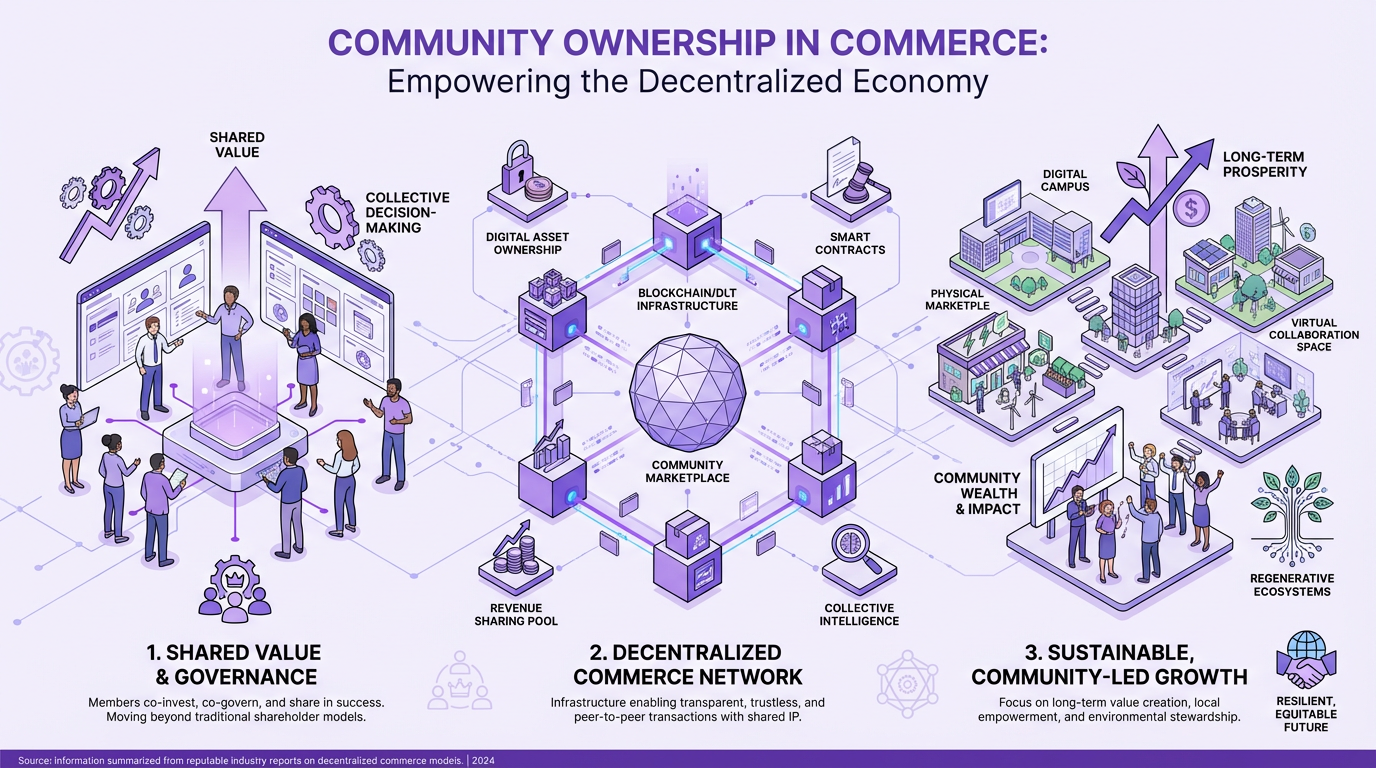
Community ownership in commerce represents a fundamental shift from traditional corporate structures, placing control and benefits directly into the hands of its participants. In the context of decentralized commerce (Dcommerce), this model is not just an ideal but a practical reality, enabled by blockchain technology and tokenization. It transforms consumers and contributors into stakeholders, fostering a deeper sense of loyalty, engagement, and shared success. Understanding how to cultivate and leverage community ownership in commerce is paramount for any entity looking to thrive in the evolving landscape of decentralized business models.Key Community Ownership Statistics • Businesses with strong community engagement report 2x higher customer lifetime value. • Over 70% of consumers prefer brands that demonstrate transparency and shared values. • Dcommerce platforms implementing community ownership models show 30% faster user growth compared to traditional counterparts. • Projects with active community governance see a 25% increase in development contributions from non-core teams.
The Paradigm Shift: From Consumers to Co-Owners
Traditional commerce often views consumers as passive recipients of goods and services. Community ownership flips this script, inviting them to actively participate in decision-making, contribute to product development, and even share in the financial success of the platform. This paradigm shift is particularly potent in Dcommerce, where blockchain technology provides the tools for transparent, immutable, and equitable distribution of ownership and governance rights.Mechanisms for Enabling Community Ownership
Various mechanisms facilitate community ownership, primarily through the use of digital tokens. These tokens can represent voting rights, a share of revenue, or access to exclusive features. The choice of mechanism depends on the specific goals of the Dcommerce platform and the desired level of community involvement.| Mechanism | Best For | Difficulty | ROI Potential |
|---|---|---|---|
| Governance Tokens | Strategic decision-making, platform direction | Medium | High |
| Revenue Share Tokens | Direct financial benefit, long-term alignment | Hard | Very High |
| Loyalty/Reward Tokens | Incentivizing engagement, repeat purchases | Easy | Medium |
| Fractional Ownership | Shared asset ownership, investment | Medium | High |
Benefits of Community-Owned Dcommerce Platforms
Beyond the philosophical appeal, community ownership offers tangible benefits for Dcommerce platforms. It cultivates a highly engaged user base that acts as advocates, contributors, and co-developers. This organic growth and collective intelligence can lead to more innovative products, more resilient business models, and a stronger competitive advantage in a crowded market.4-Step Community Ownership Integration Framework
Community Ownership and Value Creation
In a community-owned Dcommerce model, value creation becomes a collective endeavor. Users are not just consuming value; they are actively contributing to its generation. This could be through providing feedback, curating content, developing new features, or even marketing the platform. This distributed model of value creation in decentralized markets leads to a more robust and dynamic ecosystem, where the collective effort far outweighs what a centralized entity could achieve alone.Expert Insight: "True community ownership isn't just about giving people tokens; it's about giving them a voice and a genuine stake in the future. When a community feels truly empowered, they become the most powerful growth engine a Dcommerce platform can have, far surpassing any marketing budget."This shared responsibility and benefit create a powerful feedback loop, where the success of the platform directly translates into benefits for its community, further incentivizing participation and contribution. This is a core tenet of many successful Dcommerce Business Models.
Diagram: Community Ownership Value Loop [Community Contribution] → [Platform Enhancement] → [Increased Platform Value] → [Token Value Accrual / Revenue Share] → [Empowered Community] → [Further Community Contribution]
Challenges and the Future of Community Ownership
While highly promising, implementing community ownership in commerce faces challenges. These include ensuring broad participation, preventing the concentration of power (whale dominance), navigating regulatory complexities, and designing effective dispute resolution mechanisms. However, advancements in DAO commerce structures and governance tooling are continuously addressing these issues.As Dcommerce matures, we can expect to see more sophisticated models of community ownership, potentially integrating with creator economy Dcommerce to empower individual creators with collective bargaining power and shared infrastructure. The future will likely feature hybrid models that balance efficient operations with genuine community empowerment, setting new standards for equitable and sustainable commerce.
Frequently Asked Questions
What does community ownership mean in decentralized commerce?
Community ownership in decentralized commerce means that the users, contributors, and stakeholders of a Dcommerce platform collectively own and govern it, typically through digital tokens. This grants them voting rights, a share of revenue, or other benefits, moving away from centralized corporate control.How do Dcommerce platforms enable community ownership?
Dcommerce platforms enable community ownership primarily through tokenization, issuing governance tokens or revenue-sharing tokens to participants. These tokens allow holders to vote on proposals, influence strategic decisions, and directly benefit from the platform's success, fostering a sense of collective stewardship.What are the main advantages of a community-owned commerce model?
The main advantages include increased user engagement and loyalty, organic growth driven by community advocacy, more resilient and adaptable business models, and a more equitable distribution of value among all participants. It transforms consumers into active stakeholders.Key Takeaways
- Community ownership in commerce shifts control and benefits from centralized entities to platform participants.
- Blockchain and tokenization are key enablers, providing transparent and equitable mechanisms for shared ownership.
- Benefits include enhanced engagement, organic growth, and more resilient business models.
- Effective integration requires defining ownership scope, designing robust tokenomics, and fostering active participation.
- Challenges exist but are being addressed by evolving DAO structures and governance tools, pointing to a future of more equitable commerce.
Join a Global Community of Decentralized Shoppers and Creators
Experience a shopping ecosystem built on transparency and decentralization today.