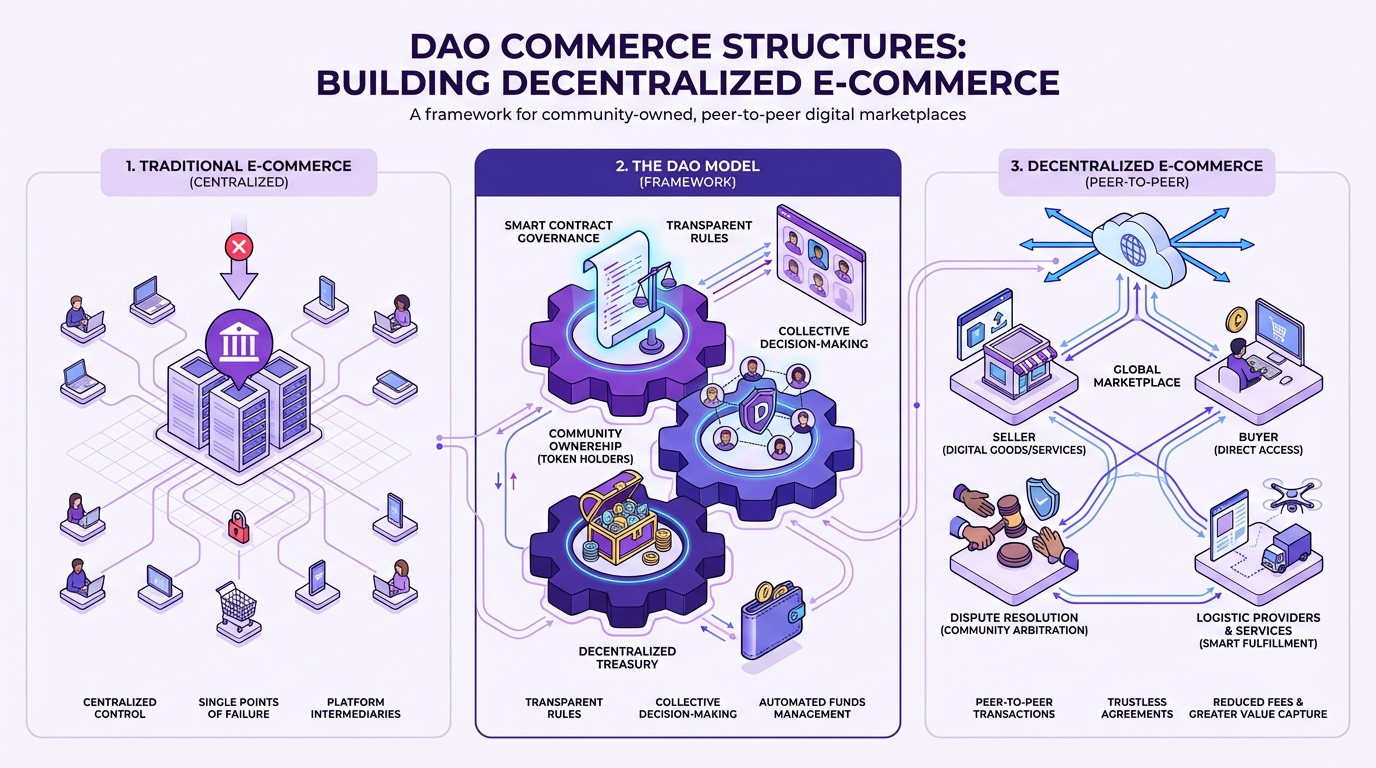
DAO Commerce Structures: Building Decentralized E-commerce
DAO Commerce Structures: Building Decentralized E-commerce
The rise of decentralized autonomous organizations (DAOs) is fundamentally reshaping how businesses operate, particularly within the e-commerce sector. DAO commerce structures represent a paradigm shift from traditional hierarchical companies to community-governed, transparent, and automated enterprises. These structures leverage blockchain technology to enable collective ownership, decision-making, and value distribution among participants, offering a compelling alternative to conventional online retail. Understanding these innovative approaches is crucial for anyone exploring the future of online business, especially when considering the broader landscape of Dcommerce Business Models.At its core, a DAO commerce structure is an organization governed by rules encoded as a computer program, transparent, controlled by the organization's members, and not influenced by a central government. This allows for unprecedented levels of trust, efficiency, and community engagement in commercial activities, from product development to supply chain management and customer service. The implications for retail are profound, promising a more equitable and resilient ecosystem.
Key DAO Commerce Statistics • The total value locked (TVL) in DAOs across various sectors exceeded $15 billion in early 2023, indicating significant capital flowing into decentralized governance. • Over 6,000 active DAOs exist globally, with a growing number exploring commercial applications and direct-to-consumer models. • A survey found that 45% of blockchain developers are actively working on or interested in DAO-related projects, highlighting rapid innovation. • Projects leveraging DAO structures for commerce have seen community engagement rates up to 3x higher than traditional e-commerce platforms.
Understanding the Mechanics of DAO Commerce
DAO commerce structures operate on a foundation of smart contracts and blockchain technology. These smart contracts automate governance rules, treasury management, and operational processes, removing the need for intermediaries and central authorities. Members, typically holding governance tokens, can propose and vote on decisions, ranging from marketing strategies and product listings to treasury allocation and partnership agreements. This collective decision-making fosters a strong sense of ownership and alignment among stakeholders.Core Components of a DAO Commerce Ecosystem
At the heart of any effective DAO commerce structure are several critical components that ensure its decentralized and autonomous operation. These include a robust governance framework, a transparent treasury, and a mechanism for dispute resolution, all underpinned by blockchain technology.| Component | Function | Key Benefit | Challenge | |---|---|---|---| | Governance Tokens | Represent voting power and ownership | Decentralized decision-making | Voter apathy, whale dominance | | Smart Contracts | Automate rules and transactions | Trustless operations, efficiency | Immutability of code, security risks | | Community Treasury | Funds for operations, development | Transparent resource allocation | Mismanagement, lack of clear spending proposals | | Dispute Resolution | Mechanisms for conflict resolution | Fairness, trust | Complexity, scalability |
Tokenomics and Incentives in DAO Commerce
Effective Tokenomics for Dcommerce are paramount for the success and sustainability of DAO commerce structures. Governance tokens not only confer voting rights but can also be designed to incentivize participation, reward contributions, and distribute value generated by the commerce platform. This creates a powerful feedback loop where active community members are directly rewarded for their efforts, aligning individual incentives with the collective success of the DAO.Designing Sustainable Token Models
Creating a token model that encourages long-term engagement and economic viability requires careful consideration of distribution, utility, and value accrual. A well-designed token can drive network effects, attract talent, and ensure the DAO's treasury grows in tandem with its commercial activities.Expert Insight: "The real innovation in DAO commerce isn't just decentralizing decision-making; it's about designing tokenomics that intrinsically link community contribution to direct financial upside. This shifts the paradigm from 'working for a company' to 'building a shared economy' where everyone has skin in the game. Without robust tokenomics, a DAO commerce structure is just a fancy voting system."
5-Step DAO Commerce Launch Framework
Launching a successful DAO commerce structure requires meticulous planning and execution, focusing on community building and robust technical infrastructure.Community Ownership and Value Creation
One of the most compelling aspects of DAO commerce structures is the concept of Community ownership in commerce. Unlike traditional businesses where profits accrue to shareholders, DAO commerce allows the community itself to own a stake in the platform's success. This can manifest through direct ownership of the platform's assets, shared revenue streams, or participation in profit distribution mechanisms. This model fosters a highly engaged user base that is incentivized to contribute to the platform's growth, knowing that their efforts directly translate into shared value.Diagram: DAO Commerce Value Flow [Community Member] → [Proposal Submission] → [Token Holders Vote] → [Smart Contract Execution] → [Value Creation (e.g., Product Sale)] → [Treasury Allocation] → [Token Holder Rewards/Platform Reinvestment] → [Feedback Loop to Community Member]This direct alignment of incentives creates a powerful engine for value creation, where every participant has a vested interest in the platform's prosperity. It moves beyond simple customer loyalty to genuine co-ownership and co-creation.
Challenges and Future Outlook
While promising, DAO commerce structures face significant challenges, including regulatory uncertainty, scalability issues, and the complexities of decentralized decision-making. Ensuring efficient governance, preventing voter apathy, and managing potential security vulnerabilities in smart contracts are ongoing concerns. However, ongoing innovation in blockchain technology and governance tooling is rapidly addressing these hurdles.The future of DAO commerce is bright, with potential applications across various sectors, from digital goods and services to physical product marketplaces. As these models mature, they are poised to offer more transparent, equitable, and community-driven alternatives to existing e-commerce giants, fundamentally redefining how we buy, sell, and interact in the digital economy. The evolution of these structures will be a key component in the broader development of leading Dcommerce Business Models.
Frequently Asked Questions
What is the primary benefit of a DAO commerce structure over traditional e-commerce?
The primary benefit is decentralized ownership and governance, meaning the community of users and contributors collectively owns and makes decisions about the platform. This fosters greater transparency, aligns incentives, and distributes value more equitably compared to a centralized corporate structure.How do governance tokens function within DAO commerce?
Governance tokens grant holders voting rights on proposals related to the DAO's operations, treasury management, and strategic direction. They also often provide economic incentives, such as a share of platform revenue or access to exclusive features, directly linking participation to value accrual.What are the main challenges in implementing DAO commerce?
Key challenges include regulatory ambiguity, ensuring sufficient community engagement for effective governance, managing the complexity of smart contract development and security, and achieving scalability to handle high transaction volumes. Overcoming these requires robust technical solutions and strong community building.Can DAO commerce structures handle physical goods?
Yes, DAO commerce structures can handle physical goods, though it often requires integrating with traditional logistics and fulfillment services. The decentralized aspect primarily governs the platform's operations, treasury, and decision-making, while the physical delivery can be managed through existing infrastructure, potentially with decentralized oversight.How does a DAO commerce structure ensure fair decision-making?
Fair decision-making is ensured through transparent voting mechanisms, where every token holder has a voice proportional to their holdings or through more complex schemes like quadratic voting to reduce whale influence. All proposals and votes are recorded on the blockchain, providing an immutable audit trail and preventing manipulation.Key Takeaways
- DAO commerce structures leverage blockchain for decentralized ownership and governance in e-commerce.
- Tokenomics are crucial for incentivizing participation, distributing value, and ensuring the long-term sustainability of these models.
- Community ownership fosters high engagement and aligns individual incentives with collective platform success.
- While facing challenges like regulation and scalability, DAO commerce offers a more transparent and equitable future for online retail.
- Effective implementation requires a clear vision, robust governance, and a strong focus on community building and progressive decentralization.
Secure Your Spot in the Next Generation of Dcommerce
Join the future of decentralized commerce and explore a new way to interact with your favorite digital brands.