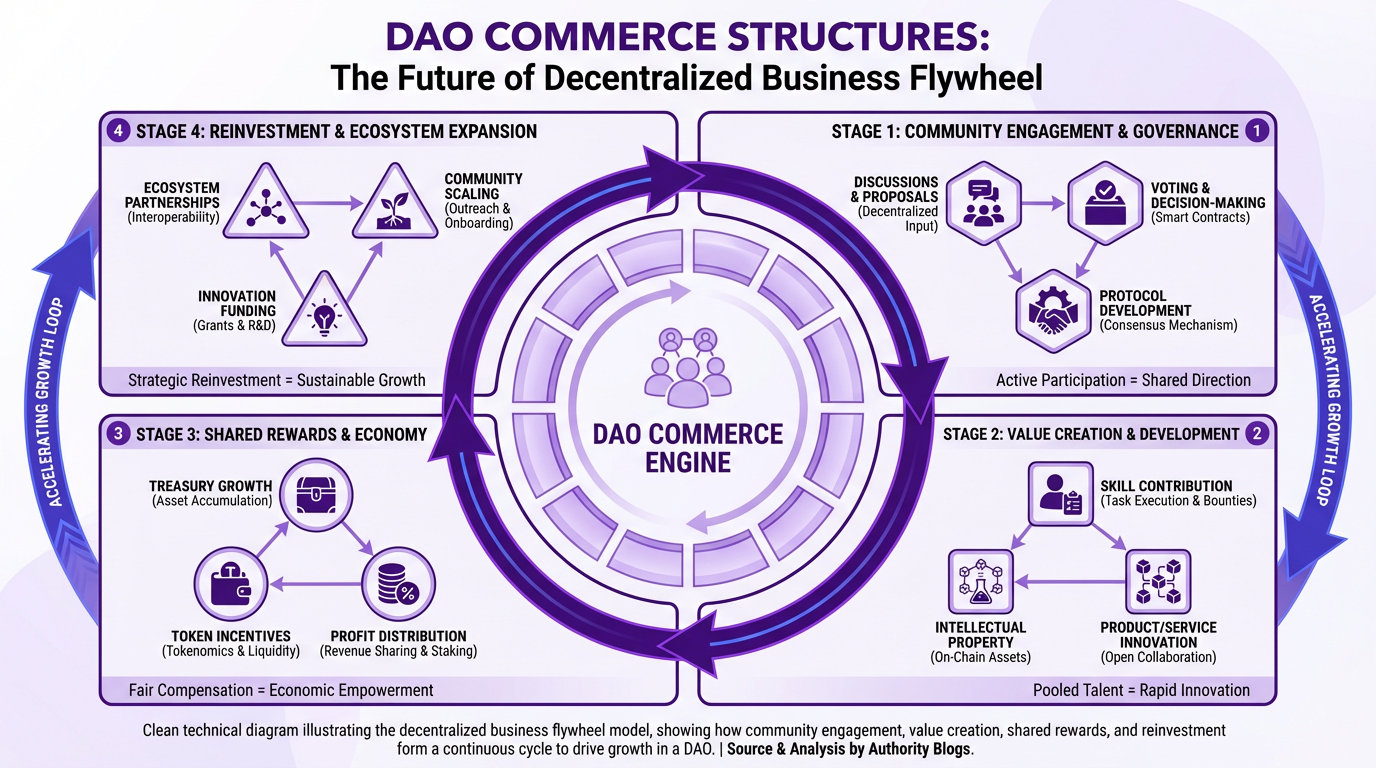
DAO Commerce Structures: The Future of Decentralized Business
DAO Commerce Structures: The Future of Decentralized Business
Decentralized Autonomous Organizations (DAOs) are fundamentally reshaping how businesses operate, particularly within the burgeoning Dcommerce sector. These blockchain-native entities leverage smart contracts and collective governance to create transparent, community-driven commercial ventures. Understanding the various DAO commerce structures is crucial for anyone looking to innovate in the decentralized economy, moving beyond traditional corporate hierarchies to embrace a more equitable and efficient model. This shift empowers participants, from creators to consumers, to have a direct stake in the success and direction of the commerce platform.Key DAO Adoption Statistics • The total value locked (TVL) in DAOs across various chains exceeded $10 billion in early 2023, indicating significant capital allocation. • Over 3.5 million unique addresses have participated in DAO governance votes, showcasing growing community engagement. • The number of active DAOs grew by over 60% year-over-year in 2022, reflecting rapid expansion and experimentation. • Approximately 70% of new Dcommerce projects are exploring or implementing some form of DAO governance for their operations.
Understanding the Core Mechanics of DAO Commerce
At its heart, DAO commerce replaces centralized control with distributed decision-making. Instead of a board of directors, token holders vote on key proposals, ranging from product development and marketing strategies to treasury management and revenue distribution. This model fosters a high degree of transparency, as all transactions and governance decisions are recorded on an immutable blockchain ledger. The core mechanics revolve around smart contracts that automate rules and execution, ensuring that agreed-upon actions are carried out without intermediaries.Types of DAO Commerce Structures
DAO commerce isn't a monolithic concept; it encompasses several structural variations, each suited to different commercial objectives and community sizes. These structures dictate how decisions are made, how value is distributed, and how participants interact with the platform.| DAO Structure | Best For | Difficulty | ROI Potential |
|---|---|---|---|
| Pure Governance DAO | Platforms needing broad community input on strategic direction | Medium | Medium |
| Treasury DAO | Managing collective funds for investments or grants | Easy | High |
| Service DAO | Coordinating freelance talent or specialized service providers | Medium | Medium |
| Product DAO | Collaborative development and ownership of digital or physical products | Hard | Very High |
The Role of Governance Tokens in Dcommerce DAOs
Governance tokens are the lifeblood of any DAO, granting holders the right to propose and vote on changes within the organization. In a Dcommerce context, these tokens can represent ownership stakes, access rights, or even a share of future profits. The design of a DAO's governance token system, often referred to as Tokenomics for Dcommerce, is critical for its long-term viability and the equitable distribution of power. Effective tokenomics incentivize active participation and align the interests of token holders with the overall success of the commerce platform.Designing an Effective Governance Model
Creating a robust governance model for a Dcommerce DAO involves more than just issuing tokens. It requires careful consideration of voting mechanisms, proposal thresholds, and dispute resolution processes. A well-designed system prevents centralization of power and encourages diverse perspectives.5-Step DAO Governance Implementation Framework
Fostering Community Ownership and Participation
One of the most compelling aspects of DAO commerce structures is their ability to cultivate genuine community ownership in commerce. By giving participants a direct say and a financial stake, DAOs transform passive consumers into active stakeholders. This deep level of engagement can lead to more resilient business models, as the community is directly invested in the platform's success and actively contributes to its growth and evolution. This contrasts sharply with traditional models where consumers are merely transactional.The Power of Collective Decision-Making
Expert Insight: "The true innovation of DAO commerce isn't just decentralization; it's the radical shift from 'customer as a target' to 'customer as a co-owner.' This fundamentally alters loyalty and incentivizes genuine contribution, creating a network effect that centralized entities struggle to replicate."Collective decision-making in DAOs can lead to more innovative product offerings, better customer service, and more ethical business practices, as decisions are vetted by a diverse group rather than a select few. This democratic approach can also enhance trust and transparency, key ingredients for success in the digital age.
Diagram: DAO Commerce Decision Flow [Community Member] → [Proposal Submission] → [Token Holder Discussion & Voting] → [Smart Contract Execution] → [Impact on Dcommerce Platform] → [Feedback Loop to Community Member]
Challenges and Future Outlook for DAO Commerce
While the promise of DAO commerce is immense, it's not without its challenges. Regulatory uncertainty, the complexity of smart contract development, and the potential for voter apathy or whale dominance are significant hurdles. However, ongoing innovations in governance tooling, legal wrappers for DAOs, and educational initiatives are steadily addressing these issues. The future of DAO commerce structures points towards increasingly sophisticated models that can handle complex operations, from managing supply chains to facilitating fractional ownership of assets in commerce.As the decentralized web matures, we can expect to see more hybrid Dcommerce models emerging, blending the efficiency of traditional business practices with the transparency and community empowerment of DAOs. These evolving Dcommerce Business Models will likely set new standards for how value is created and distributed in the digital economy.
Frequently Asked Questions
What is a DAO commerce structure?
A DAO commerce structure is a business model where a commercial enterprise is governed by its community of token holders through decentralized decision-making, facilitated by smart contracts on a blockchain. This eliminates the need for traditional centralized management and promotes transparency and collective ownership.How do governance tokens function in DAO commerce?
Governance tokens grant their holders voting rights on proposals related to the DAO's operations, treasury management, and strategic direction. They are essential for decentralized decision-making and often align the financial interests of participants with the success of the Dcommerce platform.What are the main benefits of adopting a DAO commerce model?
The primary benefits include increased transparency, enhanced community engagement and ownership, reduced operational costs through automation, and greater resilience against censorship or single points of failure. It fosters a more equitable distribution of value among participants.Key Takeaways
- DAO commerce structures represent a paradigm shift from centralized to decentralized business models, driven by community governance and blockchain technology.
- Different DAO structures exist, each tailored to specific commercial needs, from pure governance to product development.
- Governance tokens are fundamental, enabling token holders to vote on proposals and shape the direction of the Dcommerce platform.
- Fostering genuine community ownership is a core strength, leading to higher engagement and more resilient business models.
- Despite challenges like regulation and complexity, ongoing innovation is paving the way for sophisticated and impactful DAO commerce applications.
Join a Global Community of Decentralized Shoppers and Creators
Experience a shopping ecosystem built on transparency and decentralization today.